for the 82nd Anniversary of D-Day
Previously in Part 1: The Chapter 78 Delegation crossed the Atlantic to walk the beaches and bluffs of Normandy alongside two WWII veterans, the “Pair of Jacks”—tracing footsteps from Omaha Beach and Pointe du Hoc to the graves of Colleville-sur-Mer and the church tower of Sainte-Mère-Église. What began as a trip became a pilgrimage. (Click to read Part 1 in the August 2026 issue of the Sentinel)
5 June 2026 – Aaron Brandenburg
As a Special Forces soldier, particularly a 10th Special Forces Green Beret, I’ve heard the stories about our heritage. While I embraced them and swelled with pride as I learned about our history, I never truly understood or connected with the heroism and courage displayed by the men, women, and children who paved the way for today’s special operations forces.
About six months ago, we had the opportunity to have Joey Ivanov as a guest speaker at one of our SFA meetings. Joey, a former SF soldier, owns a house in Sainte-Marie-du-Mont. During the meeting, he invited members of our chapter to attend a ceremony there on 5 June honoring the French Resistance.
When we arrived, the first thing I noticed was a church with a pronounced steeple reaching high above the surrounding buildings. On the church grounds were several authentic military Willys Jeeps left behind by American forces, along with 30 to 40 reenactors. They are passionate European citizens who dedicate their time and resources to preserving history and paying their respects to the American soldiers who never made it home. It is a humbling experience.
Dressed in our SFA uniforms, we walked down the road to the ceremony site. At the gated entrance, hundreds of soldiers and civilians were waiting to get in. I wasn’t prepared for that kind of turnout.
As we got closer, a platoon of Rangers marched past us. Boy, did they look sharp in their tan berets and immaculate uniforms. I took one look at the line and decided on the spot that I wasn’t waiting in it. As the last few Rangers passed by, I moved the railing and bypassed security. As it turned out, we had been invited to an exclusive event. I watched in dismay as high-ranking officials were turned away because they weren’t on “the list.” The officials were visibly frustrated while the French security personnel remained calm and collected. They would not waiver and would not deviate from “the list.”
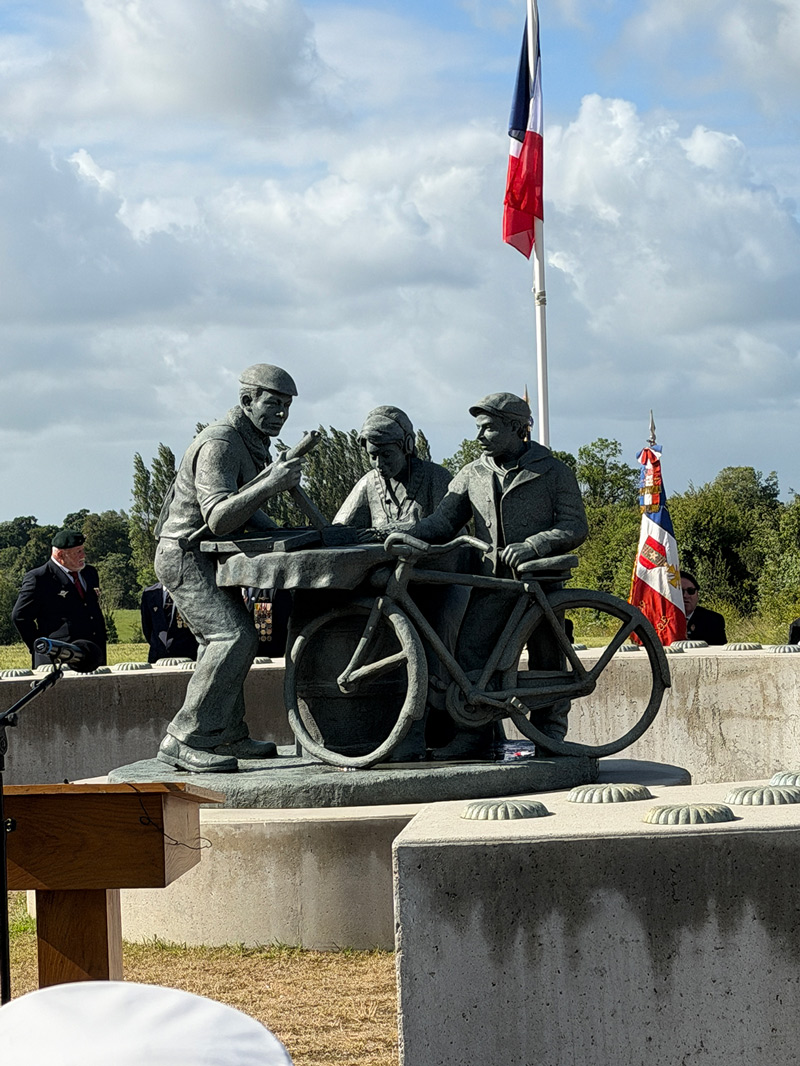
French Resistance Memorial in Sainte-Marie-du-Mont.
The monument itself depicts three figures of the Resistance. There is a civilian armed with a Sten submachine gun. A woman operates a radio transmitter, reminding us of the crucial role clandestine communications played and the immense contributions women made to the effort. There is also a child holding a bicycle, representing the youth involved, their freedom of movement in a non-permissive environment, and the liaison missions they carried out.
Around these figures stand ninety-three parachute canopies, each thirty centimeters high. They symbolize the ninety-three Jedburgh teams, mixed groups of French, British, and American operators who parachuted into France before D-Day to support and coordinate Resistance actions. It is largely agreed that the intelligence provided by the Resistance greatly contributed to the success of D-Day.
The speakers delivered several moving addresses, including those from leaders of the Resistance Foundation, the town mayor, Joey Ivanov, and SOCOM Europe Commander Admiral Bradley.
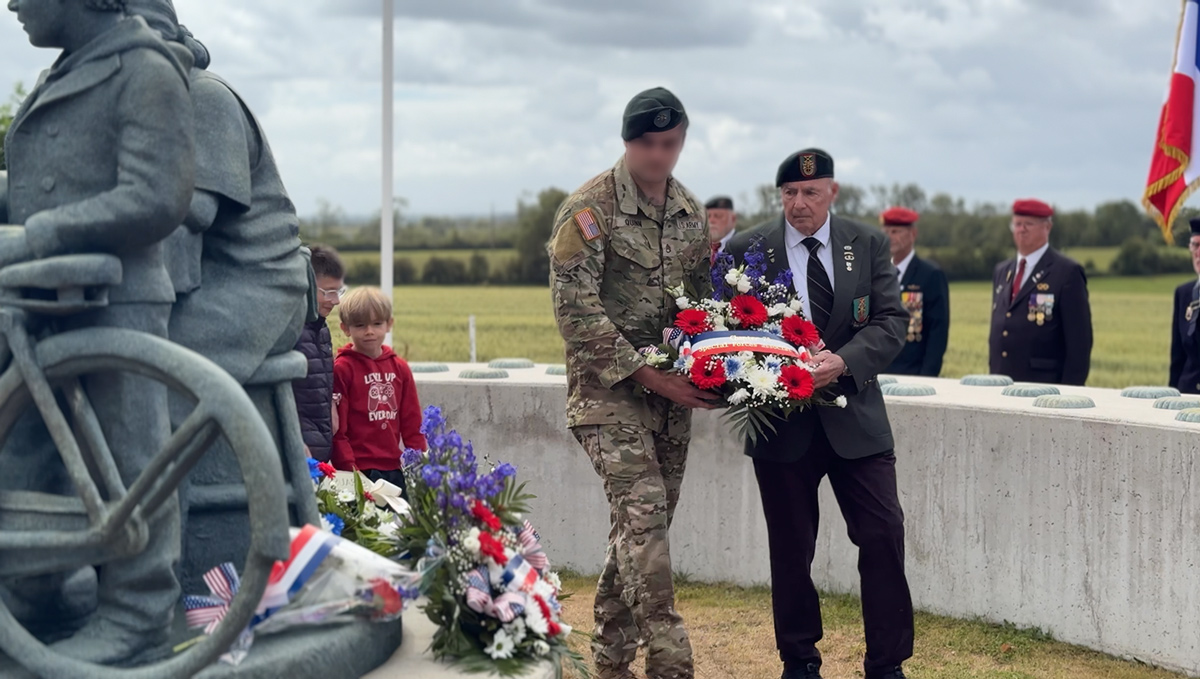
Delegation members Connor Wynn (a pseudonym used to protect active operational security) and Bob Crebbs laying a wreath at the French Resistance Memorial
Putting bias aside and remaining objective, Admiral Bradley absolutely knocked it out of the park. His message had four key takeaways.
- The French Resistance was essential to D-Day’s success. The Resistance sabotaged German communications, disrupted troop movements, gathered intelligence, and created the conditions that allowed the Normandy invasion to succeed.
- Modern Special Operations Forces trace their origins to these WWII partnerships. The cooperation forged in occupied France became the blueprint for modern special operations forces worldwide.
- Allied unity remains critical today. The alliances formed during World War II remain vital, and collective defense remains the strongest deterrent against aggression.
- Admiral Bradley’s central message was simple: the courage of the French Resistance helped make D-Day possible, created the foundation for modern special operations forces, demonstrated the power of allied unity, and serves as a reminder that freedom must be defended by every generation.
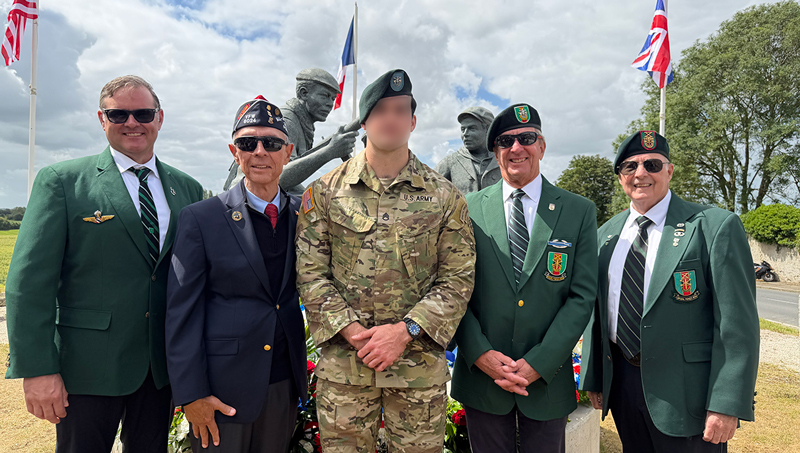
Chapter 78 Delegation at French Resistance Memorial.
We traveled to the hamlet of Angoville-au-Plain. The hamlet is centered around a church built around the eleventh century. During the invasion, SSG Robert Wright and PFC Kenneth Moore became separated from their unit during their airborne insertion.
On their own initiative, they established a casualty collection point inside the church. There, they treated wounded American soldiers. At one point, retreating German forces approached the church, and a standoff ensued. Rather than engage the enemy and put their patients at risk, both men began treating the German soldiers, too.
In total, SSG Wright and PFC Moore treated and saved the lives of approximately eighty American, French, and German souls. The bloodstains from that day still remain on the church pews as a silent reminder that compassion can exist even in the midst of unimaginable violence.
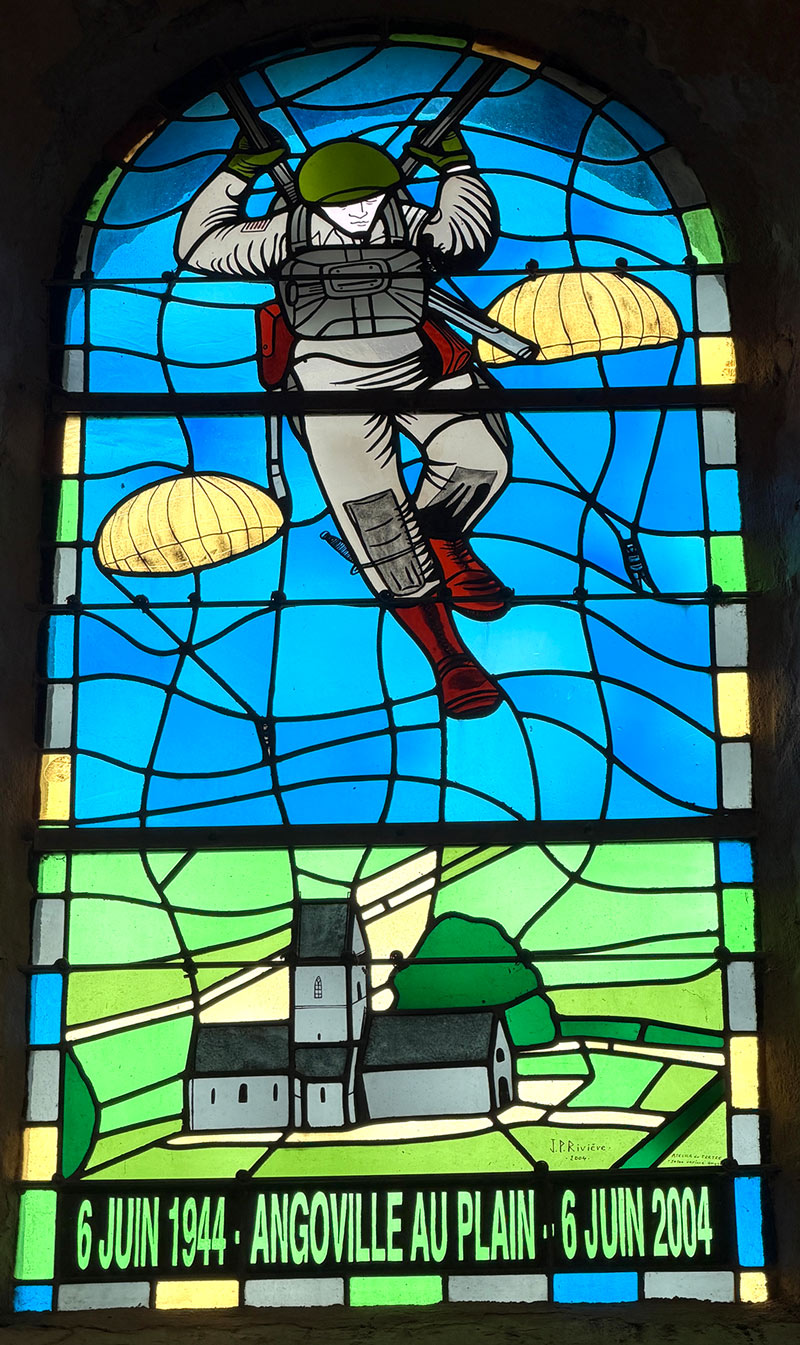
Stained glass window in church at Angoville-au-Plain, France
From Angoville-au-Plain, we traveled to the bridges and locks that men like Jake McNiece, Jack Agnew, and Jack Womer fought to secure during the opening hours of the Normandy campaign. Both were members of the “Filthy Thirteen,” the demolition section that loosely inspired The Dirty Dozen. Their reputation stemmed from their disregard for military convention. They often ignored grooming standards, earning the nickname “Filthy Thirteen,” and later joked that keeping a clean uniform in reserve meant they could head straight into town to meet the local girls when operations ended. It became part of the legend that followed them throughout the war.
These bridges and locks played a critical role in the battle for Normandy. German forces had intentionally flooded the lowlands surrounding Utah Beach, restricting movement for both infantry and mechanized units and funneling advancing troops onto a handful of elevated roads and causeways. Controlling these crossings meant controlling the flow of the battlefield itself. Had they remained in German hands, Allied forces pushing inland from Utah Beach would have faced even greater delays, bottlenecks, and vulnerability to counterattack. The actions of the airborne troops who secured them ensured that men and supplies could continue moving inland, preserving the momentum so vital during those fragile first days after the invasion.
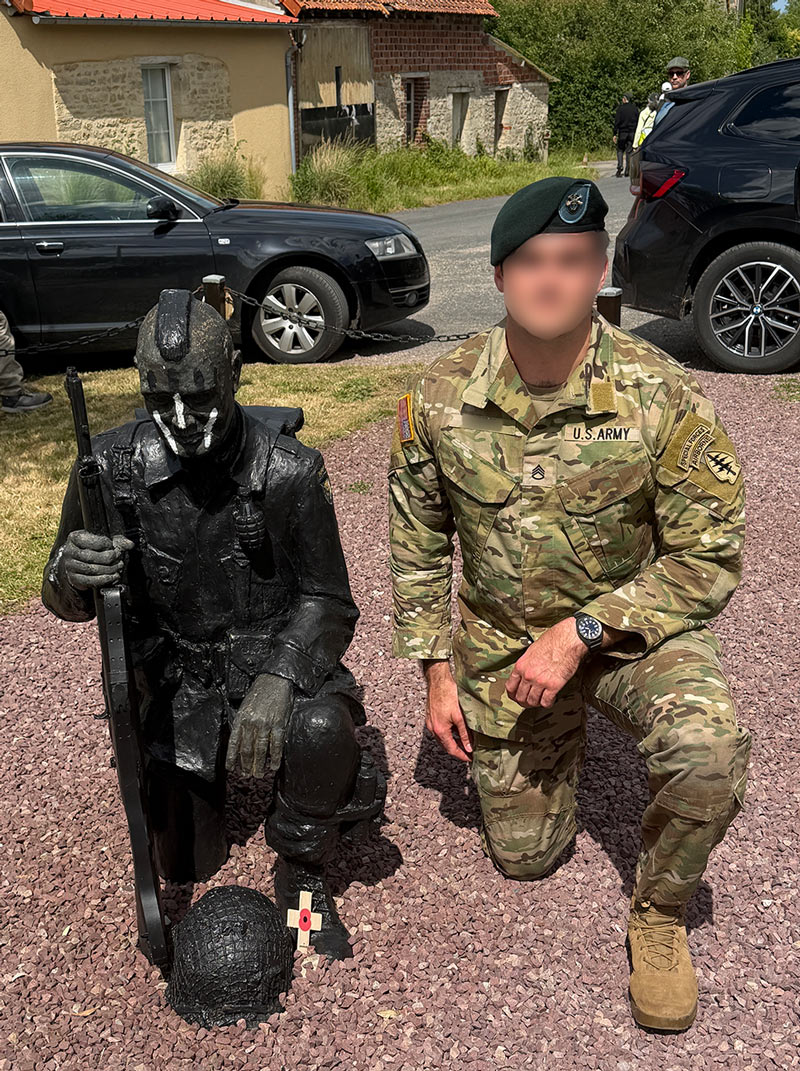
Delegation member Connor Wynn kneeling besides statue of Jake McNiece, famous “Filthy 13” member.
From there, we traveled to Dead Man’s Corner. The site served as a terrain feature for navigation during the fighting. Unfortunately, it earned its name because an American soldier’s body had been left partially hanging from the turret of a destroyed tank. Soldiers would simply say, “Go to Dead Man’s Corner and ‘Make a left’ or ‘Make a right.’”
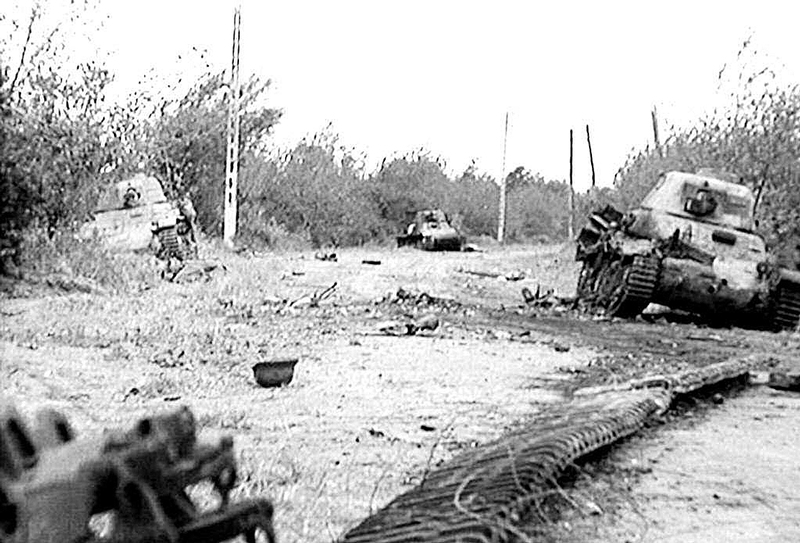
Dead Man’s Corner June 6, 1944
I came here expecting to learn more about history. Instead, I found myself understanding it in a way I never had before. The stories I grew up hearing about the OSS, Jedburgh’s, Resistance fighters, and the origins of Special Forces stopped being names in a book and became real people who stood on this same ground and made impossible decisions under extraordinary circumstances.
On the way home we stopped by a memorial to Dick Winters. On D-Day, Lieutenant Dick Winters of Easy Company, 506th Parachute Infantry Regiment, jumped into Normandy near Sainte-Mère-Église, losing his weapons and equipment in the chaotic night drop but quickly gathering scattered paratroopers and leading them toward their objective near Sainte-Marie-du-Mont.
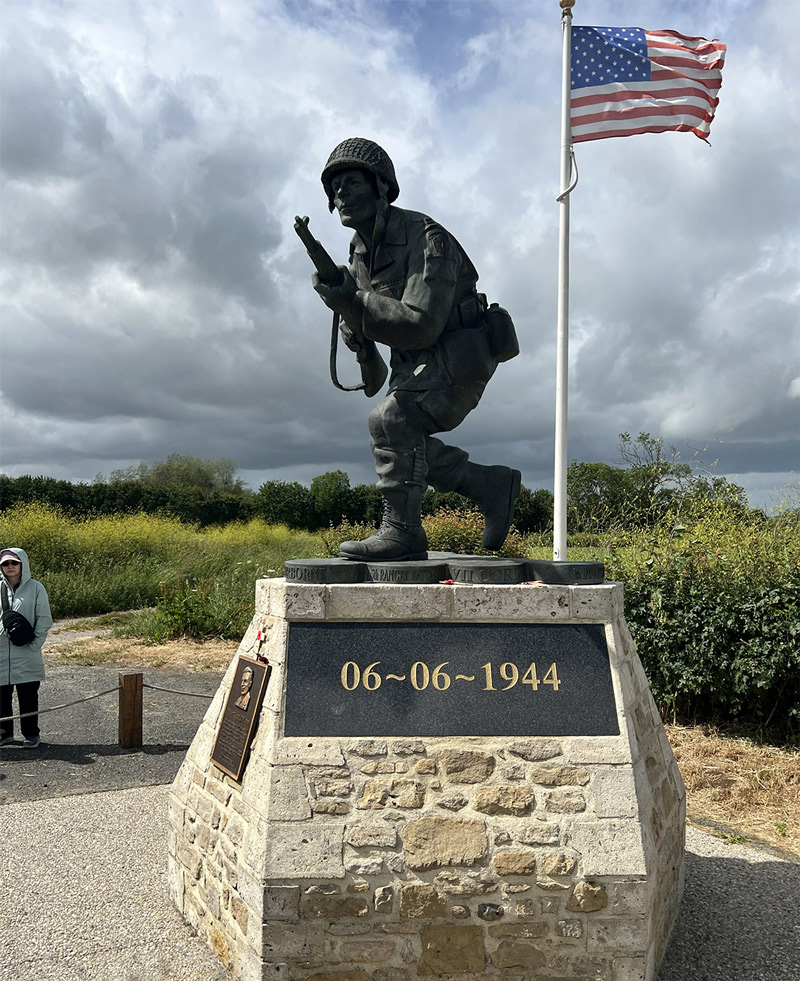
The Richard D. Winters Leadership Monument
Discovering that a battery of four German 105mm guns at Brécourt Manor was pouring artillery fire onto the men landing on Utah Beach, Winters improvised an assault with barely a dozen men, positioning machine guns for covering fire and personally leading a three-direction attack down the trenches, clearing position after position with rifles and grenades.
Under intense fire, he organized small teams to take and destroy each gun in turn, capturing the first three pieces with explosives and coordinating with another unit that seized the fourth, effectively silencing the battery and greatly reducing the deadly shelling on the beach.
That night, after surviving the drop and the assault that would later be recognized as a model of small-unit leadership, Winters recorded in his diary that he thanked God for seeing him through “that day of days” and prayed he would live to see D-Day +1.
6 June 2026 – Aaron Brandenburg
Dark and grey, a light misty rain represents a somber moment in history.
We arrived at the cemetery with VIP access, by passing the long lines of those paying their respects. The fog and mist covered the once blood-soaked beaches below, adorned with a dual rainbow in the distance, Mother Nature’s way of saying, “Today is a day of remembrance, pride, and love of country.”
We were welcomed to our seating just rows from the speakers. Flanked by the reflection pool and soldiers dressed in their best. Jump boots tight and medals gleaming, our paratroopers stood rigid, their body language saying, “Send me.”
As the officials began to take their seats, the clouds turned dark. The wind began to whip, and the rain once again peppered our faces, shielding the tears welling up. Pride and sorrow, a mixture uncommon to most, were overtaking us.
Overwhelmed and caught up in the moment, we bowed our heads as the invocation began. The phrases, “The spirit of American youth, an enduring spirit, a fight for liberty, our country’s youth remaining steadfast and unyielding,” that broke me.
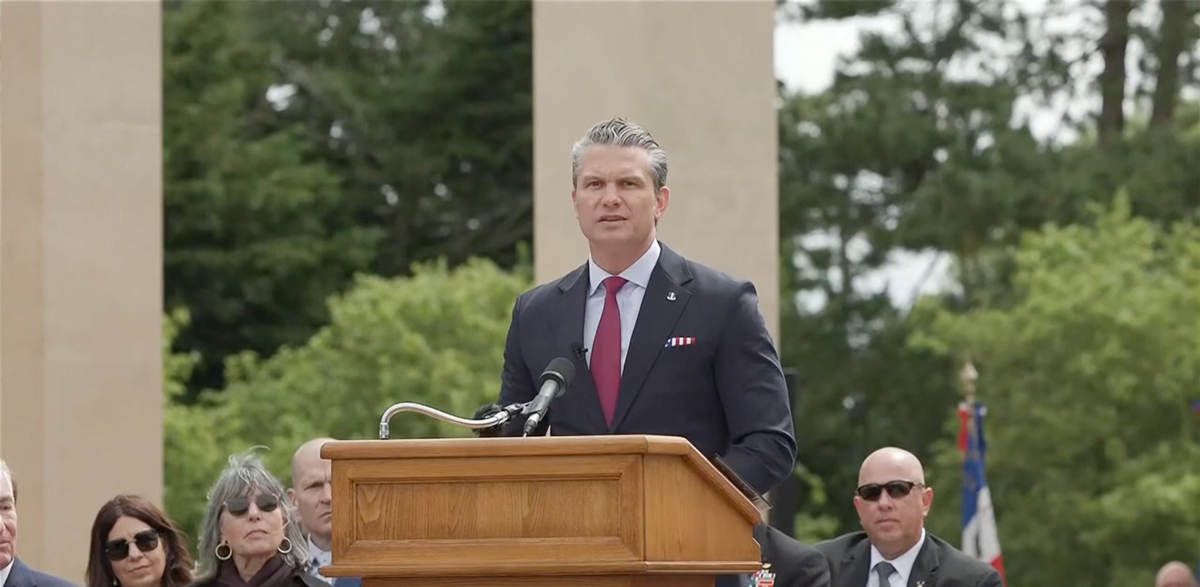
Secretary of War, Pete Hegseth addressing the crowd at the Normandy American Cemetery in Colleville-sur-Mer, France, on June 6, 2026. (War.gov)
Following the powerful invocation, Arthur Rose (107) was wheeled onto the stage. Eighty-two years earlier, Arthur had commanded thirty-six vessels supporting the invasion off Omaha Beach, helping sustain the men fighting their way ashore during history’s largest amphibious assault. As he spoke, the cost of that day became painfully real, reminding all of us that behind every statistic were young men whose lives were forever changed by war.
He began to read a handwritten letter that he had mailed home eight long decades ago. With broken, strained speech and unplanned pauses, he clearly carried the weight of the losses to this day. For us, for me, it was a portal into the past. His words were chosen with care so as not to worry his mother, but we could feel the pain, the anguish, and the dismay that a young man was trying to navigate.
Following Arthur, Chairman of the Joint Chiefs General Dan Caine took the stage. To be fully transparent, I am a fan of his. He opened by thanking Arthur and the other twenty-seven veterans who honored us with their presence. He then thanked the 9,387 souls who rest in the cemetery and acknowledged the 1,557 names inscribed on the Walls of the Missing.
One line he spoke shook me. He referred to the headstones as the “silent sentinels.” For reasons unbeknownst to me, I felt a rush of warmth and emotion come over me. It was a moving moment. General Caine spoke about the Greatest Generation’s unwavering selflessness, their resolve, and their willingness to act when freedom was at risk. How ordinary people answered the call, showing us what extraordinary looks like.
The sands of the Norman beaches were awash with the blood of our heroes that fateful day. The guns have gone silent. The tides have washed the sands clean. Yet upon the bluffs of Omaha Beach, the souls of the silent sentinels who once said, “Just Send Me,” remain.
From the American Cemetery, we drove to the UDT/SEAL monument on Omaha Beach. The UDTs received little recognition for their contributions during World War II, but the Monument to them is a tribute to their critically important role in the D-Day invasion.
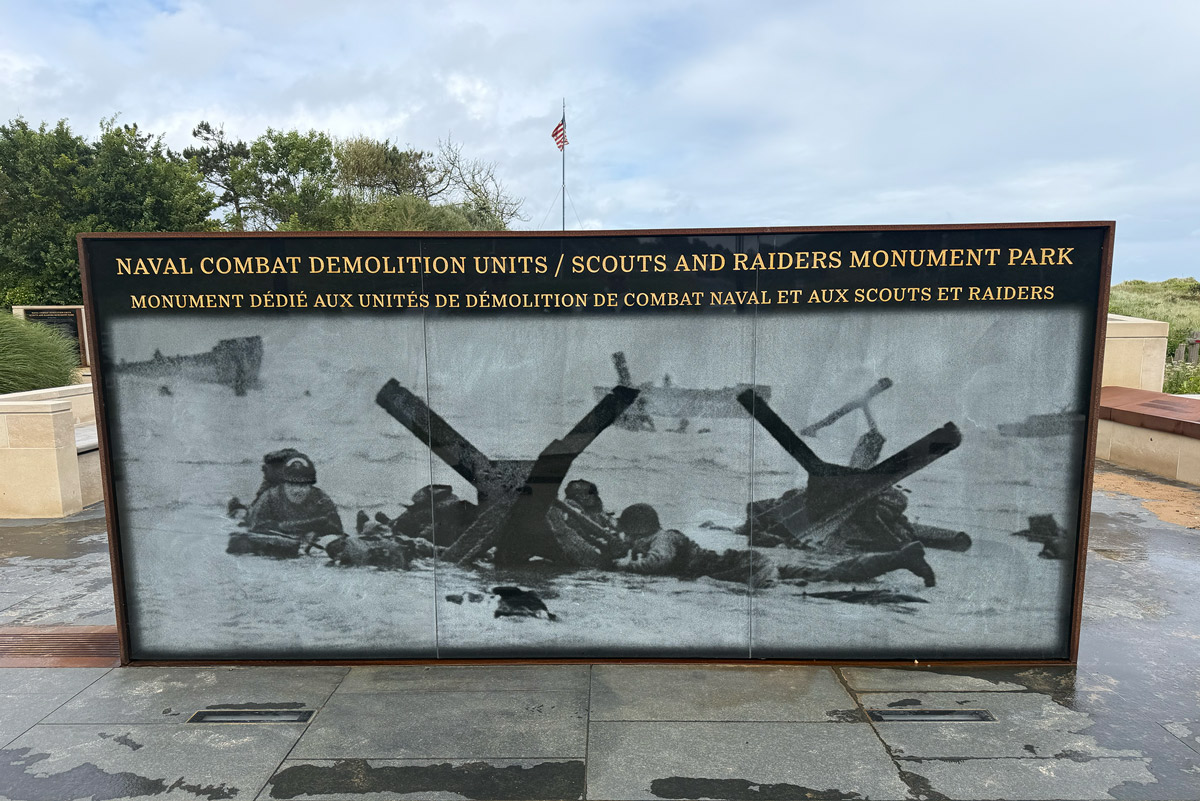
Before there were Navy SEALs, there was Draper Kauffman. A Naval Academy graduate initially denied a commission because of poor eyesight, he volunteered as an ambulance driver in France before eventually serving with the British during the Blitz, disarming unexploded German bombs. When America entered the war, Kauffman brought that hard-earned experience home and was tasked with creating a force capable of clearing the obstacles that threatened Allied amphibious assaults. In doing so, he built the Naval Combat Demolition Units, the direct ancestors of today’s UDTs, EOD technicians, and Navy SEALs.
On D-Day, those men entered the surf under machine-gun fire, carrying little more than explosives, knives, and determination. Their mission was simple in concept and nearly impossible in execution: blow gaps through Hitler’s Atlantic Wall so that the waves of soldiers behind them had a chance to reach the shore. At Omaha Beach alone, they suffered casualty rates exceeding fifty percent, yet they pressed forward and completed their task. Their success was not measured in ground taken or enemy killed, but in the thousands of lives that moved through the lanes they opened. They embodied a truth familiar to anyone in special operations: often, the most important work is done by men whose names history rarely remembers.
Standing there overlooking Omaha Beach, it was impossible not to appreciate that legacy. Another group of quiet professionals who saw a problem, accepted the risk, and simply went to work because others were counting on them.
Closing out the evening, we returned to Sainte-Mère-Église for the Liberty Banquet hosted by the Amis des Vétérans Américains.
The town was alive and bustling with foot traffic. Vendors lined the streets alongside food trucks and musicians. Hundreds of people, both young and old, were dressed in WWII uniforms and period-correct civilian clothing. Once again, it had a way of transporting you back in time. For a few moments, it wasn’t difficult to imagine what the town may have looked and felt like in the days following liberation.
As we made our way toward the Airborne Museum, the large banquet hall erected for the evening’s event came into view. Outside, an estimated 150 to 200 people waited patiently to pass through the entry point. Then the Jacks arrived.
Led by “The Pair of Jacks,” the crowd began to open up like Moses parting the Red Sea. Conversations stopped. People stepped aside without being asked. One by one, applause broke out and quickly spread throughout the crowd until the entire gathering was on its feet, giving the two men a standing ovation they had more than earned.
For all the attention focused on reenactors, dignitaries, and ceremonies throughout the week, these men were the reason we were all there. They had lived the history that everyone else had come to remember. They had been young men when the world asked everything of them, and they answered without hesitation. Eighty-two years later, they returned not as celebrities, but as reminders of what duty, sacrifice, and courage look like.
The ceremony itself was like the one we had attended earlier in the week. The venue was different. The master of ceremonies was different. Even the food was different. But one thing remained unchanged: the overwhelming gratitude and admiration shown to our “The Pair of Jacks.”
It served as another reminder that, while time marches on, the sacrifices of their generation have not been forgotten. More than eighty years later, people still line the streets, rise to their feet, and say thank you to the young men who answered the call when freedom needed defending.
I came here expecting to honor history. Instead, I found myself understanding it in a way I never had before. The monuments, ceremonies, and speeches were powerful, but it was the people who changed me. The French families who continue to remember. The reenactors who dedicate themselves to preserving the past. The young students were learning why these sacrifices mattered. The veterans who still carry the weight of memories formed as teenagers in war.
I grew up hearing about the OSS, the Jedburgh’s, and the resistance that shaped modern special operations. I was proud of that heritage, but pride and understanding are not the same thing. Walking the same ground, standing in the rain among silent sentinels, listening to the trembling voices of men who were there, and watching entire crowds stop to honor them, finally connected the dots for me.
History stopped being something I studied and became something I felt.
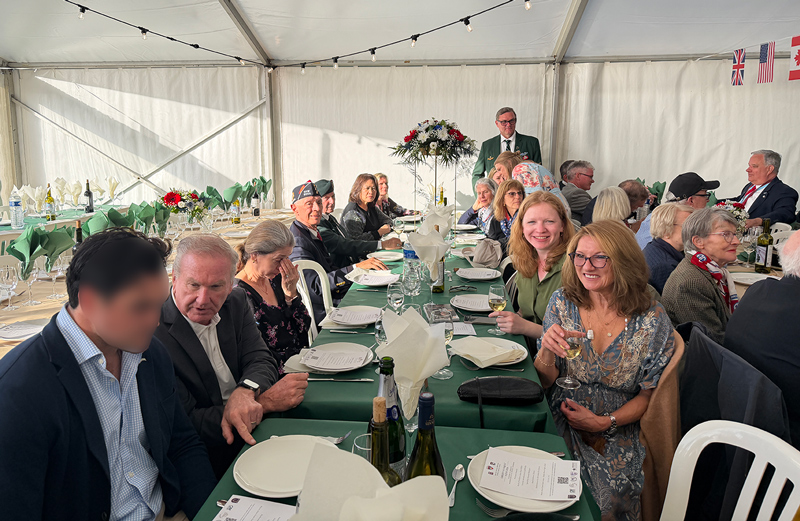
The Liberty Banquet hosted by the Amis des Vétérans Américains.
7 June 2026 – Aaron Brandenburg
Similar to the feeling inside the château, waking up this morning and gazing out over 300 acres of green fields, there was a layer of fog hanging beneath the Norman sky. Sadly, today was our last full day in Normandy. Looking out the window, drinking my morning coffee, I couldn’t help but think back to when this building was at its prime. The long, wide stretch of green carved through the forest framed a picturesque swath of history.
Construction began in 900 A.D. by a clan of Vikings; the original foundation stones, still supporting this mighty structure, are still visible. Final construction was completed in the 11th century, and remarkably, it has remained in the hands of the same family since.
The halls are draped with paintings of the past. Unique tapestries hang from the walls and windows, while the furniture creates an unmistakable aura of nostalgia. Showing the wear of time and proudly displaying the scars of years gone by, Château de l’Isle Marie is the perfect setting to fully experience Norman history. Temporarily inhabited by curious guests and historians alike, this building and these grounds have etched a place in our hearts that will remain unforgettable.
As we gathered for coffee, biscuits, and fruit, a subtle change in the atmosphere became apparent. A realization we all shared: this was it. This would be the last time we would all have breakfast with our new family of 33. Rather than sulk over the inevitable, we loaded up and headed back to La Fière Bridge to watch the paratroopers jump initially from C-47s and later C-130s, then share lunch with Helen Patton.
As the winds increased, airborne operations ceased, and we decided to head back to Sainte-Mère-Église. I wanted to pick up a few more prints for my collection. Walking toward the town square, you could see towering plumes of smoke rising and hear the crowd’s howls and cheers. Thankfully, rather than artillery shells and burning buildings, this time it was sausages and sweet treats.
With full pints of beer in hand, soldiers embraced and sang songs. Our history, American paratrooper history, was not lost, but celebrated. Memorialized in the hymns that tell our story, the story of those who will never be forgotten.
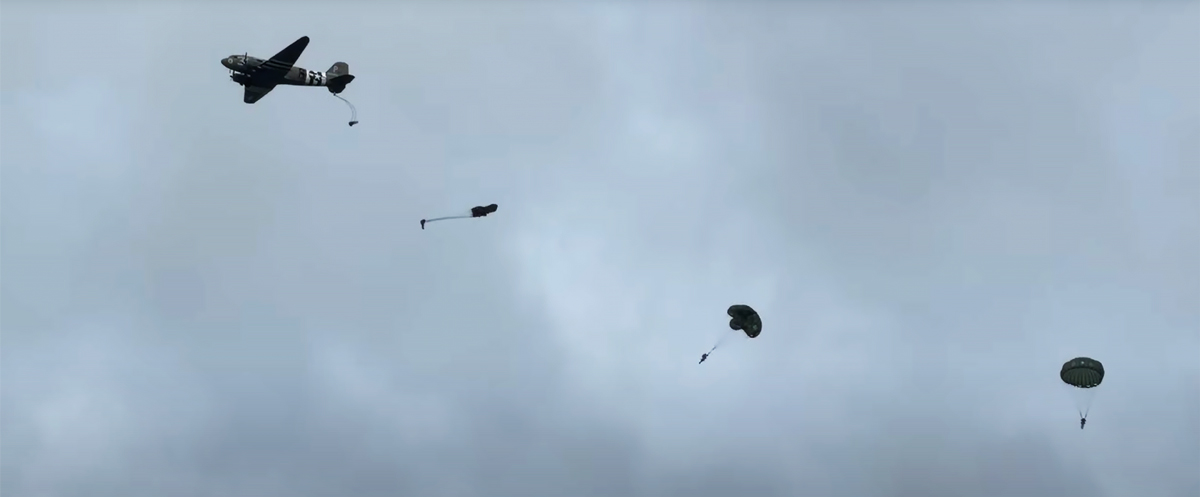
Paratroopers Jumping from a C-47.
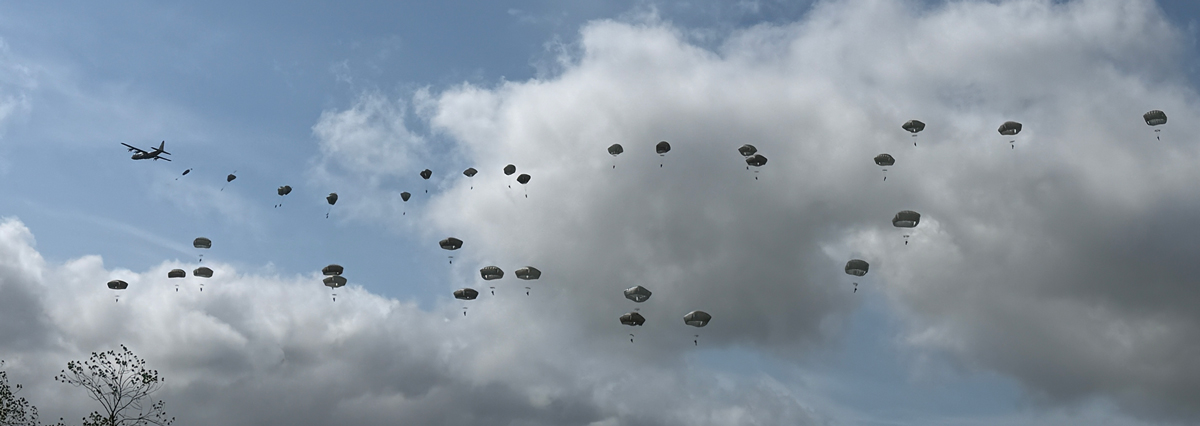
Paratroopers Jumping from C-130s.
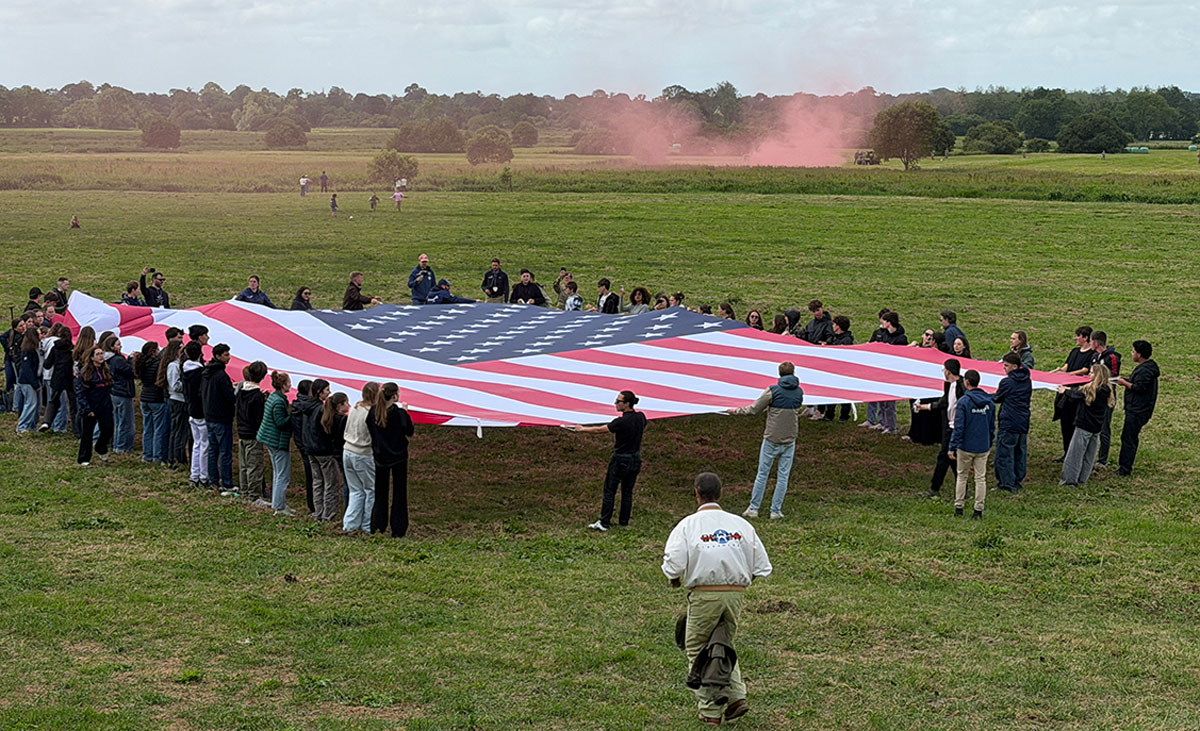
The Drop Zone
Later that evening, after returning to the Château, we gathered around the dinner table one last time. Friendships had formed in a matter of days, as though they had been forged over decades. Shared experiences, tears, laughter, and a common purpose have a way of stripping away the superficial and reminding us what truly matters. Somewhere between Normandy’s hedgerows and banquet halls, strangers had become family.
Dinner was served: perfectly grilled chicken breast, greens, and spiced potatoes to die for. As we laughed and relived the week’s events, there was a knock at the door. I noticed Jeff speaking with a few people before eventually inviting them inside.
Standing before us were two men, a woman, and a young girl, perhaps twelve or thirteen years old. After brief introductions, the father and daughter stepped forward to tell us their story.
After following Walk Among Heroes on social media, they had decided to drive blindly from the Czech Republic in hopes of finding us and, more importantly, the “Pair of Jacks,” the two World War II veterans they had grown to love from afar.
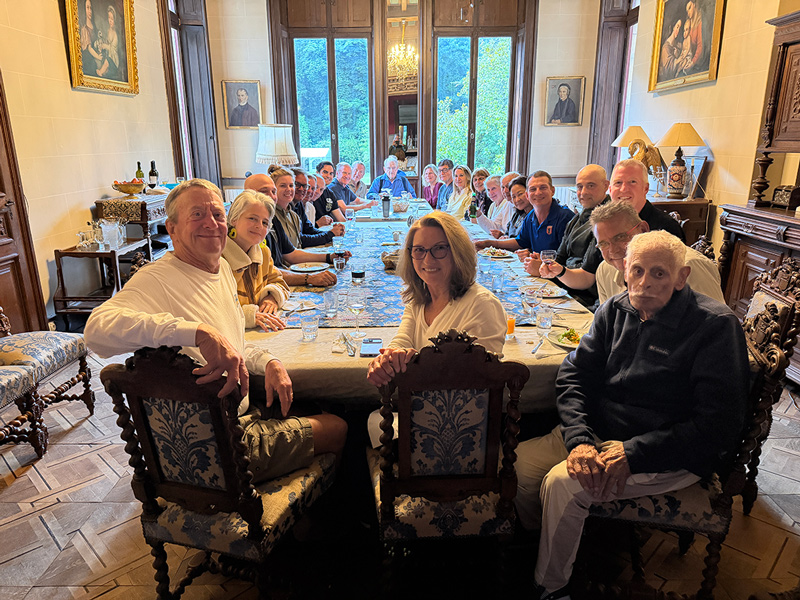
Last dinner at the Chateau.
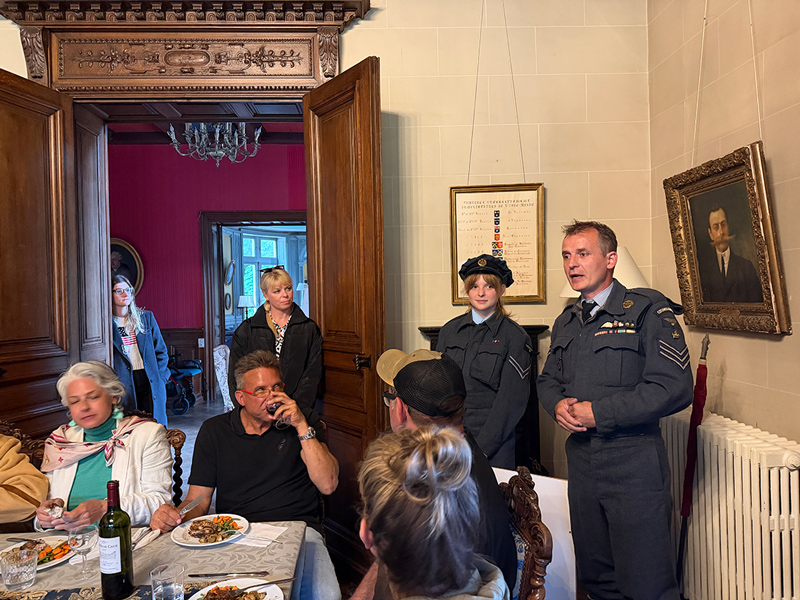
A surprise visit from a family from the Czech Republic.
After driving more than 1,300 kilometers, followed by another 200 kilometers through Normandy, they had finally found them. Nervous, emotional, and dressed in WWII Czech Air Force uniforms, they approached what we had come to affectionately call “our veterans” and embraced them. Unplanned and unexpected, it became yet another perfect moment in a trip full of perfect moments.
After our new Czech friends departed, we wrapped up dinner and shared our most memorable experiences from the journey. As the torch passed from person to person, so too did the anxiety.
How could I possibly package all these emotions and experiences into a few short sentences? More importantly, how could I control my emotions long enough to say them? In full transparency, you can’t.
With a significant event awaiting me upon arrival home, for Kath and me, this trip was the perfect setting to keep us occupied. It was a walk-through history that cannot be recreated anywhere else. The packaging and delivery from Walk Among Heroes are unparalleled, and I firmly believe no other organization could have executed them with the same level of professionalism, care, and personalization.
From the nine Walk Among Heroes volunteers, eighteen guests, two World War II veterans, and four family members, our new family of thirty-three reminded us that love does not always come from blood. Sometimes it is forged through shared purpose, mutual respect, and extraordinary experiences. We arrived in Normandy as individuals from different walks of life, but we leave carrying pieces of one another’s stories.
In conclusion, the Chapter 78 Members who attended the 82nd Annual Anniversary of D-Day speaking as a group: we all came away from this amazing experience that has given us all:
- A much better understanding of the magnitude of Project Overlord;
- Some of the individual stories of those who participated in the invasion but unfortunately so many of those stories will never be told;
- The immensity of mission that the soldiers who landed were charged with;
- But, most of all, the number of Americans who made the ultimate sacrifice for freedom on D-Day and the days that followed.
Always remember: Freedom is not Free!
WALK AMONG HEROES
walkamongheroes.org
Every one of the staff members associated with Walk Among Heroes were unbelievable hosts and hostesses not only to the WWII Veterans they were hosting (the ”Pair of Jacks”), but also to the rest of us who helped underwrite the mission of Walk Among Heroes to recognize and honor those who have served our country. A LOUD SHOUTOUT to ALL OF YOU for an AMAZING TRIP from Chapter 78 – Special Forces Association.
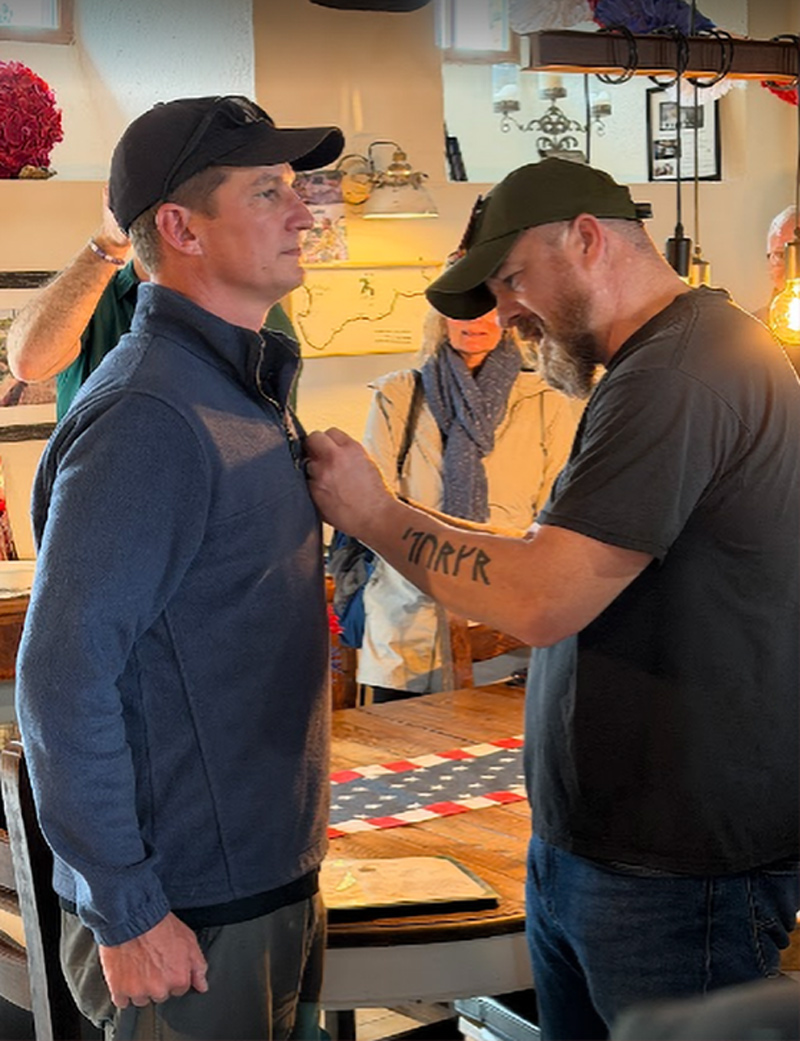
During our visit on 4 June 2026 with Helen Patton at her Chateau at La Fière Bridge, Jeff Wells, a co-founder of Walk Among Heroes, received an award presented by Rich Barbado a former 82nd Airborne Trooper. The award was a Public Service Commendation Medal from the Department of the Army for the work that Jeff has done for Veterans with Walk Among Heroes.
Leave A Comment