2025 Update on Helping the Montagnards in Vietnam
By Thomas W. Turney
SFA Life Member (M-14394)
Edited by Len Fein
Many US Army Special Forces (“SF”) veterans who served in Vietnam worked with the local indigenous peoples, largely Montagnards, to create an effective fighting force to counter Viet Cong and NVA forces operating in South Vietnam. Whether deployed at an A Camp where an SF team would recruit, train and operate with their indigenous troops; to Mobile Strike Force (Mike Force) units that acted as a quick reaction force (QRF); to MACV SOG or Special Forces Greek alphabet named units, the importance of working with these indigenous soldiers cannot be understated.
Close bonds between these troops and their SF counterparts were formed because of working together. When the US withdrew from Vietnam, many of these “Forgotten Warriors” were captured and put into re-education camps or killed. Their families were uprooted, and their ancestral lands were confiscated. All who had worked with these soldiers felt we had abandoned them, and many of us worked tirelessly to try to help them emigrate to the US. The small Montagnard community near Ft. Bragg, NC is one example of success. While a small contingent of them were able to successfully relocate to the US, most were left behind.
Many Special Forces veterans and others who worked with the Montagnards during the Vietnam era have worked tirelessly over the years to help them. Organizations such as Save The Montagnard People (https://montagnards.org/) have helped those who were able to escape to the US, and various other organizations have been working to help those who remain in Vietnam.
I have been working to support groups working to help the indigenous peoples of the Central Highlands in Vietnam since I returned there in 2016 having last been in the area in 1969. I was appalled to learn what had happened to the Yards and have been trying to help them since then. One way I do that is financial support; but also, I am hopeful that the work I do and the endorsements I make, will motivate others to donate to help them as well.
In the past, I have financially supported non-profit organizations where I believe in their mission. One of those is Refugee Relief International Inc. (https://refugeerelief.org) that has worked in many conflict areas around the world. It has as volunteers John Padgett, a well-known former SF medic and retired PA who worked with SOG, and his wife Vicki Padgett, PA-C, MAJ USAF (Ret). When I learned about Viet-Dreams in 2022, I reached out to John to see if he would be interested in working in the Central Highlands. Since then, John and Vicki have made two trips there. The first was primarily a scouting mission and the second was devoted to teaching health education and basic first aid. There was an article published in the March 2024 issue of the Sentinel outlining their initial trip.
I plan to support VietDreams and the work they are doing in the Central Highlands and urge you to join me. Donation information can be found here: https://vietdreams.org/donate.

By John “Doc” Padgett, PA-C Emeritus, MAJ (Ret), USSF
SFA # D/L 3551
SOA # 404 G/L
Refugee Relief International, Inc (RRII) sent Team Padgett (John and Vicki) on a recon to the Kontum area to assess the needs and what could be done, followed by a teaching mission. Humanitarian missions in Vietnam, especially to assist the Montagnard, or “Dega”, population are more difficult than it would seem. Our initial assessment trip was almost canceled because prior to our visit a Montagnard resistance movement attacked a Vietnamese police and Communist Party post, killing several. The Vietnamese are not inclined to let foreigners into the highlands at any time, let alone following an attack on their infrastructure. But Viet Dreams, an NGO that puts in wells and water purification into rural area villages, schools, and public places, is welcomed by the Vietnamese government. Our Refugee Relief team managed to be added to the permission document as part of the Viet Dreams team. We followed as the Viet Dreams CEO Mr. Quan examined and adjusted water projects in schools and orphanages.
As part of our initial assessment, we visited rural schools with Montagnard students, and a group of orphanages caring for Montagnard children, run by Catholic nuns. The situation among Montagnard families is critical, and poverty is the norm. Often impoverished Yard parents, knowing that they cannot feed another child, will drop off a newborn at one of the orphanages. Other children, from newborn to teenagers, are from broken homes, have been forced out of their homes, or are true orphans with no surviving parents.
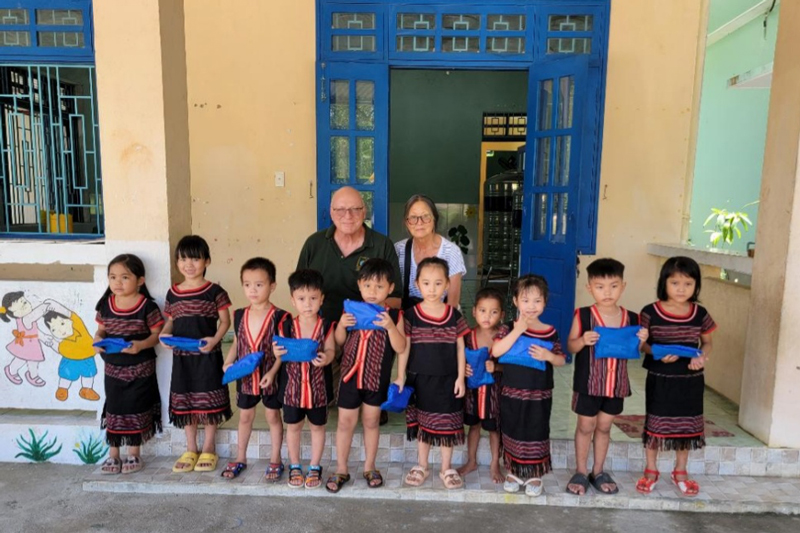
John and Vicki Padgett with Sedang schoolchildren. Note gift bags.
The orphanages are working hard to become self-sufficient because they receive no support from an antagonistic and distrustful Communist government. They have seven campuses, and some grow their own vegetables and rice and raise animals. One bakes bread to sell, and another creates handicrafts for the local market. All send the children to local schools and have computers to assist with learning. The computers were very old and hard to use because of viruses, so RRII donated 12 new laptops. Of course, these came with anti-virus software.
RRII determined that a way to help the Yards in Kontum was to teach basic pediatric skills to the nuns who care for the children, and the teachers and staff at the rural schools in the rural Kontum area. Small problems like colds, minor injuries, and stomach trouble could be evaluated and treated before they became big problems. The number of visits to the inadequate local clinics could be reduced. For the second mission John and Vicki developed and taught a course in basic pediatric primary care to the nuns. The Yard school teachers were held back by the government for political reasons. Supplies were distributed, and simple diagnostic tests such as strep throat screen, urine dipsticks and pregnancy tests were donated and taught.
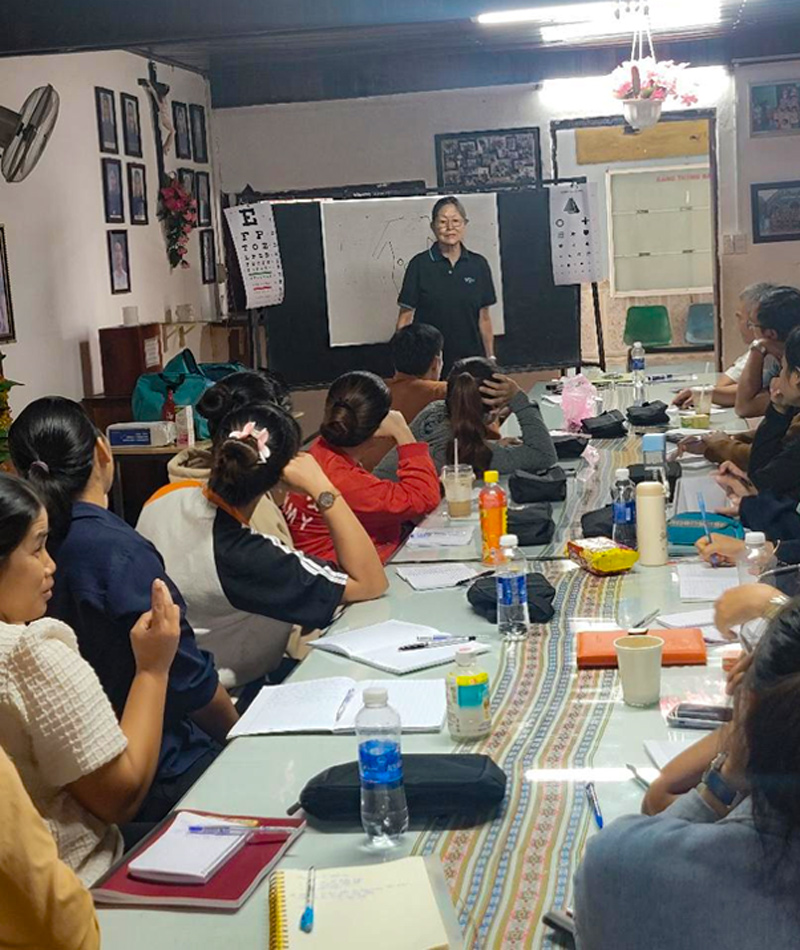
Vicki instructing basic pediatric care at an orphanage.
The single course in basic childhood illnesses and injuries is far from what is needed to support Montagnard orphanages and schools. But it’s a start. In partnership with Viet Dreams, RRII is dedicated to continuing its support of the orphanages and will continue to try to reach the schoolchildren in rural Kontum province. Go to www.refugeerelief.org to help.
About the Authors:
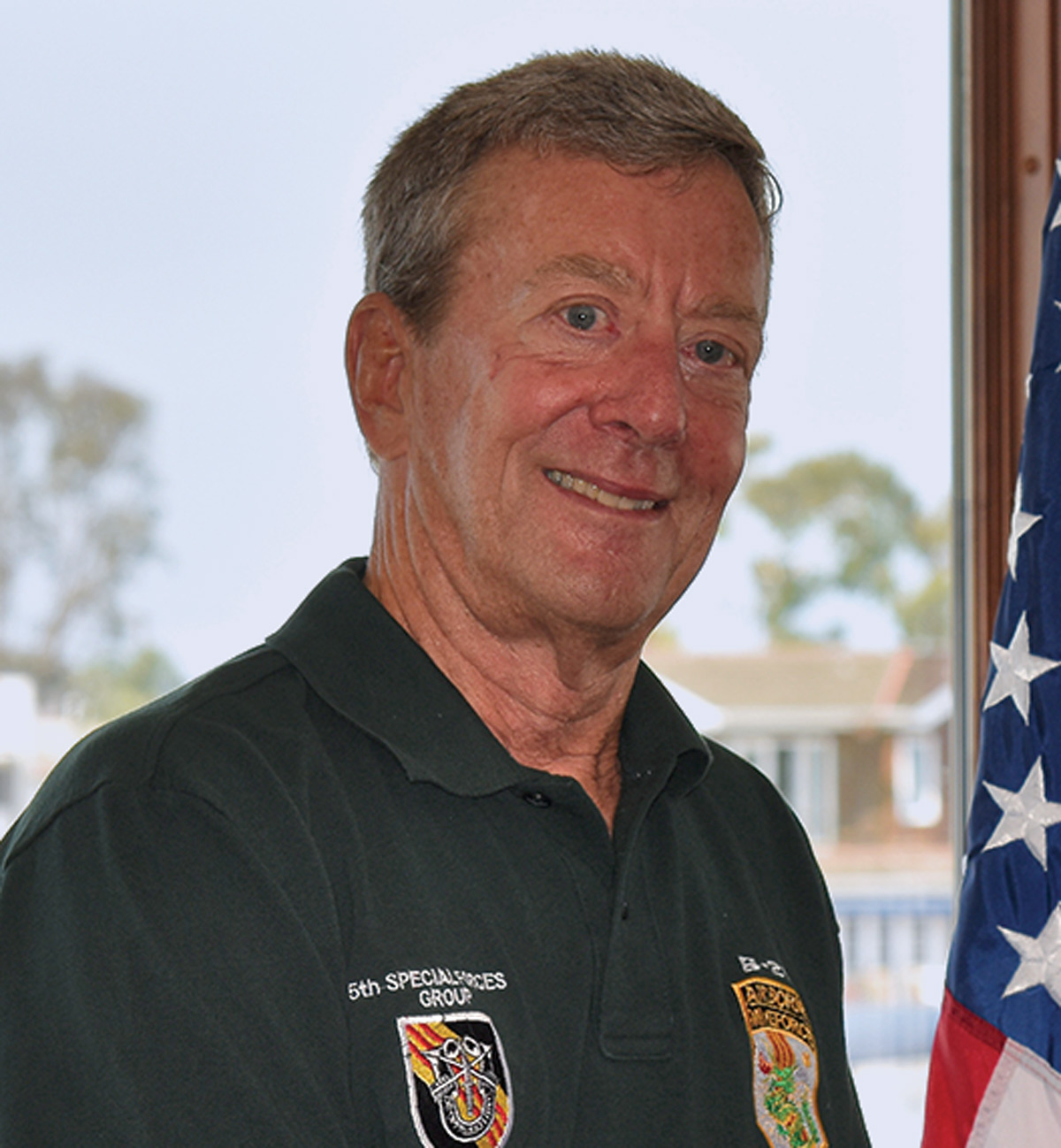
Tom Turney is a member of SFA Chapter 78. His biography is available in the member directory of this website. After a 2016 visit to Vietnam, he worked with other former Special Forces II Corp. Mike Force associates to raise funds to support the work of The Vietnam Fund.
He has contributed several articles for the Sentinel highlighting the plight of the Montagnards remaining in Vietnam after the war:
October 2016
October 2017
November 2017
December 2017
January 2018
April 2023
March 2024
John “Doc” Padgett, PA-C Emeritus, MAJ (Ret), USSF, a member of SFA Chapter 41, is a veteran Special Forces Medic who served nearly three years in Vietnam with SOG and Mike Force units. Known for his commitment to both his team and local villagers, he treated everything from combat trauma to bubonic plague. Following a 40-year military career and a parallel path as a medical professor and Physician’s Assistant, he retired from the Army in 2005 after serving in Iraq. Today, he and his wife, Vicki, work for Refugee Relief International, providing humanitarian service and medical training.
Leave A Comment