An Excerpt From
One Green Beret: Bosnia, Kosovo, Iraq, and beyond: 15 Extraordinary years in the life — 1996–2011
By Mark Giaconia
An excerpt from One Green Beret: Bosnia, Kosovo, Iraq, and beyond: 15 Extraordinary years in the life — 1996–2011; independently published, 05/13/2018, pages 55-75; used with permission from the author/publisher.
Chapter 3:
Kamenica, Kosovo, 2001
Russian Liaison Team
Kosovo is a small southern province of Serbia that holds a lot of cultural and historical significance to the Serbs. A shallow review of the situation leads a lot of people to think that Kosovo was a different country that the Serbs invaded, when in reality Kosovo is a Serbian province that they acquired circa WW1. Kosovo borders Albania, and throughout many years, Albanians have become the dominant ethnicity rather than Serbs in Kosovo.
The Kosovo Liberation Army (UCK) was a group of Albanian insurgents that fought for independence within Kosovo, with the goal of becoming an independent ethnic Albanian country. They conducted raids, bombings, and terrorist style attacks against Serb authorities, police, and military posts. Essentially, from a Serbian perspective, and a military perspective, the war in Kosovo was actually a straightforward counter-insurgency, or counter-terrorism initiative. The Serbs were trying to defeat the Albanian rebels, and from a more Albanian perspective, the Albanians were trying to fight for freedom inside Serbia. There was also an ethno-religious angle (but mostly ethnic/territorial, not so much religious).
Both sides—at least those you’d call “hardliners”—had the concept of a “Greater Albania” or a “Greater Serbia.” These “greaters” were large overlapping geographic areas within the former Yugoslavia and parts of northern Greece that each side believed they were entitled to because of history. This is a common theme in the many parts of the Balkans. Also, in terms of religious differences, Serbs are Orthodox Christian and most Albanians practice Islam (some Albanians are not Muslim, but most in Kosovo are). So due to hundreds year old ethnic, religious, and territorial disputes, there was plenty of manmade hate to go around, and of course, each side’s politicians, Serb and Albanian, leveraged these factors and the media to further the divide. The Serbs argued that the Albanians were terrorists trying to take over the most important province of their country, and the Albanians in Kosovo claimed that the Serbs were oppressing them because of their religion and ethnicity.
Once the Kosovo war started from within Serbia, the Serbian tactics (to be more precise, the way those tactics were described on the news), were adequate to once again generate a claim for genocide. There were also many other interesting US politics going on at the time, the one most notable was the Monica Lewinsky scandal. This incident led to the conspiracy theory that the only reason we attacked Serbia was to take attention off the Lewinsky scandal. Another theory is that the claim of genocide was just a tool to legitimize action against someone, anyone, in the world, to look like a moral authority and to maintain positive perception of NATO’s legitimacy. Of course, since stopping genocide aligns easily to the concepts of “just war” theory, it wasn’t long before NATO was bombing Serbia into the Stone Age for defending their own country, without the backing of the UN Security Council. The bombings actually occurred back in 1999 when I was in Brc?ko, Bosnia, as per the last chapter.
As for the team dynamic, it is important to know that in the time between Bosnia and Kosovo, my team became incredibly tight, and our Green Beret warrior spirit had been completely refreshed and bolstered by the year worth of brutal training and other experiences we endured together. Being a member of the Green Berets was very similar to being a professional athlete, except that instead of dreaming about the big game, I dreamt about the big war, like “Olympians with guns” in body, and spirit. One of the reasons my team was assigned the Russian LCE mission was because of our reputation as being “bad- asses” to the extreme. Since the Russian LCE mission had a high probability for achieving a war like state of affairs, my team was the logical choice for the task. In Special Forces, each team develops sort of its own culture and personality, and leadership knowns which teams naturally fit which types of missions.
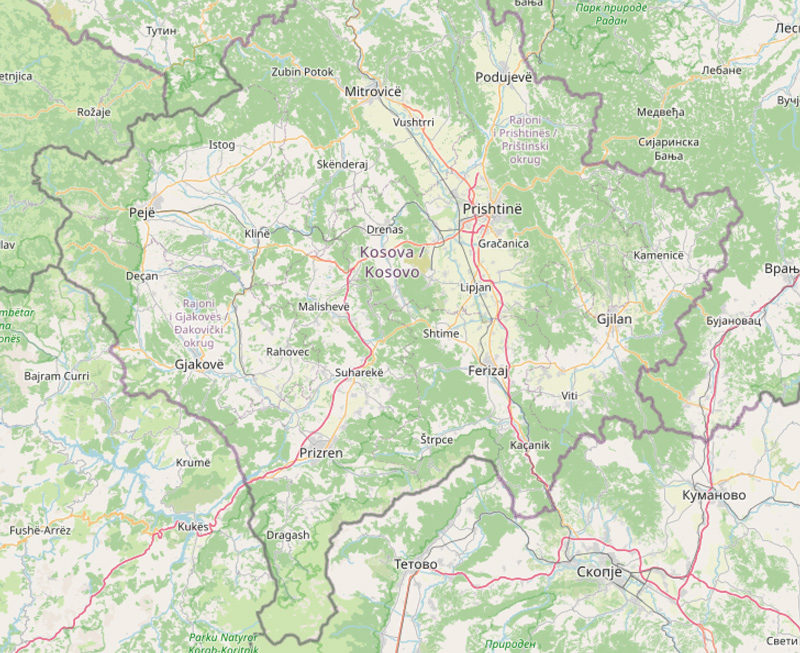
My team’s sector, and the Russian Military Sector, approximately. (Map source: OpenStreetMap)
As we drove north from Macedonia, I noticed that Bosnia was much more advanced and generally cleaner than Kosovo. Kosovo looked like you’d imagine a third world country would look like. There were destroyed buildings everywhere like in Bosnia, but the difference was in the interesting volume of trash everywhere. Signs were randomly in Cyrillic or Albanian, and it seemed like the areas with Cyrillic signs (Serb areas) were much cleaner and generally more organized. There was an American base called Camp Bondsteel, but I only saw it a few times while I was there, and as a rule we always tried to keep our distance from conventional forces.
Kamenica was a small village with one main street, and it was nestled into the mountain backdrop along a decent sized river. The big Russian base was on the right side of the road as one approached from the south. Our house was up the main road from the Russian base, and it was across from another smaller Russian compound. When we first arrived in our SUVs, the other team that we would be replacing met us downstairs. The team we were there to replace had actually gotten into a small firefight with Albanian rebels prior to our arrival, and I was very excited to hear about it.
We eventually settled in, and soon thereafter we met the Russian leadership team. My Captain was very proficient in Russian; he was a graduate of the Defense Language Institute, so he was our interpreter most of the time.
It was strange to me that I would be working jointly with the Russians in Kosovo, after being taught in boot camp back in 1991 that killing Russians should be my primary goal in life. Although interaction with Russian troops during Operation Vodka Chaser had taught me that they were vastly human like we were.
Our overall mission in Kosovo was simple: constantly patrol the Kosovo/Serbia border of the Russian sector jointly with the Russian Army, but don’t go into the DMZ. The DMZ was established by NATO, to put some distance between Serbian forces and Kosovo.
The operations room was where we kept our guns, ammo, the radio to communicate with our headquarters, maps, documents, and other sensitive information and technologies; nothing out of the ordinary in terms of military implements of war. We pulled shifts in the operations room to maintain 24/7 communications with our headquarters, and to monitor other traffic so we had “situational awareness” about things like helicopter flight schedules, and other operations. Since we were in the Russian’s area of responsibility in Kosovo, there wasn’t any US activity other than a few random helicopter patrols.
There was a giant water blivet in the back yard of the house that fed our plumbing system, and a good sized tent that held a gym full of workout equipment. There was also a small deck, and from the deck I could see five or six other people’s small houses. We were living in a development that was like a 3rd world suburbia of sorts. I frequently waved to our neighbors, all Albanians, as they hung cloths out to dry or played with their kids in the small dirt backyards.
In one of the rooms downstairs there was a secret room that was only accessible by a hidden door in the back of a closet. We made this room into a bar, which we lovingly named “The Big Whiskey.” We also had email during this trip so I was able to communicate with my wife fairly easily. We sent each other a lot of email, some in Spanish.
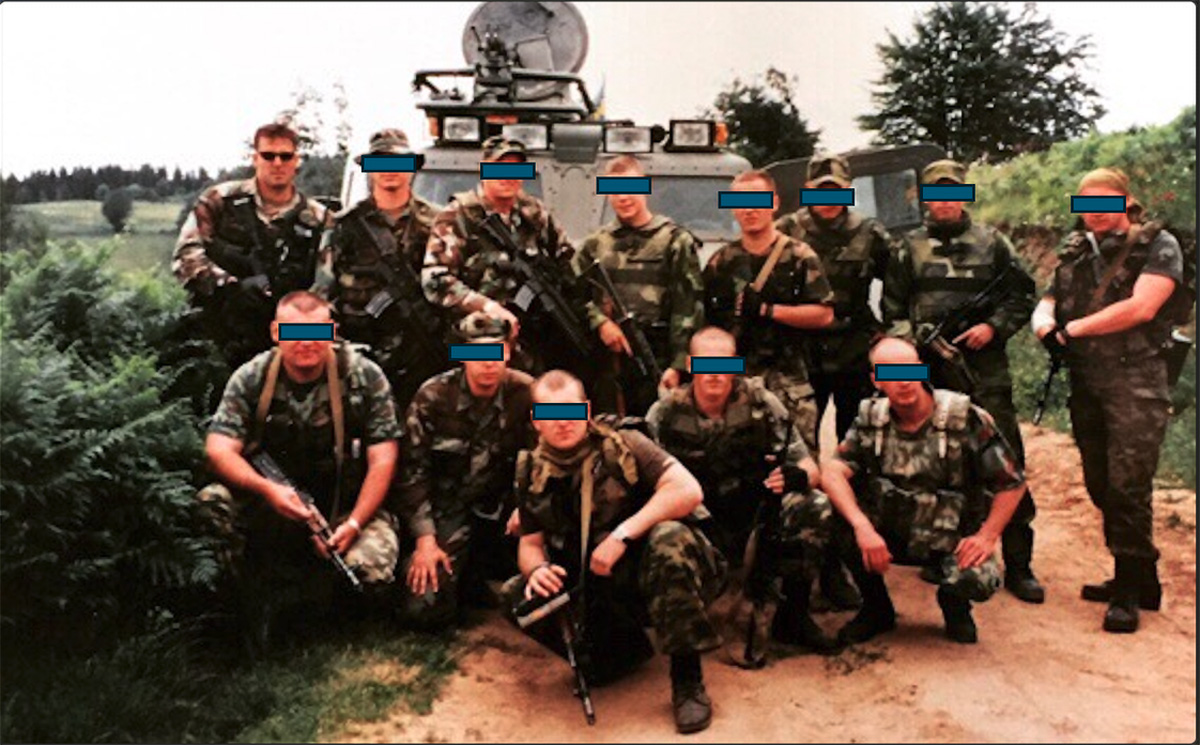
Picture on the border of Kosovo with the Russian VDV and a Swedish Ranger unit we bumped into.
Soon it was time for our very first patrol with the Russians. The Russians showed up in a light track vehicle and jumped out. They were big dudes, with headwraps, and blue and white striped t-shirts. They walked confidently, some had gold teeth, and their weapons and equipment were clean; they were sharp. They were Airborne (VDV) as well as Spetznaz (to this day I do not fully understand the structure of Spetznaz, VDV, and how those concepts overlap). We shook hands and exchanged simple greetings in Russian. We loaded into two Armored Hummers and I stood in the turret behind a MK19 automatic grenade launcher.
The roads along the border were single lane dirt roads at best, in most cases it would be more appropriate to call them trails. The trails were very rough and muddy, so we were four wheeling the whole way, which grew rapidly annoying because I was getting thrashed in the turret. On Kitka’s peak we sat and ate lunch with the Russians, drank some vodka, listened to their stories of Chechnya, and admired a great view of the beautiful Serbian landscape. I quickly realized why the Serbs love Kosovo so much and didn’t want to give it up – it’s beautiful.
In the sprawling rural scene below me I saw quaint red roofed villages and small farms nestled into the hills, pastoral views, and also a Serb checkpoint or two. On this first day I manned the turret for over 10 hours, bouncing along the border to the DMZ. I saw absolutely nothing but beautiful countryside and friendly people herding goats on small farms.
After the prior team left Kosovo, my team started to build rapport significantly with the Russian Spetznaz soldiers and the Russian officer leadership. The old team was not able to build the same kind of relationship we did because they didn’t have my Captain’s unique ability to fully communicate with them in their native language. The Spetznaz and VDV were the Russian equivalent to the Green Berets or SEALs (I think), and there was some natural synergy because of this, and a bit of competition. I believe we all barely survived one such incident of competition without being seriously injured.
The Russians had a special thing they called a banya. A banya is basically a sauna on steroids (perhaps literally in this case) in which it is not uncommon that the small steam room becomes hot enough to actually cause serious injury—scary hot. So, guess what happens when the Russian Spetznaz invite the US Army Green Berets over to the banya? Well, you get a bunch of large naked and stinky men in a steam room wearing fuzzy Russian hats and drinking vodka, the intensity of the heat progresses to downright dangerous as vodka consumption increases, and you wait to see who the last person standing is before someone literally dies or becomes seriously injured.
Not only did we brave the perils of the steam room until near death, but periodically they made us run, totally naked, outside and jump into a giant tank of cold water, just to prove we were too tough for it to give us a heart attack. I am proud to say that my team ultimately won, but I must admit it was not me who outlasted the Russians. I was just happy to survive with my skin still attached, lungs still functioning after breathing the searing hot air, and heart still beating. One interesting thing about these rapport building excursions was the unbelievable amount of commonality we had as human beings. I wondered, why were these people our enemy for so many decades?
One day while drinking peppermint vodka with one of the Russians on our back deck after a long patrol, one of them asked if we had been scared that Russia might actually bomb the US with nuclear ICBMs back in the 80s, and he had a serious look on his face and tone in his voice. I was a little stunned by the bluntness of the question, but I answered honestly that I really didn’t think so. The Russian guy chuckled, in a somewhat annoyed way, and proceeded to tell us how imminent they thought a US attack really was. Because, as he explained, we did nuke Japan, why wouldn’t we nuke Russia?
The magnitude of the rapport we built with the Russians was incredible, we had open conversations like this all the time, in fact there were instances where my Captain found himself in meetings where he claimed that they had forgotten he was an American altogether, and they were exchanging Russian classified information right in front of him. My next story will illustrate this level of trust in another interesting way.
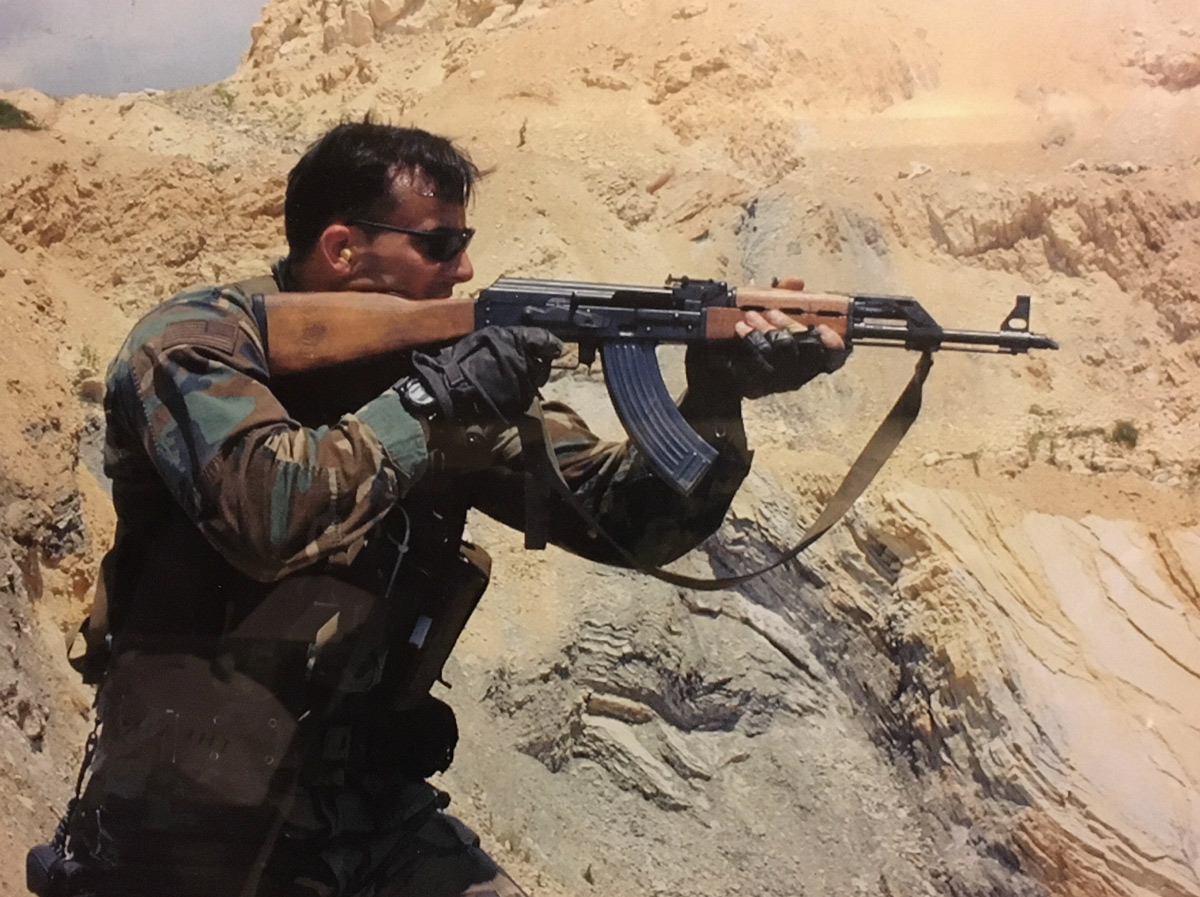
This is me on the firing range with the Russians in Kosovo.
One day, the Russian Colonel came to our house to take my Captain somewhere special. Since we never travel alone, my Captain brought another member of my team with him. The three of them and an interpreter drove in a small Russian jeep north – further north than any of us had ever been. My teammate that had gone with my Captain said he took a reading on his GPS and the grid coordinate plotted them over 10 Kilometers into Serbia, and he quickly realized that they had gone all the way through the DMZ and out the other side into “Serbia Proper,” which we as US troops were strictly forbidden from doing. We knew that the Serbs and the Russians had a history of strong ties, so apparently the Russian colonel felt comfortable just driving into Serbia as if it was normal. The problem was, we were still basically at war with Serbia (or at least that’s what we thought the Serbs would think), so my teammates grew increasingly concerned as the vehicle continued relentlessly north through the hills of southern Serbia.
After driving for quite some time, In the distance, they saw what looked like a large military checkpoint, and as they grew closer, it became apparent that it was a sizable Serbian Army outpost. My Captain thought they were about to be handed over to the Serbs as prisoners. They pulled up to the Serb checkpoint and stopped, and the Russian colonel got out of the vehicle.
The Russian Colonel and a Serbian commander spoke for a while as numerous Serbian soldiers curiously gathered and peered into the jeep. My captain readied a frag grenade, and he and my teammate quickly planned how they would throw grenades and try to run south as fast as they could if bad things happened; likely dying or being captured in the process. What happened next is a miracle of sorts. Apparently, the Russian Colonel had described to the Serbian officer our absolute commitment to ridding Kosovo of the Albanian rebels and what great work we had done so far, and the Serbs seemed to like that. The Serbs said that as long as they weren’t the pilots who destroyed their country, my two teammates were ok to continue to live. Then the Serbs broke out some classic Rakiya to take the edge off.
Right there on the side of that dirt road in Serbia, where US troops weren’t supposed to be due to imminent danger and international agreements, a Russian Spetznaz colonel, a couple US Green Berets, and some Serbian Soldiers (all sworn enemies at some point in recent history) sipped rakija while they talked about how insane the cold war was, how absurd the bombings of Serbia were, how much they hate politicians, and how amazing it was that they were all allies during World War two. They got a little tipsy, and had to back off on the rakija before exchanging “I love you guys” man-hugs with the Serbs, and making the drive back into Kosovo. The meeting was also productive, because as they gulped rakija they also exchanged information about where the UCPMB was operating. Oh, the humanity.
Apparently, word spread fast among the Serbs about this meeting in the hinterlands of Serbia, because from that point on we had Serb checkpoints in the distance waving at us as we drove the border. Also, some of our other teams had reported that the UCPMB morale was low because now they thought that the Russians, US Special Forces, and Serbs had joined forces against them. This fueled our resolve to continue our hunting operations along the border, and we just kept hoping for the big game… which would come soon enough.
One day one of the Russian spetznaz burst into our house and told us that they needed our help to evacuate a dead Russian soldier who had been shot by a UCPMB sniper while on patrol. We didn’t ask any questions and we set out to get to the area where we could call in a medevac. I was in the Gym working out and listening to death metal when my Team Sergeant rushed in and said something picturesque like “I really need you on this one G-man.” I got serious, put on my gear, and took to the turret, and our vehicle soon joined with a large convoy of Russian tracks, trucks, and jeeps headed for the scene of the incident.
We struggled through brutal roads and mud, and arrived an hour or two later, on the top of a grassy ridge overlooking rolling hills, and then we searched for a proper Helicopter Landing Zone (HLZ) nearby. We identified a sufficient HLZ that was a good distance away from the scene, then we called for a chopper to evacuate the Russian soldier. The Russians were all very emotional and yelling things to each other that I couldn’t understand.
As I rode the turret to the HLZ, many vehicles got stuck in the mud several times, and we had to continuously get them out for what seemed like hours on end. Finally, we got to the HLZ, and the helicopter flew in and landed very dramatically. This was when I saw, for the first time in my life, a combat-related fatality.
The dead Russian had been shot in the upper face and the exit wound was on the back of his head; I could tell because I saw a hair covered skull fragment swinging by the skin under his head. Four of his comrades pulled him out of a truck and carried him face up, each holding an arm or leg, across the several hundred feet of grass to the chopper. His lifeless body jiggled unnaturally as blood, and fragments of grey brain matter fell out of the back of his head. His eyes didn’t move at all, and his body was unresponsive to their touch. The dark fluid left a sparse trail on the grassy ground behind them as they ran for the chopper. As they got closer the rotors of the aircraft blew several Russian’s hats off, and the grass around their feet swayed impetuously under the force of wind. Their hunched forms deposited their friend’s body into the loud chopper, and then they ran back towards my location, not caring about their lost hats.
My reaction to the scene came mostly in the form of anger, or at least that was the only emotion I was capable of defining for myself at the time. The anger and the scene before me created or reinforced the notions that the UCPMB Albanians were the enemy; an enemy that was worthy of being feared. All those stories the Serbs in Bosnia told me about Albanians in Kosovo made sense at that moment.
After the US helicopter took off with the Russian soldier’s body, the four young Russian troops walked past our vehicle, some of them in tears, and soon thereafter we left in a large convoy for a very quiet trip back to Kamenica. Once we got back to the house, we had a very somber meeting, and we all reminded each other that this wasn’t a game.
In the next few days, while on a routine patrol, we revisited the spot where the Russian had been sniped, and one of the Russians pointed out where he thought the shot had come from. The location was about 800 yards north of the road; which meant the sniper had made one hell of a long shot. The skill it would have taken to make a shot like that, especially with the typical rifle a UCPMB guy would use, made me curious.
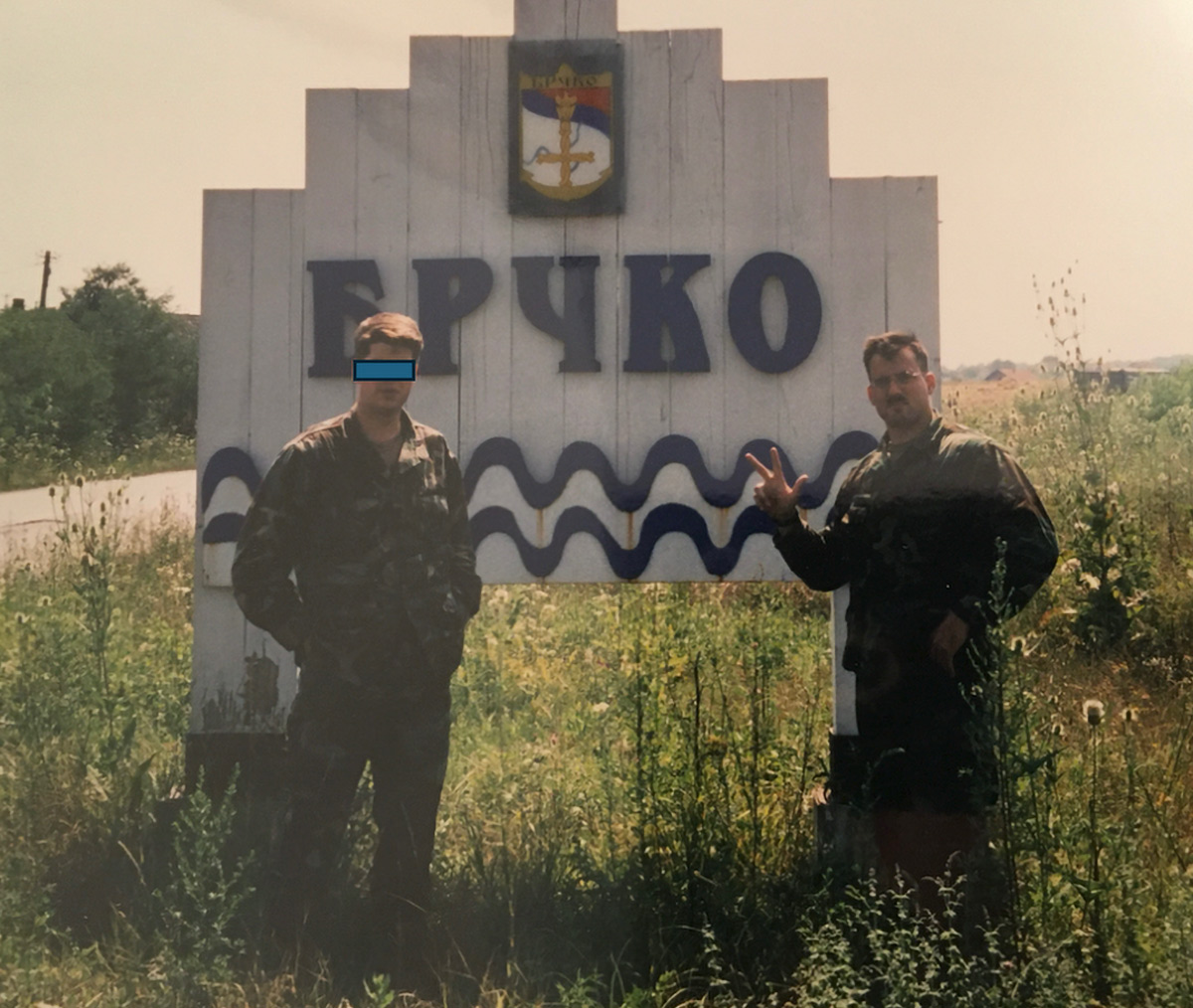
Picture of me and a teammate at the Sign in Brčko.
A few days later, on the way back from a typical excursion around the border, I was riding in the turret as usual, and we encountered an Albanian man, about 25 years old, who was exceptionally dirty, and wearing a green military belt walking in the middle of nowhere down a dirt road. The Russians decided to question the man and search his car, and they found evidence that he was a UCPMB member.
The Russians took him into their vehicle, and then they drove him, with our vehicle following behind, back to the Russian base near our house. This was all very intense. Within an hour, the man told the Russians and my Captain the exact location of a UCPMB base camp, and he said that anywhere between 40 and 80 fighters were operating out of it. My adrenaline surged when my Captain said it was “go time.” We rushed back to our house and loaded all the ammo we could carry in our hummers. I jumped into the turret behind a MK19 automatic grenade launcher, and we set out to disrupt the base camp as fast as the roads would allow. In unconventional warfare one of the basic principles is speed, if you don’t act immediately, the situation will change because the enemy is always adapting and moving. Generally, this is why conventional forces are largely ineffective against unconventional threats. We were headed to a small area in northern Kosovo called Velja Glava.
As we approached the area where the base camp was supposed to be, I saw nothing out of the ordinary. In fact, I had driven by the spot dozens of times. However, one of the Russians noticed a faint indication of tire tracks that ran north through the grassy open area over a hill towards a thick forest. Every map we had in our possession depicted a slightly different line that defined the boundary of Kosovo, but we quickly decided we could go a few hundred meters along the subtle tracks and still be “in bounds,” so we followed the tracks uphill towards a barely perceivable opening in the dense evergreens.
As the rumbling Humvee came over the crest of the hill, with me in the turret, my heart surged so hard I thought it might rupture. Those faint tire tracks turned into a very narrow but worn tunnel-like trail leading into the thick evergreen forest, and there was a makeshift wooden gate blocking the way. The rickety gate had a square sign nailed to it with the words “STOP, UCPMB!” crudely painted onto it in bright red. My eyes immediately shifted to a very young man who was guarding the gate; he wore a colorful camouflage uniform and a red beret with a UCPMB patch on it, and he carried an AK. He stared up at me with his eyes as big as oranges and mouth agape in disbelief.
Before I could move, two of my teammates jumped out of our vehicle. One ripped the sign off the fence and smashed the gate out of the way, while the other simultaneously apprehended and disarmed the young UCPMB guy. The Spetznaz, who were right behind me on top of a Russian vehicle called a BTR, rapidly dismounted, and with the chatter of frantic Russian, they ran into the woods to my left. A commotion ensued in the trees in front of us, and I saw indications and impressions of movement everywhere before me. Everyone in both of our Humvees dismounted except for the drivers and the gunners. I was gunner on the lead vehicle, the driver lurched forward, then we started creeping forward towards the center of what I quickly realized was a base camp that probably covered 5 or 6 acres of thick forest. This was no joke.
My heart quaked as I listened to dozens of Albanians shouting feverishly everywhere from the forest in front of me, but I couldn’t see any of them. My senses were pegged, and my eyes moved frantically in response to every micro sound I heard. I noticed a small car that was cleverly camouflaged into the trees, and several tents, all under small botanical bubbles that were carved very cunningly into the extremely dense canopies of the very large evergreen trees. The purr of the hummer’s engine and the sound of my own pulse made it hard to hear anything clearly. My Captain asked our interpreter what they were all saying, and he said he really couldn’t tell. The interpreter said he thought some of them were speaking Persian Farsi so he couldn’t understand. At the time, I had no idea where people that spoke Persian came from, and I was too busy scanning the woods in front of me to think about it.
Suddenly, to my front I heard the popping of gun fire and the subsequent sound of bullets streaming through the trees; the whizzing and snapping sound blended with the sound of the purr of the hummer beneath me. It sounded like the bullets were streaming past me, but because of the Hummer engine, and since I had never heard the sounds of bullets flying past me before, I wasn’t completely sure. Within a fraction of a second, a few more rounds whizzed by, and I became convinced they were shooting at us. My whole body tensed, and I clenched my teeth so hard I felt the roots poke up into my jaw. I braced my body in anticipation, as the fear of being shot swept over me.
I ducked down low in the turret and swung the MK19 cannon towards the general direction of the fire, towards the thick evergreens in front of me, and towards a bend in the path about 75 meters ahead. I was scared to death, and a vision of the dead Russian soldier’s lifeless body and dripping head wound flashed into my mind. I thought of my wife, my team’s safety, and I imagined bullets ripping through my flesh. Suddenly the overwhelming perception that I had to act now took over my senses. I became furious, more furious than I thought was humanly possible, and I made the decision to return suppressive fire, based on what I felt and what I thought I knew about the situation. The unprecedented combination of fear and rage further brimmed as I flipped the safety off and started to depress those cool steel butterfly triggers on the MK19 machine gun. I was wearing my fingerless black leather gloves, and the steel butterfly triggers felt cool on the tips of my thumbs.
In slow motion, I felt the weight of the weapon’s bolt slide forward once I depressed the triggers far enough to cause its release. I heard the cannon roar and watched it belch fire. I felt the bolt rhythmically rock back and forth as it pulled round after belted round into the chamber and hurled them unmercifully towards the trees. The forest in front of me lit up with incredibly loud and concussive explosions of fire and smoke from the barrage of 40 millimeter grenade rounds that flew from my weapon as I cussed in fury at the hidden enemy before me. A few other guys on my team returned fire as well. I reloaded the weapon robotically, subconsciously, and continued to fire. In less than a minute all the firing stopped when my Captain called cease fire. My heart rate was alarmingly high, my ears rang at a feverish pitch, and my adrenaline was so pegged I was tingling all over and felt weightless. The forest in front of me was smoking and branches were still falling off trees even after the firing had stopped.
My team sergeant, Frank, started yelling orders to secure the perimeter of the camp, and my captain was speaking Russian into a radio. I dismounted and grabbed the M240 machine gun from inside the Hummer as I rushed to exit the vehicle. I ran north about 75 yards through the botanical tunnels that connected the multitude of interwoven bed-down sites within the base camp. I reached the end of the green kaleidoscopic tunnel and stopped at what appeared to be the edge of the base camp. I noticed there were old bloody bandages on the ground, and I assumed they were from wounded UCPMB fighters that had recently returned from attacks on Serb checkpoints nearby. The rest of my team and the Russians were conducting a detailed search of the camp, and for the next few minutes I just kneeled next to a big evergreen tree, and faced outward waiting for a counter attack. I thought through every scenario I could imagine… a sniper taking me out, perhaps watching me every moment in his crosshairs, getting captured and taken off to some evil place, and I even thought the whole area may be rigged with explosives and we may all explode at any second. I had never been so tense in my life.
Within a minute my team called me back to the hummers, and I helped pull a mortar tube out of the ground. Then I saw something harrowing.
The Russians had captured several UCPMB members, and they were marching them past us towards their vehicle. I saw that several of the men were injured, with lots of blood on their faces and one had an injured hand. One had blood running out of his hand onto the ground. The blood was darker than I thought it would be. I realized that maybe it had been me that injured these people—things got real. As they walked by me one of the Albanian men looked into my eyes and we connected to each other’s stare. His face was heavy with doom and fear and blood, and his eyes pleaded to me. In that tiny instant when our eyes met, it was like he silently begged me to explain to him what the hell just happened, and why. I looked away and continued to drive through the situation.
We weren’t there more than 20 more minutes, and we loaded the vehicles and backed out of the base camp the same way we entered. A guy on my team who had lost his grenade the day we medevac-ed the dead Russian soldier found it in one of the tents inside the center of the base camp. This tent was full of an amazing amount and variety of large munitions like landmines and mortar shells. This could have caused a massive explosion, and we were very lucky that one of my grenades did not hit this tent.
We captured 8 or 9 of the UCPMB members that day at Velja Glava. Several of them were injured by shrapnel or bullet wounds. We drove them back to the Russian base, and I went back to our house still completely pumped with adrenaline. The Russian Spetznaz team immediately came over and said that my fire was perfect for covering their advances on the left flank. When they said this I was alarmed, because it was pure luck that my fire was helpful to them. I had no idea where they had gone once they entered the forest (although my Captain likely did). In fact, I think we were all surprised that I didn’t hit any of them by mistake.
This was the first firefight that I experienced as a Green Beret and as a soldier. At the time it was a very big deal to have seen “combat,” because this took place prior to 911 and very few Green Berets could say they’d ever seen combat. The Russians further interrogated each of the captives, and we conducted several more follow-on operations in the next few days based on tips from the captured, none of which amounted to much in comparison to what happened at Velja Glava.
The Big Whiskey’s character completely changed after that day. In our minds we had all become real warriors. We built a table out of a captured machine (DsHK) gun tripod. We hung uniforms of the UCPMB on the wall for display. We hung a reconstructed belt of some of my MK19 round casings proudly on the back wall. Frank had captured the ultimate prize, the “STOP UCPMB!” sign, and we hung it in the Big Whiskey as well. We even decided that now the Russians were worthy of coming into the Big Whiskey, and we frequently invited them to drink beer and listen to Johnny Cash as we uncovered the infinite layers of detail concerning the Velja Glava incident. Afterwards, I thought that the intense dreams I had just came with the territory of being a real warrior.
A few weeks later, the UCPMB gave up and turned in their weapons. Moreover, NATO decided to close down the DMZ as part of a deal with the Serbs and an attempt to keep the Albanians in control, because they were again causing trouble in Macedonia as well. I basked in the notion that it was our single act of brutally decisive violence at Velja Glava that made them realize that they could not withstand the pressures of the Russians, the US Special Forces, and the Serbs all at once. Our egos were quite inflamed.
A few weeks later, we were part of the operation of linking up with Serbian forces as part of NATO eliminating the DMZ. When we went on this operation, for some reason the conventional Army guys accompanied us. As the three or four Serbs that were sent to link up with us approached on foot on the dirt road, the conventional troops trained all their weapons on them. We adamantly yelled at the young troops who were aiming at the alarmed Serbs in order to make them stop. I find it interesting now, that the conventional troops held the belief that the Serbs were the enemy, while at the same time we held the complete opposite belief. This was a good example of how significant the divide between conventional and SOF units can be.
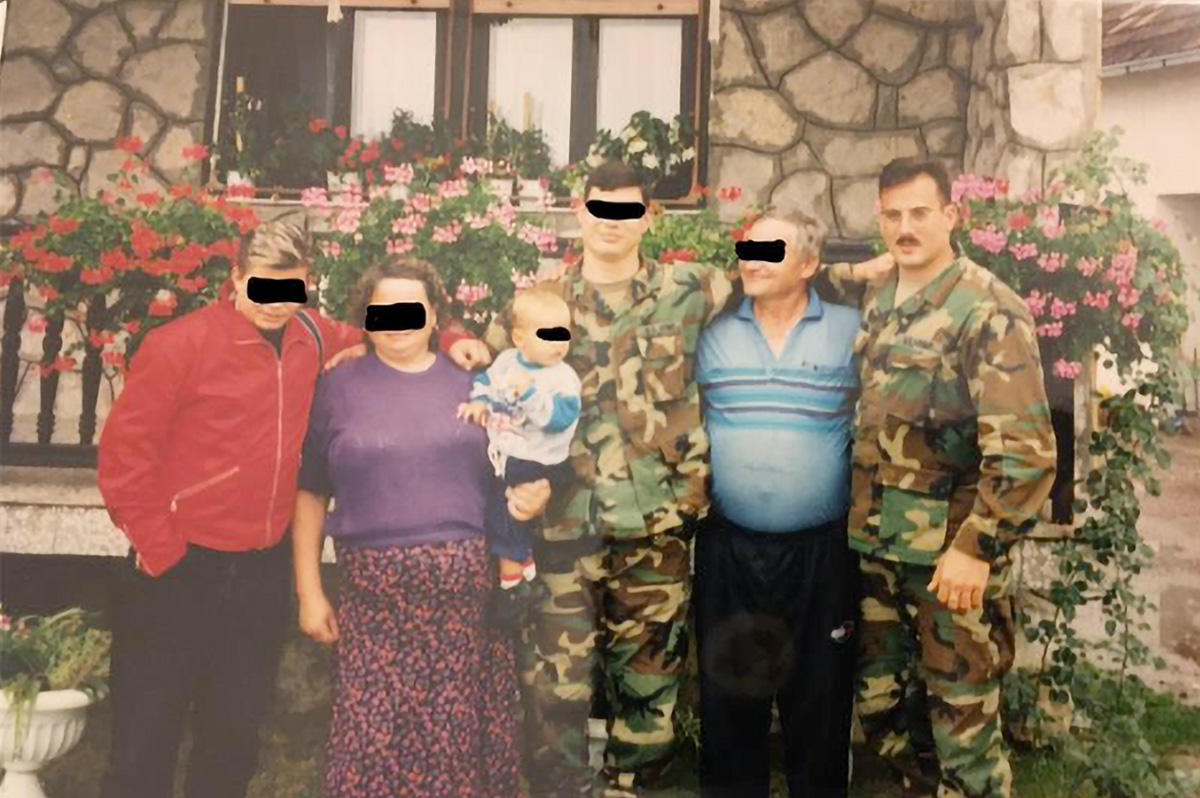
Me in Bosnia with a Serb family that I got drunk with at least once a week. We also did woodworking together.
The Serbs were very excited to meet Americans, and I shook all their hands as we exchanged pleasantries and smiles in Serbian. They were surprised and impressed at how well I could speak some basic Serbian phrases (due to spending over a year in Bosnia). They had very clean weapons and equipment, and seemed very professional. They told us and the Russians all the locations they would patrol, and we exchanged other types of military information such as potential UCPMB locations. They had a natural rapport with the Russians. This was all very ironic.
Since the Serbs had arrived on foot, I offered to give them a ride back to their checkpoint in our Hummer, an idea that the conventional guys thought was insane. Regardless, the Serbs and I all piled into our hummer and we drove a few miles to their checkpoint and we dropped them off. As the Serbian troops walked away I flashed the three finger hand symbol to them, this made one of the Serb soldiers openly excited and he high fived one of his buddies. The three finger hand symbol is when you hold out only your thumb, index, and middle fingers, palm facing outward, thus making a V with the index and middle finger, and a J with the shape of the index and thumb together; it was something I had learned in Bosnia from my Serbian sergeant friend. This is a very important part of Serbian culture, founded in the holy trinity, but now has a more general purpose of expressing, ultimately, pride in being Serbian.
Towards the end of our tour in Kosovo, some interesting conversations occurred between my Captain and the Russians that he frequently spoke to. The conversation led me to believe that the death of the Russian soldier by the Albanian sniper may have been a hoax. In fact, it was suspected that another Russian soldier may have murdered the soldier I had seen carried to the helicopter, or it was a suicide, or accidental discharge. One thing that had been suspicious to me was the precision of the shot; it would have taken a very skilled marksman with a high-end rifle to make a shot like that (without luck). I am/was a trained special forces sniper (Special Operations Target Interdiction Course (SOTIC) graduate), and to imagine a UCPMB guy with a clunky soviet SVD rifle making a shot like that seemed unlikely (although possible). I was alarmed at this new info, because the fact that a Russian had been killed by “the enemy” had really legitimized all the operations we’d been doing against the UCPMB as well as my entire mentality. If I had known about this prior to Velja Glava, would I have pulled the trigger?
It would be absurd to imagine the Albanian resistance ever quitting. The UCPMB merely turned in a fraction of their weapons to make it appear that they had quit, and so they could go into a latent and insipient state until NATO departed. It made sense; NATO was on the verge of taking Kosovo from Serbia and giving it to them, why would they want to piss us off?
As I reflect on Kosovo now, I feel some guilt for the injuries I may have caused on Velja Glava. Sometimes I think maybe if we had just taken the JCO approach and smiled at that young guy at the gate, and asked if we could talk to whomever was in charge, then we’d probably have found ourselves drinking tea in the middle of that base camp, and things probably would have ended up about the same as they did except no one would have gotten hurt. However, at the same time I can’t help but remember that, then, I truly felt like my team and I were in grave danger that day on Velja Glava. They were shooting at us, and I had absolutely no doubt I needed to return fire to protect my team and preserve my own life. Also, just maybe the decision the UCPMB made to go back into remission would not have happened if we hadn’t done what we did that day, and maybe that was good. Maybe the UCPMB going into remission was a good thing and maybe it was bad or maybe it was progress.
Today, from a macro level, I don’t think that the US should have ever been involved in Kosovo in the first place, and to be totally honest, I personally view what we did to Serbia as very hypocritical. However, it’s hard to dismiss the fact that we now have a huge base in one of the most historically strategic locations on earth – the southern Balkans. Maybe that was the point all along.
Soon enough, we were on our way back to Macedonia, and then Colorado. My wife and I moved into a different house as soon as I got home.
Mike interviews Mark Giaconia who discusses his two decades in the Army, going from infantry to the Green Berets. Mark looks back on his time in 1990s Bosnia, where his team lived among locals in remote villages, collected intelligence, and had some tense encounters with Serbian police. He also covers his path to Iraq, his reaction to 9/11, and what it took to get through Ranger School.
Mark Giaconia spent 15 years in the Green Berets, and his memoir, One Green Beret, covers it all: working alongside Russian Spetsnaz near Kosovo, living among locals in postwar Bosnia, and helping prepare the Kurdish Peshmerga for the 2003 invasion of Iraq, including the battle known as Operation Viking Hammer.
In this conversation with The Teamhouse, Mark reflects on those missions and on the personal evolution that followed, from hard-charging soldier to computer scientist.
ABOUT THE AUTHOR — Mark Giaconia served 15 years of his 20 year Army career in the Special Forces; he served in Bosnia, Kosovo, Kyrgyzstan, and Iraq as a Green Beret. Prior to SF, Mark served 5 years as an infantryman in the 4/27 and 2/27 Wolfhounds in the 25th ID in Hawaii.
Mark holds two awards for valor from combat actions in Iraq and Kosovo (Bronze Star with “V” and an ARCOM with “V” respectively). He graduated from the Special Forces Qualification Course (18B initially, then later became an 18F and 18Z), Ranger School, Airborne and Jumpmaster School, Mountaineering schools, three different Sniper Schools, ASOT LVL III, and a few more.
After his postwar intellectual evolution, Mark became a Computer Scientist, CTO, and technology leader, and he is also an accomplished Flamenco and Metal Guitarist, impressionist oil painter, woodworker, computer programmer and data scientist, and loves studying philosophy. Mark holds a Masters in Software Engineering, and a Bachelors in English and Philosophy.
Leave A Comment