
The Voice of Home
By Marc Yablonka
Little did San Francisco area radio station KGEI know, but in February 1939, it would soon become the model for Armed Forces Radio Service (AFRS), later, Armed Forces Radio and Television. KGEI’s parent company, General Electric, had just developed a short-wave transmitter and antenna with the ability to reach Asia and Latin America.
But while GE had the technology to launch a radio station that could broadcast that far, it was not versed in the art of radio programming. GE’s public relations representative Buck Harris changed that when he created programs and broadcast them via KGEI.
According to a Defense Department publication documenting the history of the American Forces Radio and Television Service (AFRTS), the electronic giant’s only guidance for Harris was to “broadcast unbiased news and music to Asia and Latin America three hours a day and to develop good will.”
As the Japanese attack on Pearl Harbor fast approached, listeners in Asia wrote the station, urging it to compete with Japan’s Radio Tokyo.
It did so, and caught the attention of Pacific Forces Commander Douglas MacArthur. The general sent out an urgent request from Bataan for KGEI to broadcast warnings about counterfeit Philippine currency the Japanese were pouring into areas they had overrun.
“They are doing this in order to strip your stores and farms at no cost to themselves. Do not accept this counterfeit money made in Japan,” warned KGEI’s public service announcements. The PSAs made an impact.
Within weeks, Radio Tokyo beamed out the counter warning that anyone questioning the money would be shot.
As the war entered its first year, the station became the primary source of news and information for American troops fighting to save the Philippines. The GIs had moved a 1,000-watt transmitter from Manila to Bataan and, after picking up the signal out of San Francisco, proceeded to relay it throughout the Philippines
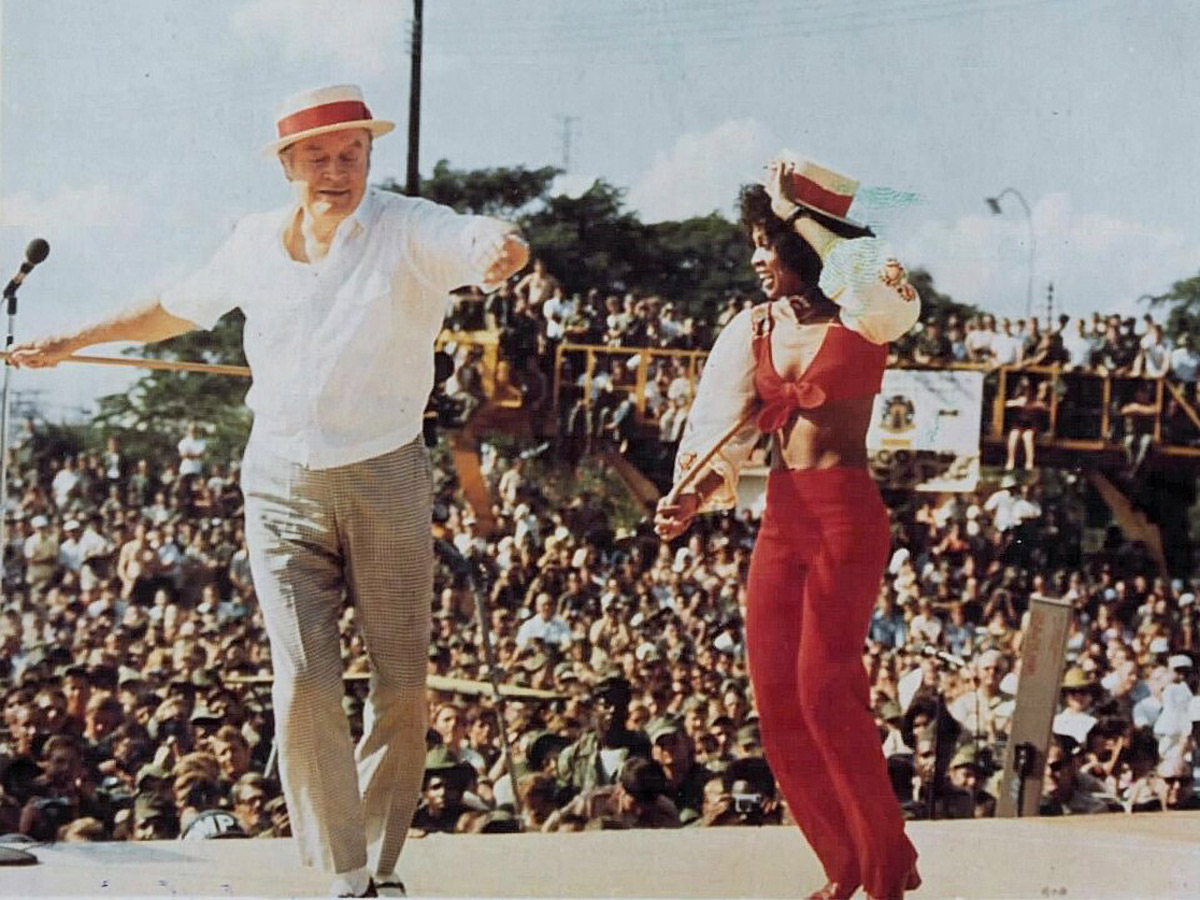
Bob Hope and Lola Falana doing a song and dance at Tan Son Nhut Airbase, Vietnam during the Vietnam War. (Photo courtesy National Archives)
Though not the first Army radio station in existence, AFRS soon became so critical to the morale of our troops in World War II that several Hollywood actors, including Bob Hope and Clark Gable, performed live for them over the station’s airwaves. Ironically, Gable—who thrilled millions on the Silver Screen and later served with distinction as a B-17 door gunner in the Eighth Air Force—was initially frightened of the microphone and had to be coaxed by his friend Hope into going live.
Hollywood and AFRS soon developed a close-knit relationship. Many actors took to the mic, both in Hollywood and overseas, to entertain our service personnel. In fact, many of these celebrities spent their war years in uniform attached to AFRS.
One link between the film capital and Armed Forces Radio—by 1943 called American Forces Network (AFN)—was Loretta Young. The actress was married to advertising executive Tom Lewis, who, soon after Pearl Harbor, was commissioned a major in the Army and tasked with fine-tuning AFN.
Lewis set up shop at the 20th Century Fox Studios on Western Avenue in 1942. Once the word got out, he began hearing from the radio industry’s top writers, producers, and technicians. His task was simple: boost the morale of GIs overseas. Always the realist, Lewis acknowledged that “neither radio nor any other media can completely reconcile a boy from Grand Rapids to a military life in Persia, but we can help his adjustment.”
The key was programming around-the-clock news and entertainment that kept the GIs in touch with the world they had left behind.
Tom Lewis died in 1988, but he is considered today to be the father of American Forces Radio and Television. As of 2004, when this writer visited the AFN Broadcast Center at March Air Reserve Base in Riverside, Calif. for the first time, his photograph was hanging in the lobby.
After World War II, while the Cold War troop buildup was occurring in Europe, the Japan-based Pacific branch of AFN (then as now called Far East Network) began dismantling its relay radio stations in Pusan, Chonju, and Kwangju, South Korea. By 1948, only the FEN station in Seoul remained operational.
That all changed in June 1950, when North Korean forces burst across the 38th Parallel to start the Korean War. Three months later, after United Nations troops retook Seoul from the North Koreans, Gen. MacArthur, supreme commander of US Forces, signed a general order creating the American Forces Korea Network. The following year, MacArthur was relieved of his duties by President Truman, with whom he had been at odds over his operational view of the war.
Ironically, since the president’s emissary had not yet arrived because of bad weather encountered after a refueling stop, MacArthur learned of his dismissal while listening to the very radio station he had mandated,
“Much like its World War II predecessor, AFKN’s staff and broadcast facilities moved with the battlefields,” wrote Trent Christman, author of the book Brass Button Broadcasters: A Lighthearted Look at 50 Years of Military Broadcasting.
He wrote, “Reporters with portable tape recorders went wherever the fighting took place. They’d cover all phases of the conflict–a mile behind enemy lines, on a combat patrol, and over enemy targets in Air Force planes.”
By the time the ceasefire took effect in 1953, television had already gone from being the rage to being commonplace. AFN felt that if it did not incorporate the new medium into its programming, both enlistments and troop morale would suffer. Moreover, with the onset of peace and the Cold War buildup, the implementation of TV had become a necessity. Thus, in April 1954, AFN evolved into Armed Forces Radio and Television.
Television continued to play an important role with the onset of hostilities in Vietnam.
TV announcers like mini-skirted Bobbie “The Weather Girl” Keith played a big part in boosting the morale of GIs in Vietnam. But it is the radio side of the American Forces Vietnam Network that Americans are most aware of—due in large part to the film Good Morning Vietnam, in which the late actor/comedian Robin Williams portrayed one of AFVN’s most famous disc jockeys, the late Adrian Cronauer.
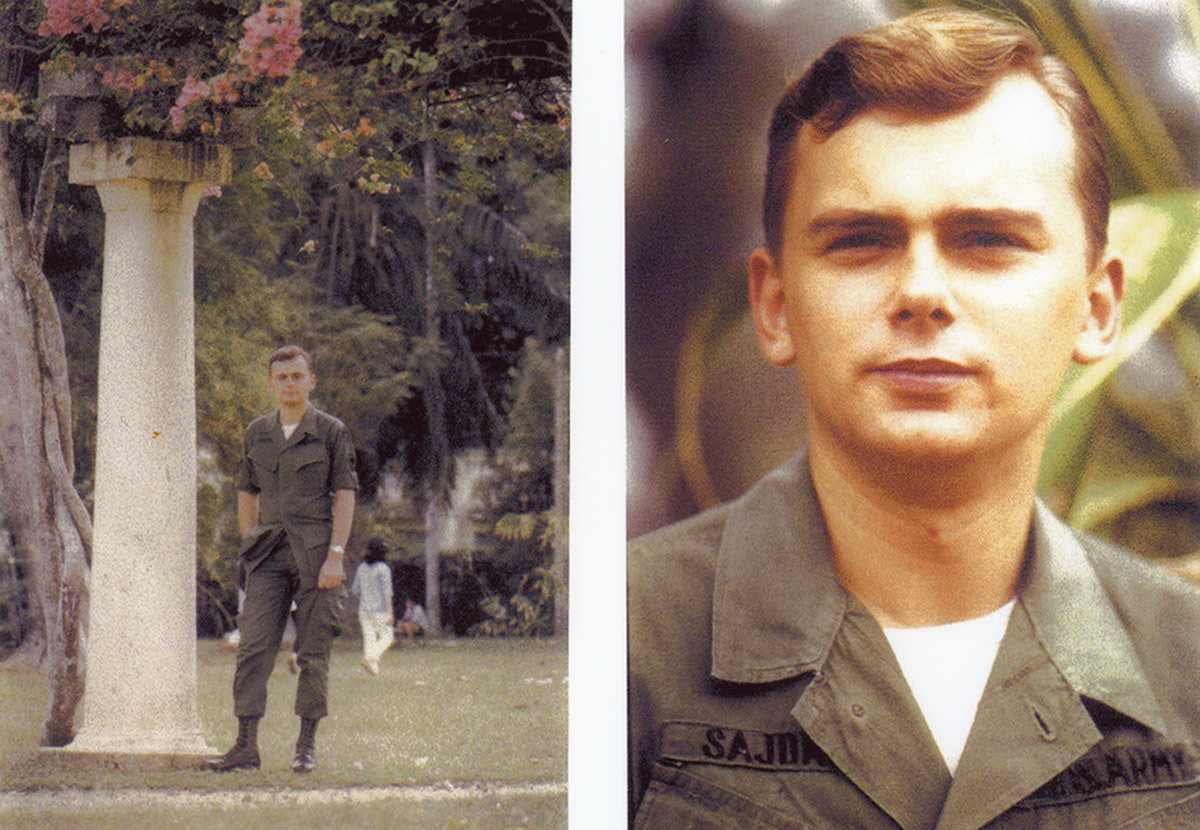
Pat Sajak in Saigon. (Photo courtesy Pat Sajak).
But Cronauer, for several years after the war employed by the Pentagon’s POW/MIA office, was not the only morning jock to utter those famous words. Every morning man did, including former ABC-TV’s Wheel of Fortune game show host Pat Sajak. “I joined the Army looking for that golden experience in broadcasting,” the former Chicago disc jockey and Nashville TV weatherman joked with me over the phone in 2004. “The Army in its infinite wisdom stationed me at Long Binh in 1968 and made me a clerk typist. And I was a damn good one, too!”
Sajak was eventually reassigned to AFVN, but it took four attempts on his part and a letter from his congressman, who had owned the first radio station Sajak had worked for, to affect the transfer.
Working at AFVN did not evade the possibility of peril. At one point during the war, Viet Cong sappers had destroyed much of its Saigon studios when a car bomb went off outside. Three Americans were killed by North Vietnamese Army regulars at AFVN’s detachment at Hue during the Tet Offensive in 1968, and five AFVN staffers were taken prisoner and spent the next five years in North Vietnamese prisons before being returned home safely in 1973. Elsewhere, at Udorn Airbase in Thailand, five more would lose their lives in 1970 when an F-4 fighter jet crashed into the AFTN radio station there.
Despite the dangers, Pat Sajak enjoyed his tenure as AFVN morning man—so much so that he re-enlisted and stayed in Vietnam until 1970.
“It was funny and strange,” he recalled during our phone conversation. “There was a war going on. Barbed wire was everywhere and I was playing records and going to restaurants every night. It was a fairly normal life. Given the circumstances, mine was a pretty lucky duty. It was the height of the buildup, and I had half a million civilian listeners.”
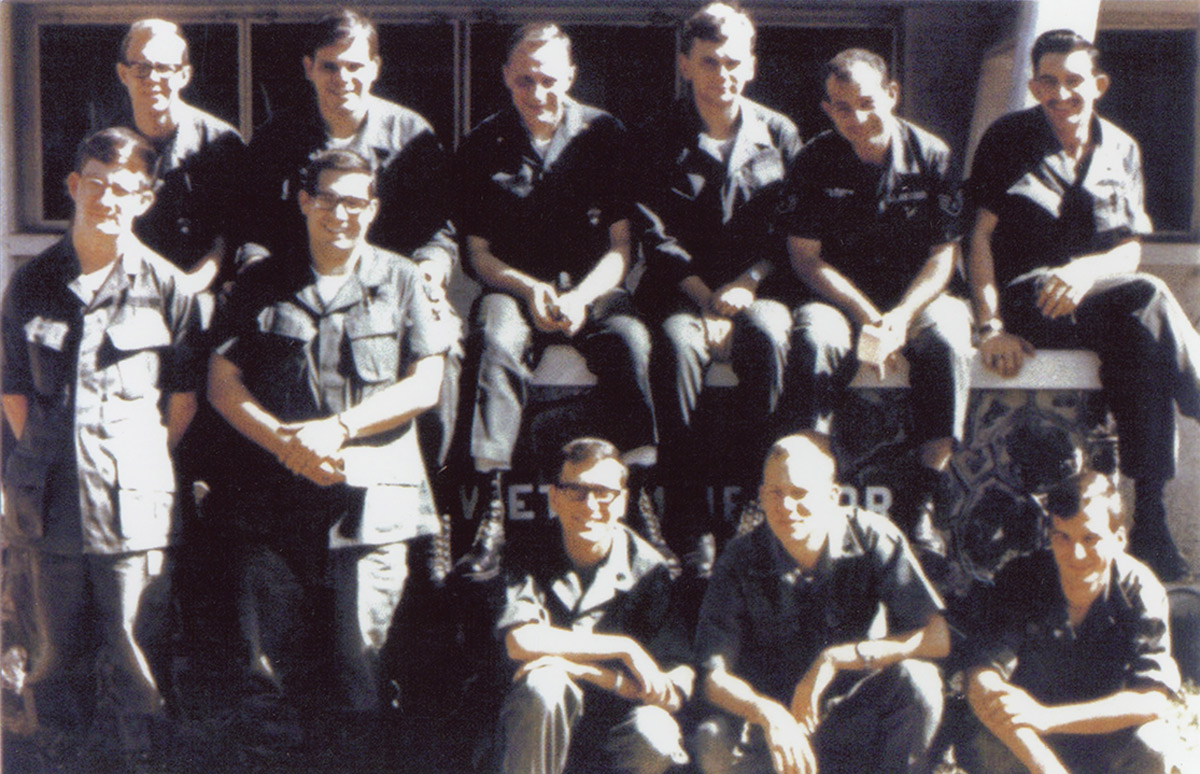
Pat Sajak, top row third from left, at AFVN with fellow staffers. (Photo courtesy Pat Sajak)
Those listeners—as well as the men and women in fatigues—were able to hear Sajak via in-country affiliates to whom his shows were relayed. The signal reached the entire Republic of South Vietnam between 6 and 9am. From 9am to 10pm, AFVN cut its power to include only Saigon.
The station operated like one stateside. “We played Top 40 since the listeners were mostly young men,” Sajak explained. “We didn’t have commercials, but we did have snappy PSAs: ‘Be sure to keep your M16 cleaned.’ That kind of stuff. We produced our own jingles and ran very tight shows.”
Meanwhile, on the other side of the Pacific, actress-turned-deejay Chris Noel had been broadcasting her show A Date with Chris from the AFRTS Studios in Hollywood since 1966. By 1971, she was so dedicated to the cause that, with a bit of coaxing from her then-boyfriend singer Jack Jones—who had been over to Vietnam with Bob Hope—Noel soon found herself face to face with the GIs who had been listening to her show from afar.

Chris Noel with American troops in Vietnam in 1967. (Photo courtesy Wikimedia Commons, US Army, Public Domain)
Unlike Sajak, who was mostly posted to Saigon, Noel always took her AFVN show on the road to places like Cam Ranh Bay and Pleiku. Everywhere we had troops. “All I did was go out there and say hello. They didn’t have anybody,” she told me during a phone interview in 2004.
Apparently, those hellos mattered greatly to the grunts in Vietnam because, as of 2004, Noel was still getting letters, emails, and tearful hugs at the Vietnam Veterans Memorial from soldiers who told her how much it meant to them for her to have been there.
Being “there” meant grinding out her shows, ten a day, because AFRTS had to have shows on the air when she was in Vietnam.
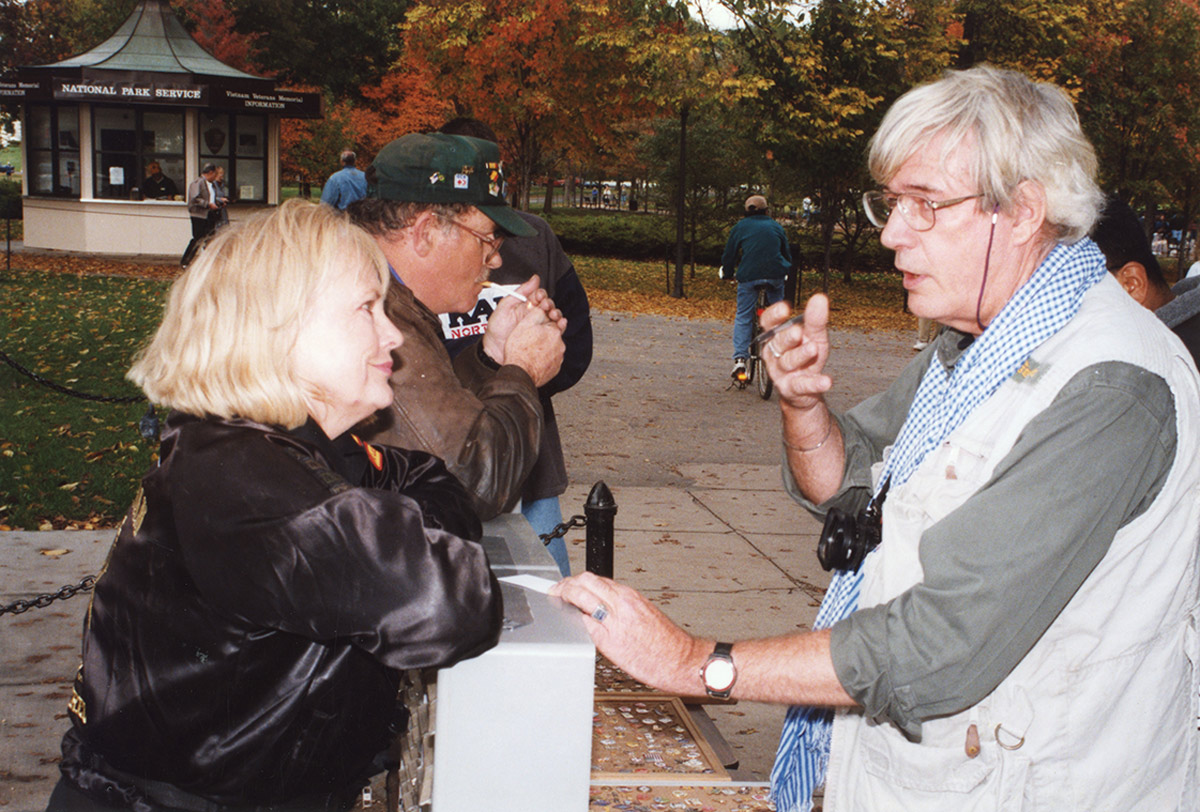
Chris Noel speaking with the late British photojournalist Tim Page, who photographed the Vietnam War for UPI, at the Vietnam Memorial in 1997. (Photo by Marc Yablonka)
Chris Noel—who, for many years, has operated Vetsville Cease Fire House, a shelter for homeless Korean and Vietnam War vets in West Palm Beach, Fla.—remembered her Southeast Asian experience as “the most interesting, dangerous, exciting, on the edge time” of her life.
No doubt many of the “brass button broadcasters” who found themselves behind a mic or out in front of a TV camera for AFN could say the same thing.
AFN TODAY
Today, the American Forces Network (AFN) remains the official broadcast network of the United States Armed Forces. Headquartered at Fort Meade, Maryland, it provides stateside news, sports, and entertainment programming to U.S. military personnel, Department of War civilians, and their families stationed overseas and on naval vessels. AFN features several key services and platforms: AFN Now, the official video streaming app and IPTV service is available on iOS, Android, and popular streaming devices like Roku and Amazon Firestick. It delivers top-rated US network television, movies, and dedicated sports and news channels. AFN also operates AFN Go, an internet-streaming radio service that connects listeners to local “AFN The Eagle” stations worldwide. It does so, having transitioned its land-based transmission method from traditional bulky satellite dishes to internet protocol (IP) delivery.
ABOUT THE AUTHOR
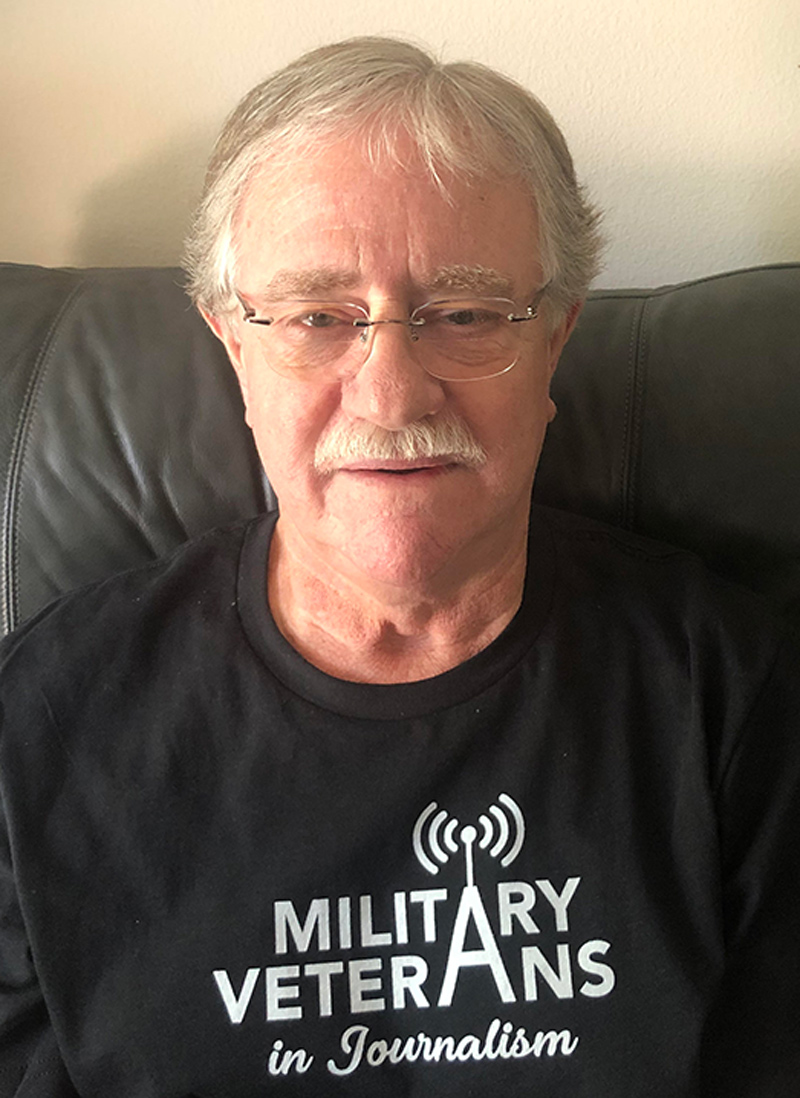
Marc Yablonka is a Burbank, Calif.-based military journalist and author whose reportage has run in the US Military newspaper the Stars and Stripes, Army Times, Vietnam magazine, and many other publications. In addition to being a contributing writer for the Sentinel, he is also the senior reporter for the Sacramento-based Hmong Daily News. He has written four books on the Vietnam War, the most recent of which are Vietnam Bao Chi: Warriors of Word and Film, about combat correspondents and photographers who served in the US Military during that war, Hot Mics and TV Lights: The American Forces Vietnam Network, Tears Across the Mekong, and Distant War Recollections of Vietnam, Laos, and Cambodia.




Leave A Comment