A Man in His Element—
MSG Jerry Michael Tate Shriver
An Interview with
Colonel (ret.) Bob Killebrew, MACV-SOG
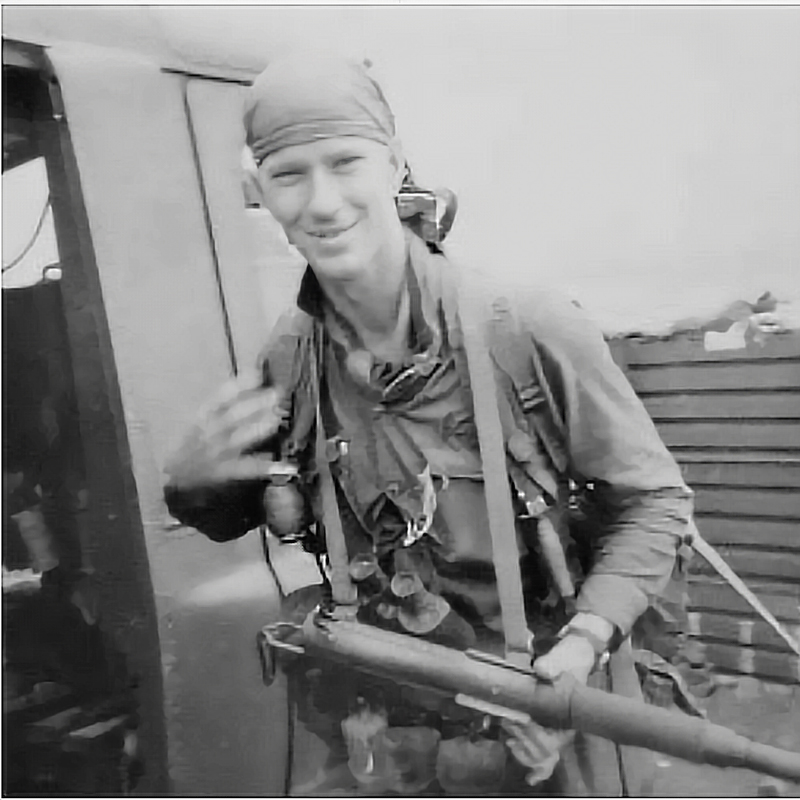
Prologue
Bob Killebrew retired from the Army in 1997. He served two combat tours in Vietnam, commanded rifle companies in the 1st Infantry Division (Mech) and the 101st Airborne Division (AASLT), a battalion in the 82nd Airborne Division and a joint task force in Central America. After retirement he worked as a private consultant for defense industry and was a Visiting Fellow at the Center for a New American Security. He lives with his first wife, Pixie, in Newport News, Virginia.
Thanks to a fellow Citadel graduate of MG (ret.) Kenneth R. Bowra (MACV-SOG, CCN), Bob accepted Ken’s invitation for me to interview him regarding his recollections and memories of his platoon sergeant, Jerry Shriver. A follow-on interview with Bob was conducted by another historian and is available on YouTube. I am proud to have served under MG Bowra at USASFC and SOCSOUTH among other more recent projects and efforts benefiting the U.S. SOF community-at-large.
Jerry Shriver remains an Active Pursuit case for the Defense POW/MIA Accounting Agency (DPAA). Per Mr. Sean Everett, DPAA PAO “MSG Shriver is still considered MIA, otherwise we would not be looking for him. If remains had been found that had been positively ID’d as him, his case would be considered solved and he would be considered Accounted For.
“To answer your questions about Active Pursuit, this means that the case has some kind of lead or leads that our researchers and analysts are able to follow. If we don’t have any leads to pursue on a case, it goes into Deferred status.”
DPAA confirmed they have located and identified a witness present at the battle in Cambodia where Shriver was lost. “DPAA has a named potential witness located in Vietnam whom we plan to interview. This interview will be conducted by personnel from DPAA’s Detachment-2 in Hanoi, in conjunction with our Vietnamese partners with the Vietnam Office for Seeking Missing Persons (VNOSMP). While interviews of named witnesses are a high priority, due to their age and health concerns, those same factors affect scheduling. We do hope to accomplish this interview this year of 2025.”
Shriver knew it was a suicide mission at that point and that he wasn’t coming back. It was this knowledge that saw Jerry give his German Shepard, Klaus, to one of the ‘Yards not going on the mission. “Take care of my boy,” was all he said.
According to David Maurer, MACV-SOG CCN 1-0 and author of The Dying Place—“I remember well the night Jerry and I spent together. I told him about stories I’d heard about him and he’d tell me what was true and what wasn’t. The thing is that you didn’t have to make stuff up about him. He was a character, a loner, and a very brave guy. He was also in that select group of SOG guys who really did it right.”
“I think Jerry, like others of us, got caught up in the war and couldn’t stop. I would have continued to run missions, too, if it hadn’t been for that idiot Covey rider who almost got us all killed as I documented in my first book. I cannot picture Jerry leaving the war and going back to the states. His end was about as good as one could expect – going down fighting.”
Interview – Colonel (ret.) Bob Killebrew
“It has been nearly sixty years since Shriver and I were together, and my memory is hazy in spots about his final op which was a suicide mission for all that participated.
“I met him when I reported to CCS, and salty old LTC Tribue said something like “I’m going to assign you SFC Jerry Shriver, a Special Forces legend. He has been over here for three years and he knows everything there is to know about this business. Listen to him.” Then he fixed his eye on me “But if you screw this up, lieutenant, it’s your ass.”
“Bill O’Rourke came in to be introduced and the whole deal almost went south when Tribue found out we’d known each other at Benning, but Bill assured him he could handle me. We walked out and he introduced me to Shriver, who saluted and said, “Good to meet you Sir,” or something like that.
“My first job was to re-recruit my platoon, as they had quit the field on another lieutenant who shall remain nameless (and which makes me think that Shriver was new to the company too, as they would not have quit on him). Jerry was close to my interpreter, Y Plai Hdoc, who was the son of the headman from whence came “my” platoon. So we loaded up in one of our black jeeps (that suspiciously had other unit markings painted over), got an aviator kit bag with piasters in it, and drove off into the hinterlands with just Y Plai, Jerry (driving) and me in territory that the 4th Division later got in a big fight in.
“We got to the village, met the headman, handed money all around (most of the male ‘Yards were in uniform anyway, and there were a lot of M2 carbines showing) and went up the steps into one of the big, stilted log longhouses for a party. I don’t remember (or won’t say, anyway) much until the next morning when we got dressed, found our weapons, and wobbled back to CCS; the platoon trickled in over the next few days and I became a platoon leader with a platoon, and a brass bracelet that made me an honorary tribesman.
“I tell the story to point out how close he was to the ‘Yards. While I was the lieutenant and got due respect (I was, after all, the guy with the money), it was clear who got the hearty handshakes and the hugs. He knew everybody and was loved by all; watching him in the crowd was like watching a popular politician on the hustle. There were some happy incidents in the longhouse, and we’ll leave it at that. There was no doubt in my (inexperienced) mind that we were secure in the village.
“He did have a wicked sense of humor. In that long operation up north, we ended up sheltering (as planned) with a Marine outfit that had run out of food. We had occupied a portion of their perimeter on a foggy, miserable, and muddy ridge right on the border. After a day or so a couple of Marines came over scrounging chow. We offered them some of our rice and one of them said something like “You guys are all right, at least you don’t have to put up with those ************ officers.”
“A second later Shriver hopped out of the hole, pulled himself to attention, and said “If it’s okay with the Lieutenant, I’ll go check on the platoon.” I thought the Marines were going to have a stroke. We relaxed and all had a good laugh. But he did have a sense of humor.
“His deceased date, of course, is when he was officially declared KIA; he was killed in April 1969. In the immediate aftermath of Jerry’s death, we were all hoping that he would be remembered for the hero he was. I think—but am not sure, it has been a long time—that there was some kind of local memorial to him in our compound at Ban Me Thout. I am so pleased that he is not forgotten.
“CPT Walt Marcantel was one of the four lieutenants in our Hatchet company. As a 1LT he was with Jerry on that final, ill-fated mission into Cambodia (I missed being there by a simple coin toss). Gossip was that he died a few years later in a training accident.
“We did a number of hatchet force missions, but I can only remember some highlights. We did two or three “training” missions in the local area (training the Lieutenant) on one which I distinguished myself by stepping on a booby-trapped underwater bridge, which happily did not explode. Another that ended in a firefight over an NVA latrine with US propaganda leaflets stacked for toilet paper. We built an LZ on a mountaintop somewhere and blew up a hell of a lot of trees (that’s where the picture of Jerry was snapped). A few missions in Cambodia against caches of food and ammo that RTs found. One week-plus occupying a launch site (I think Tay Ninh) and stealing plywood from the 1st Cav when they all took to their bunkers during a rocket attack. The long op up north, which was the longest sustained fight I was ever in, and then my long mission after Jerry was killed.
“Bill O’Rourke was the company commander and another ‘war dog.’ He left the Army and went to work for the DEA. He showed up at Bragg one day years later and tried to convince me to retire and join him in ‘just like the old days’ drug interdiction in South America. He died a few years ago. I was the XO and 1st platoon leader; Shriver was my PSG. Greg Harrison was the 2nd platoon leader. He was killed in the op that killed Shriver. Walt survived that op and got a silver star for retrieving Greg’s body and, as I said, died after Vietnam in a training accident, or so I heard. The company 1SG, Tom Toomey, retired a CSM, became the honorary CSM of the 3rd Infantry Regiment. The last I heard he was in poor health. He and I are the only survivors of the original 1969 Company.
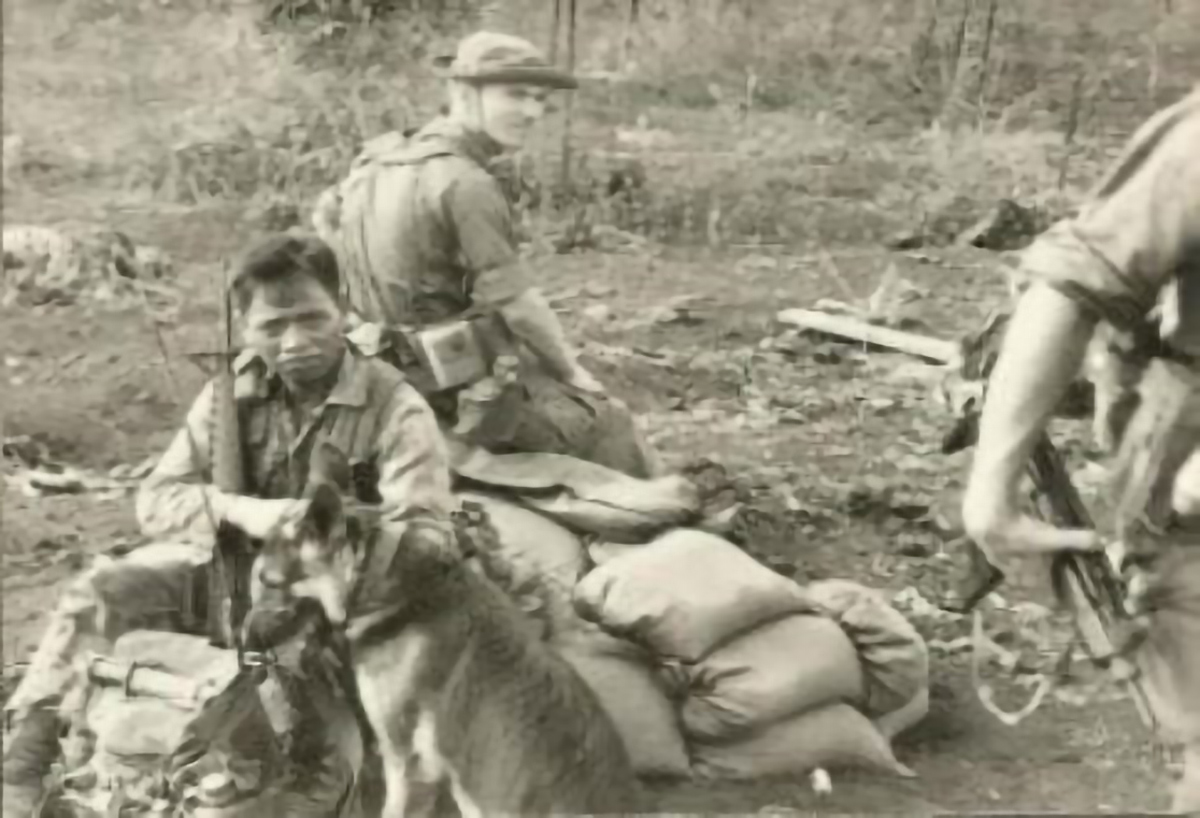
The picture was taken by CPT Walter Marcantel on 4-23-69. The “yard” is Y Juh Nig and SGT Jamison is to his rear. Shriver, holding his UZI SMG, is on the right. Both SGT Jamison and Shriver were KIA. (Credit: CPT Walter Marcantel/provided to the author by his brother, Jerry Mancantel (documented).
“The only time I am mentioned in John Plaster’s book is that Bill O’Rourke mentioned me being in reserve on that disastrous mission into the Hook when Shriver went missing. Bill’s memory was wrong, but understandably so. I was off on another mission.
“We had just gotten back from a CCN mission and Shriver and I flipped a coin to see who would take a few days off to go to Nha Trang. I won and I was in the air in one of those SVN Cessnas when I got the word to come back. We turned around in the air and flew back and got there just in time to see the C-130 with our Hatchet Company taking off in clouds of Highlands red dust. The order to deploy had come down so fast that Greg Harrelson took ‘my’ platoon.
“When I got back I suited up to go down and rejoin Bill but was given another platoon and some NCOs—did not know any of them—and sent on a completely hair-brained in-country mission to find an NVA division near the border in South Vietnam.
“We stayed in the field for about ten days, according to my fuzzy memory, moving around and having contact every day but never any major fight (one of our previous positions was mortared one night).I learned about Shriver’s fate—everybody’s fate—one night on the FM [tactical radio] from an RT on a hill across the border — we were happy to have somebody to talk to. We got out okay after ten days, though our exfil was fired on. That mission was my “gut check” on following orders when I was pretty sure the mission was poorly
planned—it was—and we were all going to get nailed. Based on who we were contacting, I retrospectively believed we were in the middle of a major NVA infiltration and they were just avoiding us.
“I found out after we got back that Greg, Shriver and almost all my ‘yards had been killed. Bill was in semi-shock, as he and Shriver were very close, and I completely understand how, after ten or fifteen years, he’d forgotten where I was. He got out of the Army and came to see us when I was a battalion commander at Bragg— in the DEA fighting the drug wars, long walrus mustache, on his third or fourth wife and on his way to Thailand. Bill was a natural warrior.
“The mission that killed Jerry was an abortion and should never have been executed. The nub of the plan was a B-52 strike on a major NVA headquarters. As I recall that strike was supposed to be the key for success on the UH-1s landing in the post-strike dust and smoke and grabbing bomb-dazed prisoners. As it happened, the B-52 strike was delayed, and their insertion was delayed after that, giving the NVA too much time to dust off, tap their magazines and get ready for us. And of course, we later learned that there was an NVA spy at MACV who was telegraphing SOG missions to their pals across the border; I do not know if this particular mission was betrayed, but anything big enough to involve B-52 strikes had a big staff signature. Made me permanently suspicious of complicated plans.
“Why did he keep running? He was addicted. At times he would tear up, and he once confided to me that he expected to be killed. Bill and I used to talk about it, but we decided in our senior-lieutenant wisdom that sending him out of the fight would have killed him, psychologically speaking. I still think it would have.
“Here’s the picture I’ve got of Shriver; this was during an op (location forgotten) and Jerry is in his usual field uniform — nondescript gray shirt too small for him and baggy green trousers. My memory is that it was an old NVA uniform, but I can’t swear to it. He was a man in his element
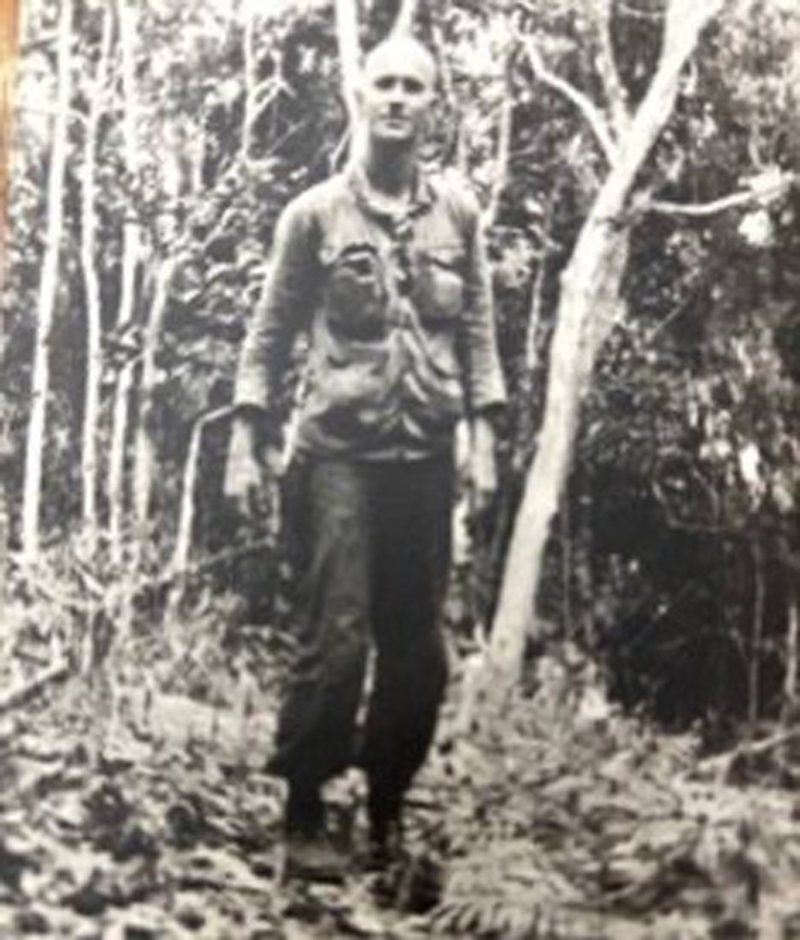
“Mad Dog Shriver”—A man in his element (Credit: COL Bob Killebrew)
“Shriver and the men I served with were professionals doing professional jobs. The guys who are the real heroes of Vietnam, in my humble opinion, are the drafted kids who didn’t want to go but went anyway, who wound up as line grunts in the unglamorous infantry divisions like the 4th or the 9th, who humped rucks for twelve months and who then went home to an uncaring, and sometimes hostile public. You see them now in the VFWs and American Legion halls and I wish the country really knew what heroes they are besides all that “thank you for your service” stuff.
“There’s no question that Jerry went down fighting. It’s my belief that the NVA never knew they killed Jerry. If they did they would have used it for propaganda”—Dave Maurer, 1-0, CCN, author of The Dying Place, and close friend of Jerry Shriver
“What would he advocate? My mind boggles at the thought of him alive today—I think, like Bill, he would have found peacetime stultifying. But he was a professional soldier and proud of it; I suspect he would say weapons proficiency, knowing your team, and good commo. Good professional advice.”
“On the knife,—Shriver had one of those early Gerber fighting knives —a long double-edged razor-sharp dagger before the Gerber people began putting a serrated edge on one side. There is a picture of him hanging upside down from his LBE. Sometime in our time together he gave it to me. It was a nice knife for stabbing people but impractical for anything else—the blade was too delicate and the knife was too light for chopping.
“It lived on my bookshelf for many years and I finally gave it to the Airborne/Special Ops Museum in Fayetteville.”
Note: During our communications, Bob learned the knife he donated in good faith to the museum was lost or stolen in roughly 2015. Communications with the museum curator confirmed the donation, acknowledged with COL Killebrew by the museum in their correspondence, is nowhere to be found. Additional inquiries with the Special Forces Museum at Fort Bragg and another national military museum revealed no evidence the knife was transferred to them or ever received by the Airborne/Special Ops Museum in Fayetteville. It is felt by museum personnel and several above the board military artifact collectors the knife is likely in a private collector’s hands, who may or may not know it was stolen.
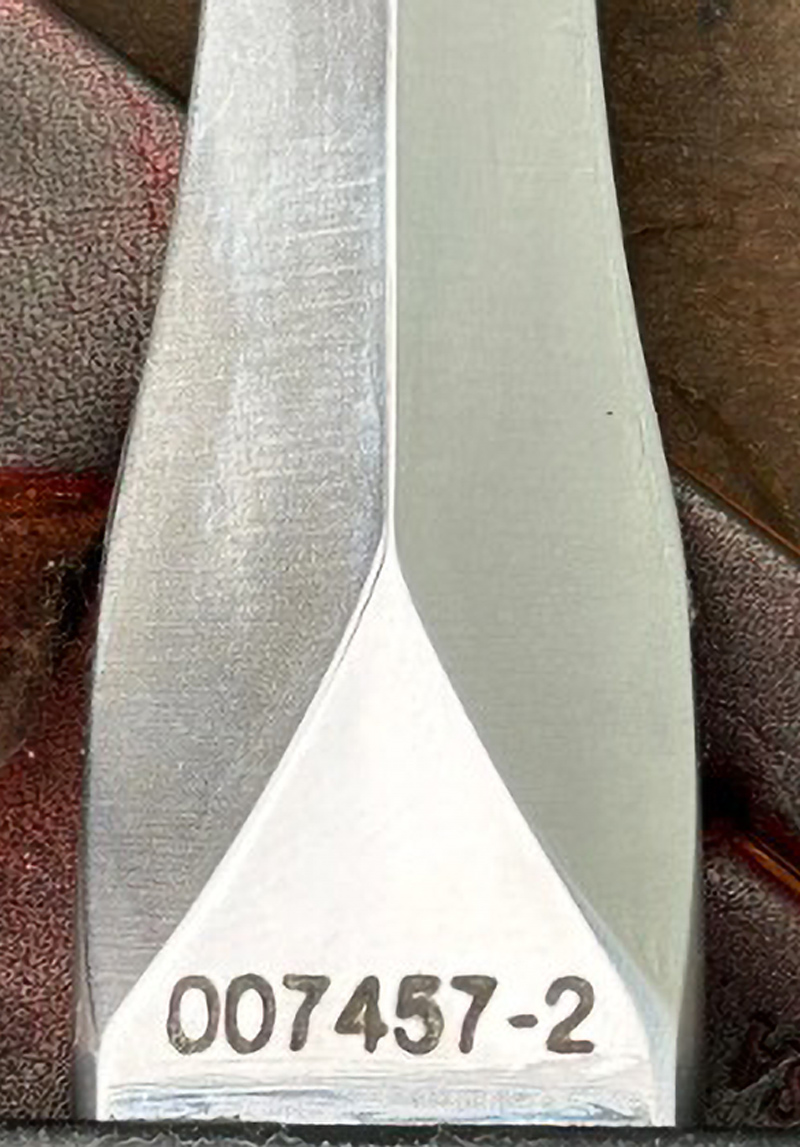
The knife’s original serial number is 007457 (at left). The #2 reflects this being a version of Shriver’s knife as created by master bladesmith Greg Covington, who offers replica and special order knives to ,among others, the Special Operations Association (SOA) at our annual reunion in Las Vegas (SOAR).
Aftermath – The Legend, the Myth, the Man
Some say Jerry Shriver survived the slaughter that day and simply made his way to safety and remained, quietly, in SE Asia. After all, he’d run 93 SOG missions, a record no one else came close to. If anyone could do it, they offer, it was “Mad Dog.”
The evidence to date and many of Shriver’s SOG brothers firmly believe he was wounded and then killed while attempting to flank an NVA machine gun position that was killing his platoon and friends.
DPAA, as noted, is determined not to leave “Mad Dog” Shriver behind if there is any chance of his being found, identified, and repatriated home.
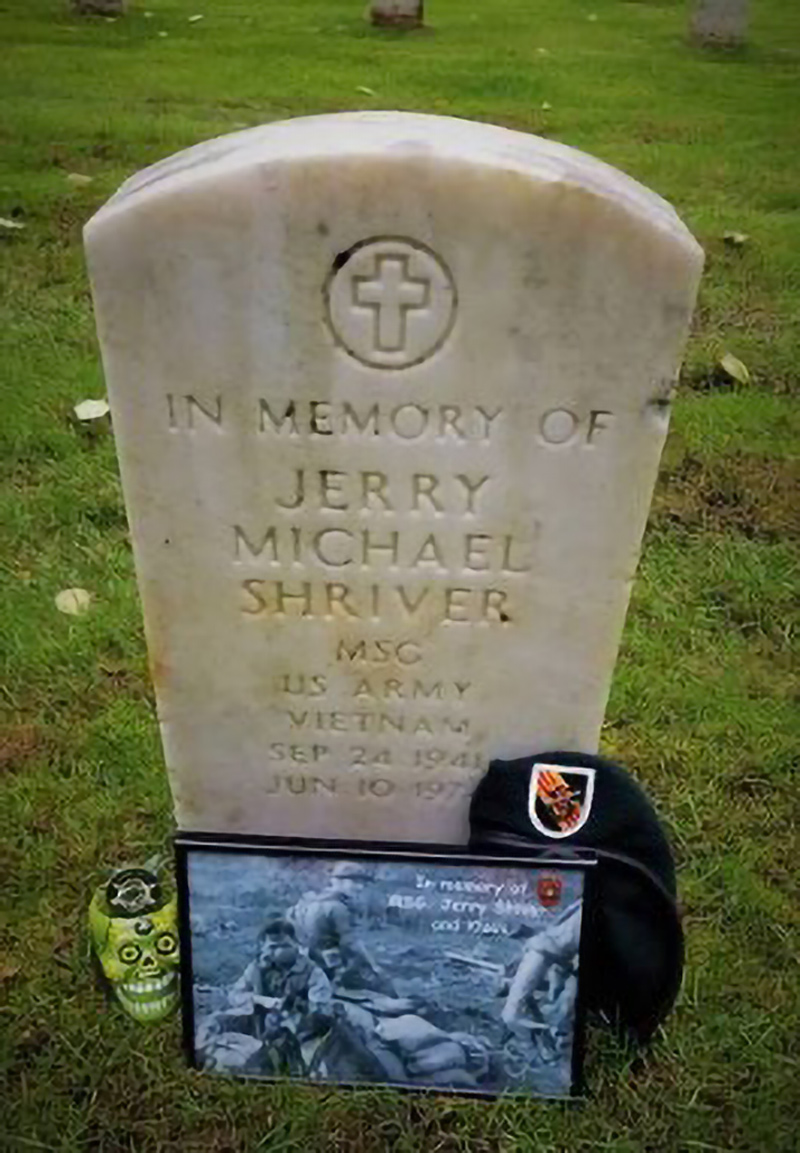
In 1974, the then Secretary of the Army gave Shriver a ‘Presumptive Finding of Death even though his remains have yet to be found. He was posthumously awarded a second Silver Star and promoted to Master Sergeant. His marker is present at the Fort Lawton Military Cemetery outside of Seattle, Washington. Upon visiting now some years ago the author paid his respects by leaving several items in Shriver’s memory. (Credit: Author)
DPAA in Active Pursuit
In recent communications with DPAA, it was learned the one expedition to Cambodia for 2025 was specifically to act on new information regarding Jerry Shriver and his possible remains. This information came from a former NVA soldier who’d fought in the battle and is today living in Hanoi. DPAA interviewed him, and it is his recollections they used to execute the return to the battlefield. According to Mr. Sean Everette, team lead for DPAA’s Media Relations section, “It’s too soon to say if the 2025 Cambodia mission will lead to any identifications. Anything that was found was accessioned into our lab, and our scientists are still going over everything. We don’t speak publicly on exactly what was found, as we don’t want to get families’ hopes up.”
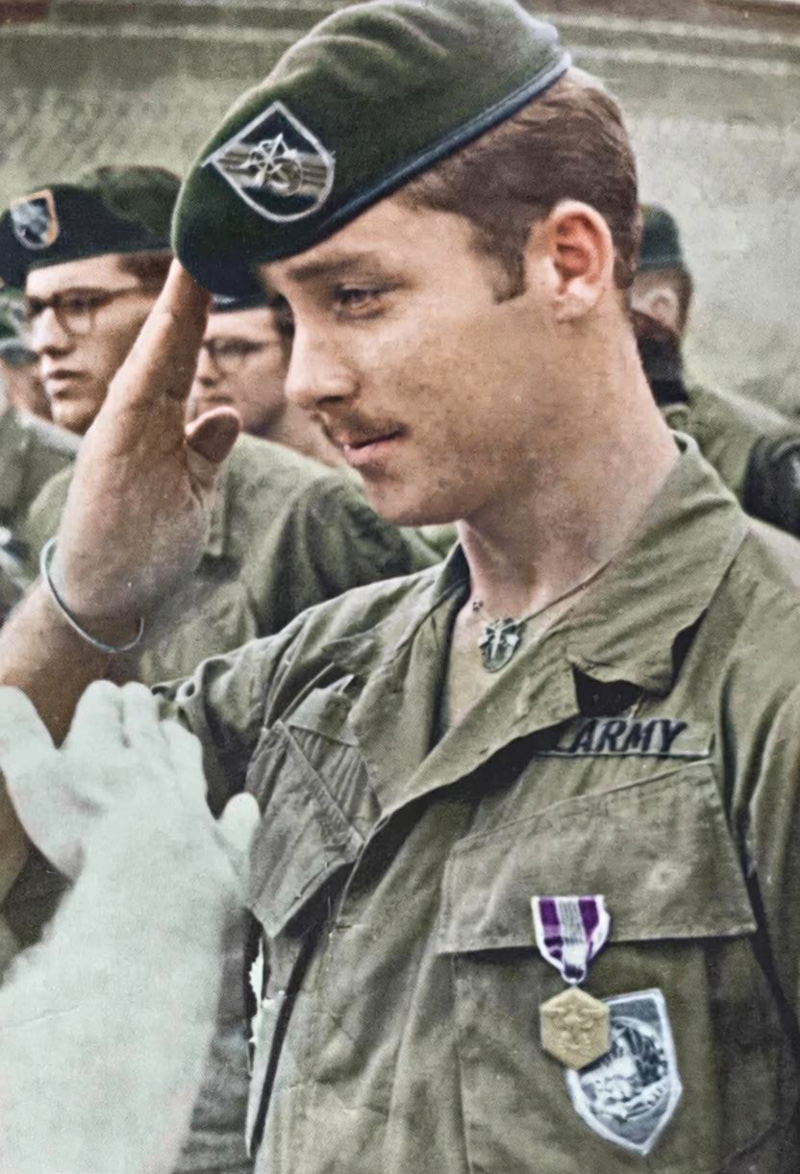
Sergeant William W. Stubbs, 1-1, RT California, CCC
Before the expedition launched, I’d put Jerry Shriver’s biographer, Gordon Denniston, in touch with DPAA. Mr. Denniston had shared with me he had map coordinate imagery that might better illustrate where Shriver may have entered the woodline after having been wounded. DPAA contacted Denniston and collected this information. “I know that our Vietnam War analysts received information from Gordon Denniston,” Mr. Everette confirmed with me. “But I don’t know that it has led to anything we didn’t already know.”
According to DPAA, both Shriver and Sgt. William “Bill” W. Stubbs remain in the Active Pursuit category at DPAA. Sgt. Stubbs, shown here receiving an award at CCC, was the One-One of RT California. He was killed on October 20, 1969, while on a mission in Laos (target area Sierra 7). He is still listed as missing in action because his body was never recovered or accounted for by the North Vietnamese.
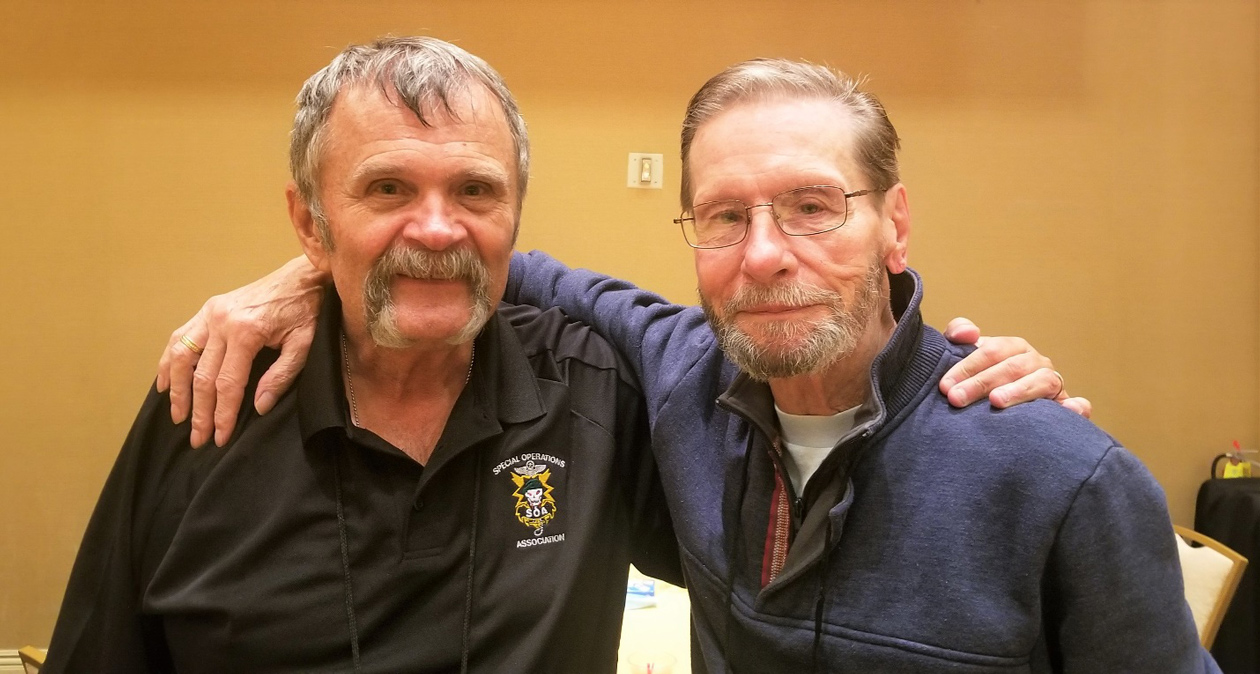
The author with former One-Zero Dave Maurer (r) at a past SOAR reunion. Maurer’s book The Dying Place is one of the finest accounts of serving with SOG/CCN published to date. (Credit: Author)
About the Author
Mr. Walker is a retired Special Forces soldier (1980–2005) with service in El Salvador and Iraq. His military awards and decorations include the Legion of Merit, the Combat Infantryman Badge (X2), the Special Forces Tab, and the Order of Saint Maurice. From 2009–2013, Greg served as a case manager and patient advocate with the U.S. SOCOM Care Coalition for our most seriously injured, wounded, or ill and their families.
Greg is a much published military historian on Special Forces and U.S. SOF. His work includes At the Hurricane’s Eye: U.S. Special Operations Forces from Vietnam to Desert Storm, SEAL with LCDR Michael Walsh, and Teammates: SEALs at War with Chief Gunner’s Mate Barry Enoch. Mr. Walker is a frequent contributor to the Sentinel, SFA Chapter 78’s award-winning monthly news publication.
In 2026, Mr. Walker is completing the family authorized biography of Michael D. Echanis, a Special Forces/Ranger legend and world class martial artist, a project that has taken sixteen years to fully research and document.
Greg lives and writes from his home in Sisters, Oregon, along with his service pup, Jasper. He is a Life Member of the SOA and SFA Associations.
[…] dead in 1974.“Shriver and the men I served with were professionals doing professional jobs,” retired Col. Bob Killibrew said. “… There’s no question that Jerry went down fighting. It’s my belief that the [North […]