Catholic Priest Tended To His Flocks In Laos While War Raged
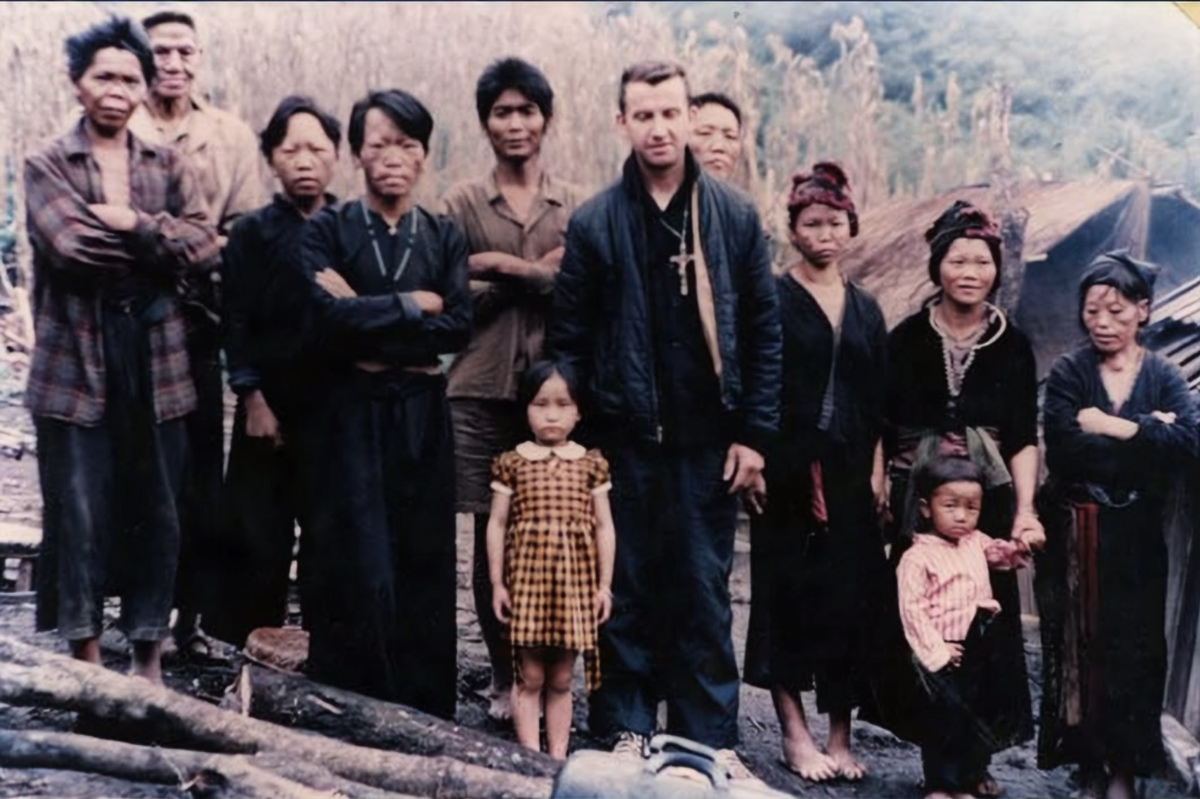
Father Lucien Bouchard, of the Oblates of Mary Immaculate, with Hmong hill tribes’ people in Laos. (Photo courtesy of the Museum of the US Air Force; Public Domain)
By Marc Phillip Yablonka
Father Lucien Bouchard’s calling was not a political one, yet politics—and war—were constantly in his path.
Father Bouchard is a legend to practically anyone who was in Laos during the years of the secret war. From the lowland Lao and Hmong hill tribes to CIA, USAID (United States Agency for International Development), and Air America personnel, everybody knew “Father B.” They ought to have. He was in Laos from 1956 until it fell to the communists in 1975.
Father’s goal was to give Mass and instruct the locals in the tenets of Catholicism in as much of the country as it was safe to travel. That included two years between 1958 and 1960, when he sought to baptize and teach as many who chose to attend the Central Mission in Sam Neua.
Very often, Father B, who speaks fluent French, Lao, Hmong, in addition to English, found himself working outside the boundaries of what one would think would fit the job description for a Catholic priest.
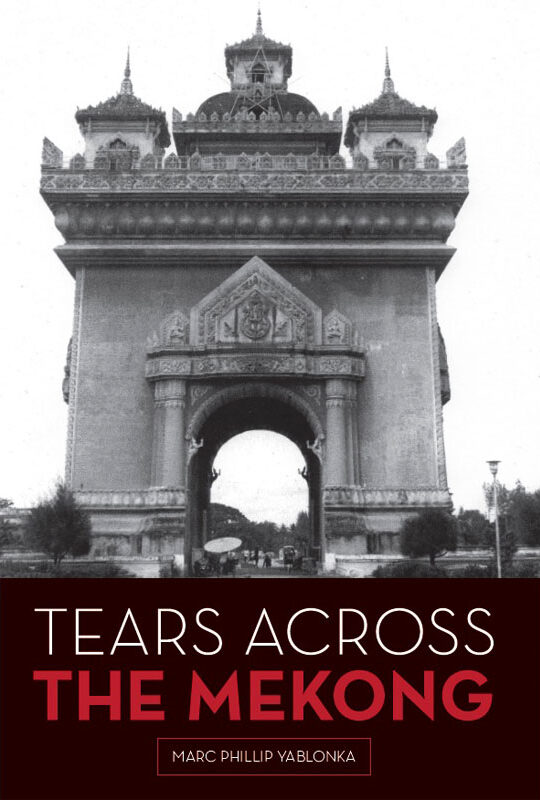
“In 1957, ten villagers from the mountains came to me because there were no doctors around, and they’d had problems having their teeth pulled. I was afraid they might hemorrhage. I had Novocain from the hospital in Luang Prabang,” he told me in 2016 when I interviewed him for my book Tears Across the Mekong.
He used it on the villagers and they survived the ordeal. Another ordeal involved a villager who needed to give his horse a shot of penicillin but was afraid the animal would kick him. So, Father B was enlisted.
“I tried to help them as much as I could,” he said at the time.
That help also extended to the two leper colonies the Massachusetts native helped to set up with the assistance of another Laos legend whom everyone knew and revered: Edgar “Pop” Buell, a Steubenville, Indiana, farmer who worked for the International Voluntary Services, a Peace Corps-like agency that had offered him a job as agricultural adviser for Laos after his wife passed away in 1958.
Pop applied the farming skills he used on his Indiana farm and organized relief aid to villagers before being forced to flee Laos when it fell to communism in May, 1975. Pop’s extrication from Laos as the communist forces drew nearer reads like a movie script.
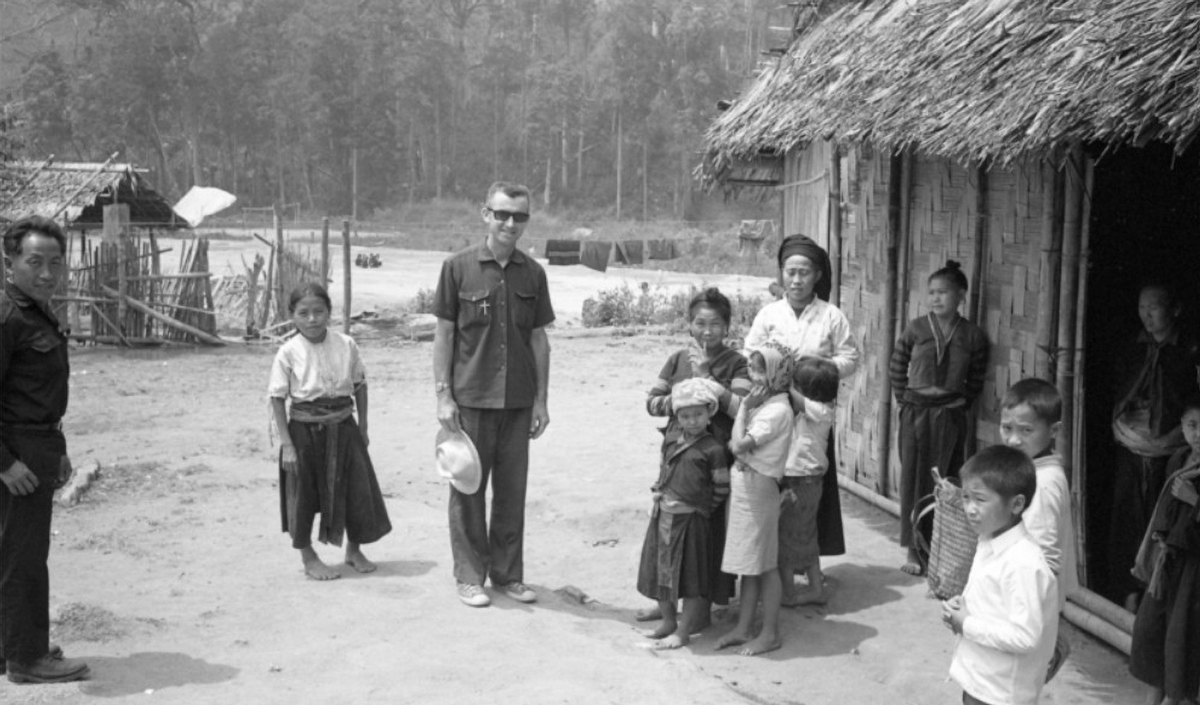
Father Lucien Bouchard, of the Oblates of Mary Immaculate, with Hmong villagers in Phu He, Laos in 1971. (Photo courtesy Galen Beery Collection via Hmongstory Legacy, Fresno State University)
The U.S. Embassy in Laos learned that Pop was on a joint North Vietnamese Army/Pathet Lao hit list during the time they were beginning to overtake Laos. CASI (Continental Air Systems, Inc.) pilot Lee Strouse dressed Pop up as a pilot, took him to the airport in Vientiane, and flew him to Bangkok, where he lived until he died in 1980.
“Pop used to help giving me pots and pans. He helped with the rice drops that the Air America Helio Courier kickers carried out,” Father B said, remembering that, very often, Pop would ask him to help with much needed mosquito nets in the villages.
Thoughts of Pop drift away and are replaced by thoughts of the lepers in Laos.
“I felt bad for the lepers as individuals. They had to live by themselves a quarter mile from the village. Their relatives would bring them rice.”
Whenever Father B would tend to the lepers, it was a three-hour walk not without peril. They were close to Pathet Lao strongholds, which meant that some lepers’ family members did not want to risk bringing food and needed medicines to their relatives living there.
In one case, Father B took medicines to one of the lepers for six months straight. Others would only travel to the lepers at night.
“They never felt very secure,” said Father B, “because the Pathet Lao would come to visit their own families in [nearby] villages at night. People visiting their relatives in the leper colonies hoped to get there when there were no Pathet Lao around.”
On one such occasion, Father B’s life was in danger when, though previously warned by three women with leprosy, the Pathet Lao had stalked him as he walked along the trail to the leper village. On that occasion, they were by his side when the Pathet Lao surprised them along the trail.
All at once, the women shouted to the cadres, “Don’t shoot him. He’s a priest!” Their exclamation was apparently enough to dissuade the Pathet Lao from taking his and their lives, and the cadres marched off into the jungle.
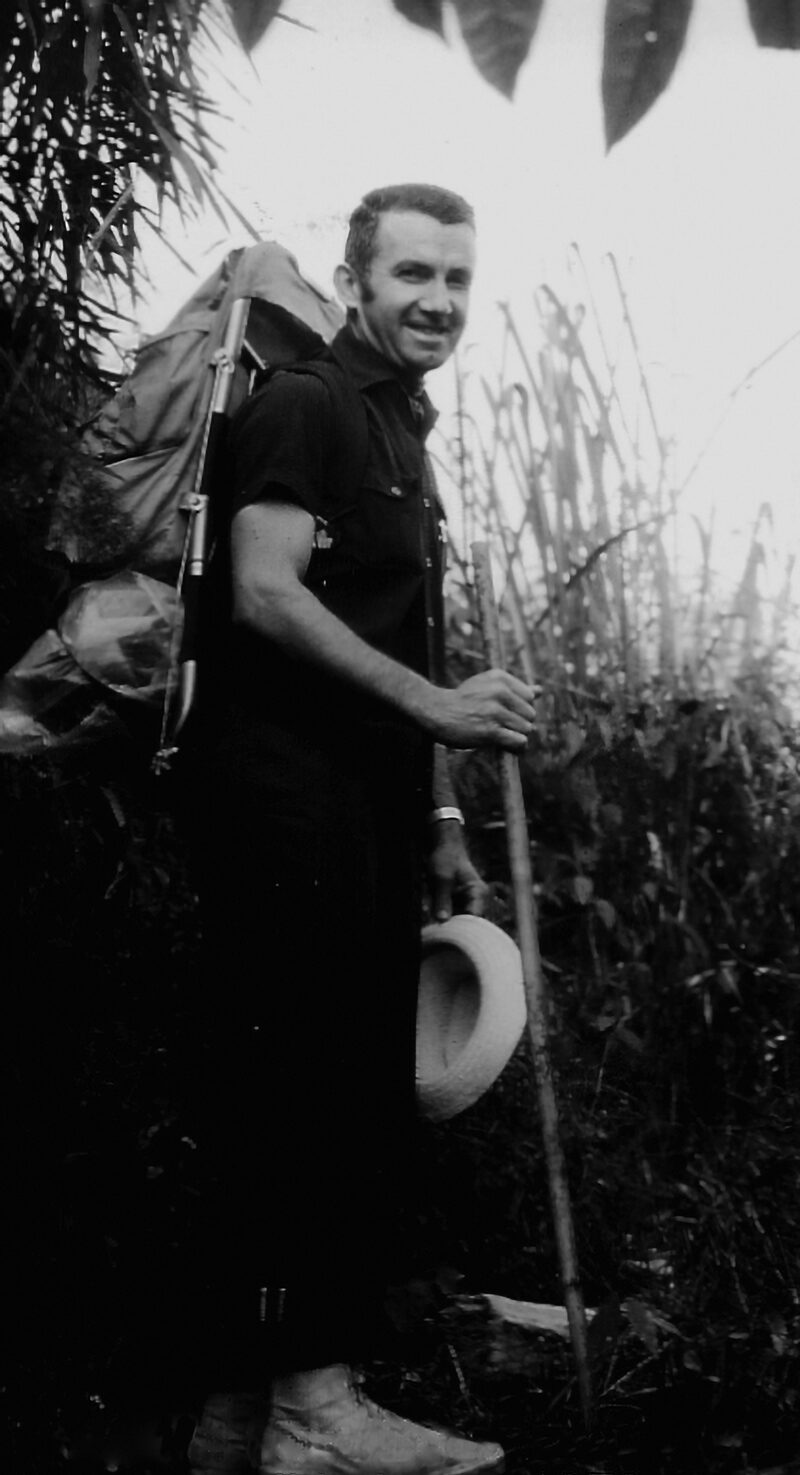
Father Lucien Bouchard, of the Oblates of Mary Immaculate on a trail in Laos in 1973. (Photo by Steve Schofield)
Even in the middle of a war zone, Father Bouchard was not then and is not today above looking at the bright side of life in the leper colonies.
“Some were married and were quite happy,” he recalled.
Though a Catholic priest, Father Bouchard admits that most of the people he helped practiced Buddhism, the main religion in Laos. But his help had nothing to do with attempting to bring them to the Catholic faith.
“I would visit the hospitals at Long Tieng (headquarters of the CIA), and the hospitals for wounded soldiers. Some of the patients were Hmong, some were Khmu Lao, some were animists, and some were Christians. It made no difference to me. I would visit everyone.”
And though he was not a trained physician, he would help distribute medicines in the villages he received from Dr. Charles Weldon, who along with the Doctor’s first wife, Dr. Patricia McCreedy, were physicians in Laos employed by USAID, or from USAID medic and former Vietnam Green Beret Steve Schofield.
Father B would then help the sick and have a Sunday prayer meeting for whoever wanted to attend.
Life was pretty much cyclical for Father B. When he was up at Sam Thong, an encampment for the Hmong SGUs (Special Guerilla Units) under the command of Hmong Royal Lao Army Gen. Vang Pao, he and Pop Buell would be flown by Air America into various villages and take care of whatever needs they could.
Air America would then fly them back to Vientiane to obtain more medicine from Dr. Weldon. They’d sneak in a Mass in Laos’s capital city, and then be flown back to Sam Thong to do it all over again.
During one such stopover in Sam Neua, things quickly went from routine to extremely dangerous.
“I was painting the doors of the nuns’ convent when the Pathet Lao started attacking Sam Neua near the main mission there. On the last day of the siege, the Pathet Lao got hold of a mountain overlooking the city. They shelled it with mortars. I had to get out.”
Father B left at noon that day along with doctors from an organization based in the Philippines called Operation Brotherhood, who had a Jeep, so they were able to make a fast getaway.
However, Father B and a group of 13 Christians equipped only with blankets and rice in their backpacks walked all the way to Xieng Khouang, all the while being pursued by the Pathet Lao.
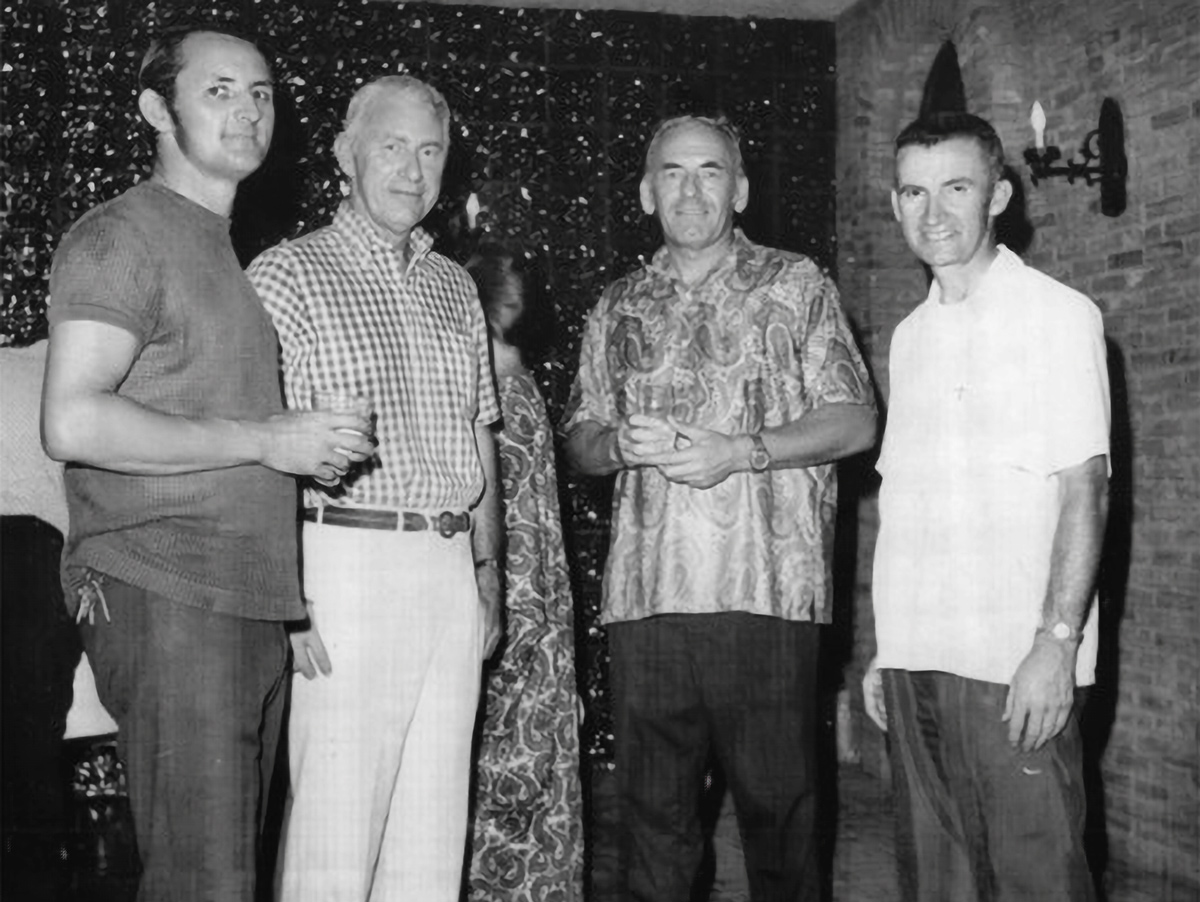
The late International Voluntary Services and USAID volunteer Larry Woodson with (then) US Ambassador to Laos Charles Whitehouse, Bill Gill, and Father Lucien Bouchard, of the Oblates of Marry Immaculate, at a US Embassy Party sometime between September 1973 and April 1975. (Photo courtesy Larry Woodson)
Along the way, Father B and his entourage encountered some Filipino doctors who were encamped in a village helping locals take care of health problems.
“Some people told us that the enemy was ahead of them and coming toward us. When the Filipino doctors heard that, they turned around and began going back from where they had come and, unfortunately, fell into Pathet Lao hands.”
The priest lamented, “I had told them it was best to keep on going, that when we got closer to Xieng Khouang, we would hide.”
Sadly, Father never heard what happened to the doctors, but he will never forget the fact that after he and his entourage left them, they walked for six long days and nights until reaching Xieng Khouang.
“It was a close shave, but I’m still free from the Pathet Lao,” he said happily.
Visiting those remote outposts and SGU bases was part of Father B’s work for 14 years. He always had to be prepared for his liturgical work by night and attacks from the Pathet Lao by day, which is why he made it a practice to never say Mass in the mornings.
For his own “comfort,” his living quarters more often than not were a small four-foot-high lean-to in which he would often bivouac atop a mountain. Under it, he would dig a hole in the earth one foot deep and settle in as best he could for the night with the jungle and all that it conjured up surrounding him.
In between his hundreds of trips into the bush to minister to the health and religious needs of lowland Christians, Lao Thung and Hmong tribespeople, Father B would be invited back to Vientiane where he was afforded the chance to study the Lao language and to teach math and geography in addition to religion.
Then he would be right back where he started having to seek permission from the authorities at the American Embassy in Laos’ capital city to go to the villages again.
“Things were falling apart. I went to visit the bishop, who had previously taken stock of the villages and the safety factor in reaching them. The bishop had visited the SGU strongholds in Sam Thong and Long Tieng and determined that things were very dangerous,” Father B remembered.
“By this time, half of the city of Vientiane had been taken over by the Pathet Lao. I went to Steve Schofield’s house, and we talked until 11:30. Steve felt that it was too dangerous for me to leave his house or even to be driven the six kilometers to where I was staying. We would have been ambushed.”
So, Father stayed overnight with Steve, and the very next day, on May 8th, 1975, got a visa to leave Laos as whatever vestige of freedom that remained in country was crumbling all around him.
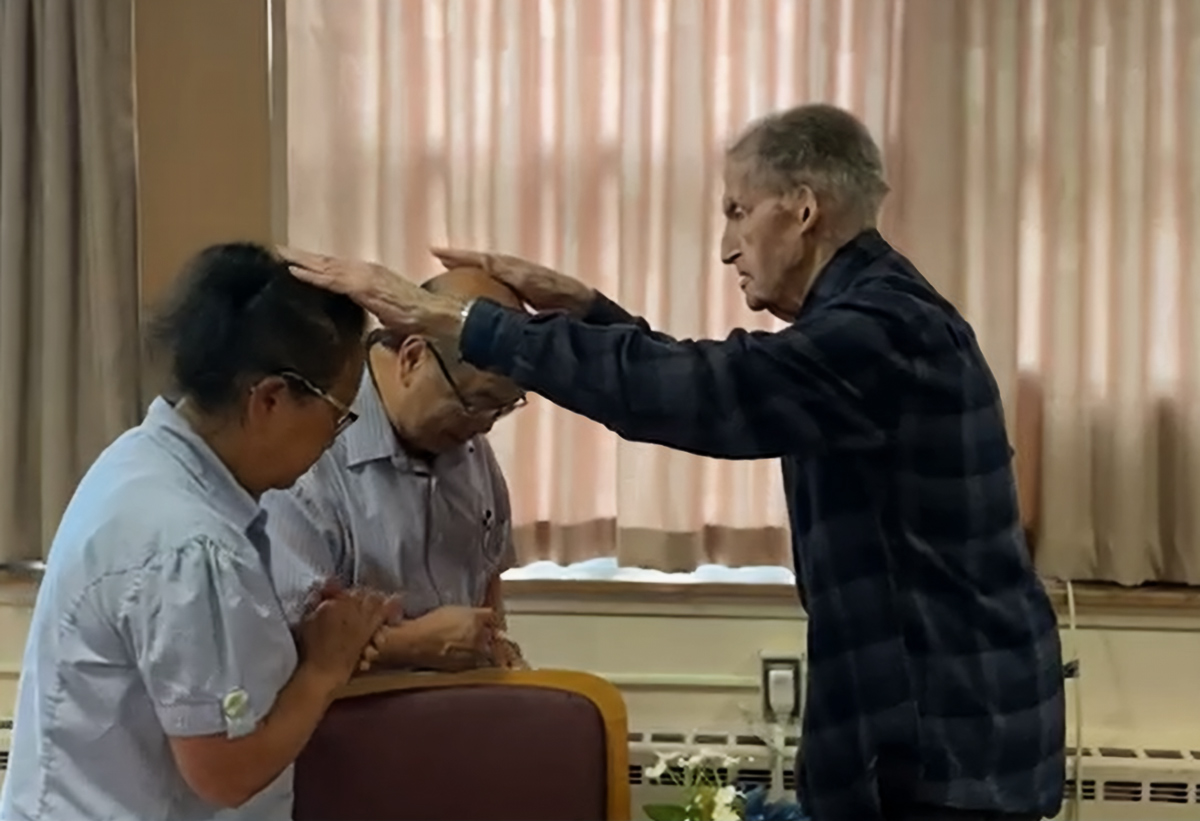
Father Lucien Bouchard, at the retirement home of the Oblates of Mary Immaculate in Tewksbury, Mass., blessing Xia Vue Yang, co-founder of the Lao, Hmong, American Veterans Association of Sheboygan, Wisc., and his wife Pa Vang Yang. (Photo courtesy Xia Vue Yang)
He crossed the Mekong River by boat and pulled up at Nong Khai, Thailand. God’s providence must have been shining down on Father B that day because, right after he left, he later learned from fellow priests, two Pathet Lao cadres came looking for him and, undoubtedly, would have carted him away to years of servitude in one of the notorious communist re-education camps known in Laos as the “Seminar.”
As Father said, it was a close shave, but today he is still free from the Pathet Lao. Among many other liturgical opportunities throughout his life, that freedom meant that he could deliver the Mass in French to Haitian refugees at Christ the King Catholic Church in Perrine, Florida from 2005 to 2013.
As for Father Bouchard’s future, the soon-to-be 97-year-old Catholic priest, now a resident of the Oblate Retirement Home in Tewksbury, Mass., he told me in 2016, “I’ll leave things in God’s hands. If He wants me to keep ministering, or wants to call me to Him, that’s okay, too.”
ABOUT THE AUTHOR
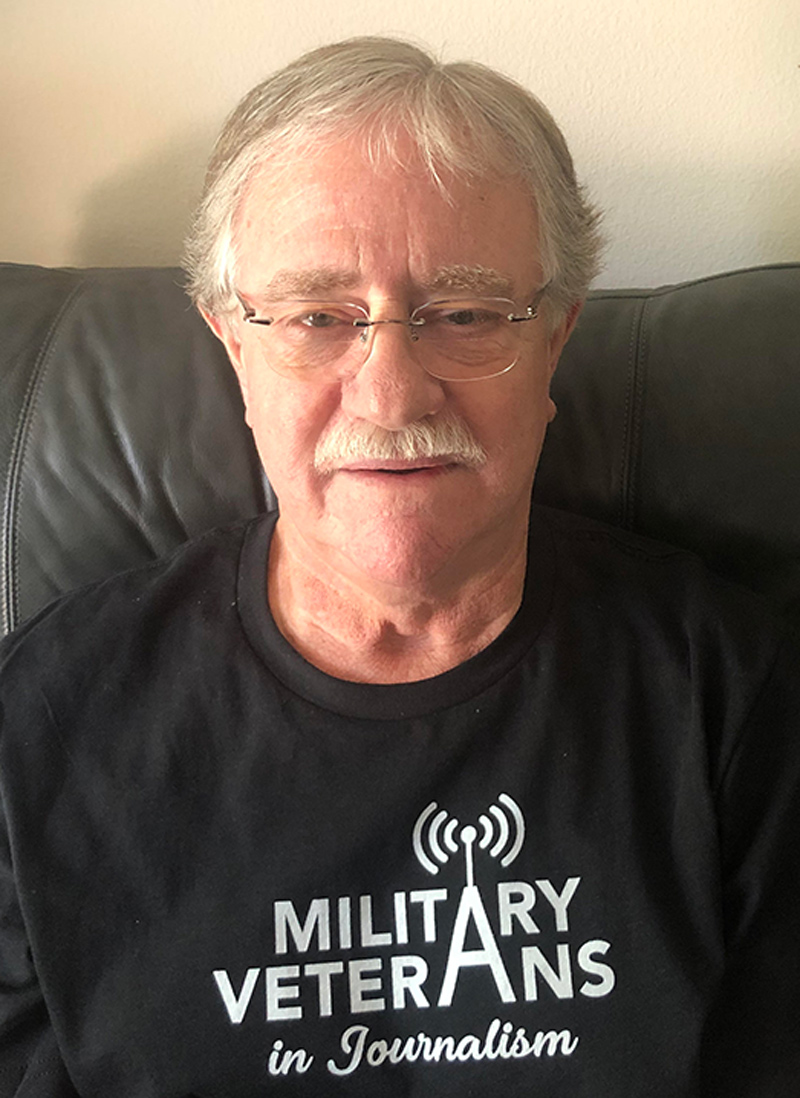
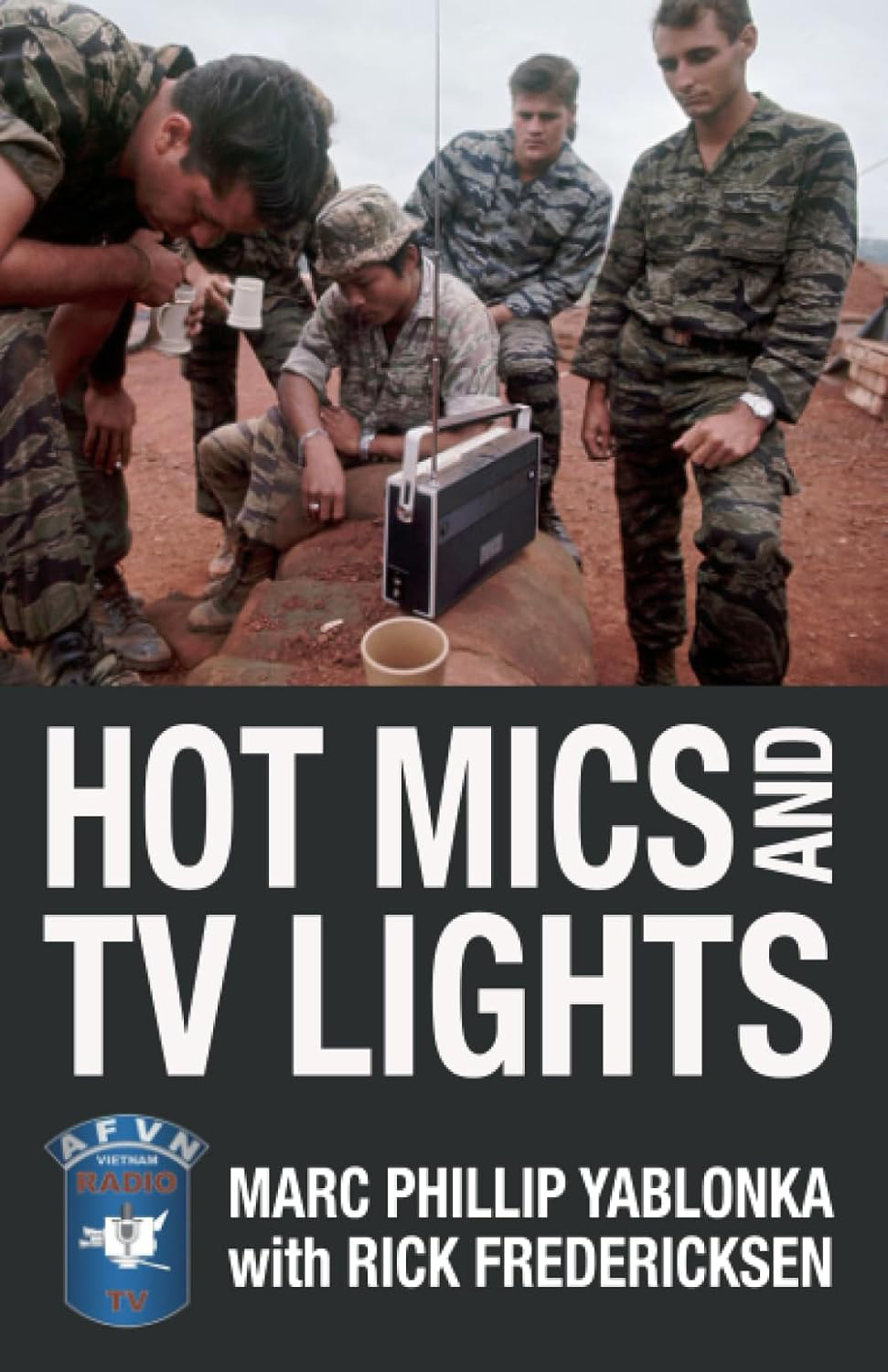
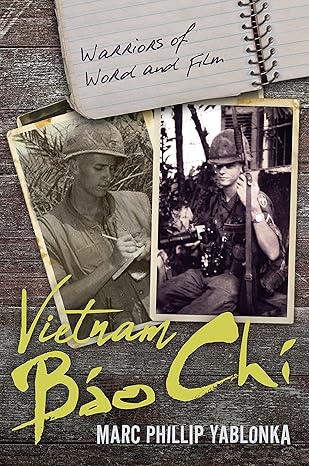
Marc Yablonka is a Burbank, Calif.-based military journalist and author whose reportage has run in the US Military newspaper the Stars and Stripes, Army Times, Vietnam magazine, and many other publications. In addition to being a contributing writer for the Sentinel, he is also the senior reporter for the Sacramento-based Hmong Daily News. He has written four books on the Vietnam War, the most recent of which are Vietnam Bao Chi: Warriors of Word and Film, about combat correspondents and photographers who served in the US Military during that war, Hot Mics and TV Lights: The American Forces Vietnam Network, Tears Across the Mekong, and Distant War Recollections of Vietnam, Laos, and Cambodia.
Leave A Comment