“Another died in my place.”
Part 1
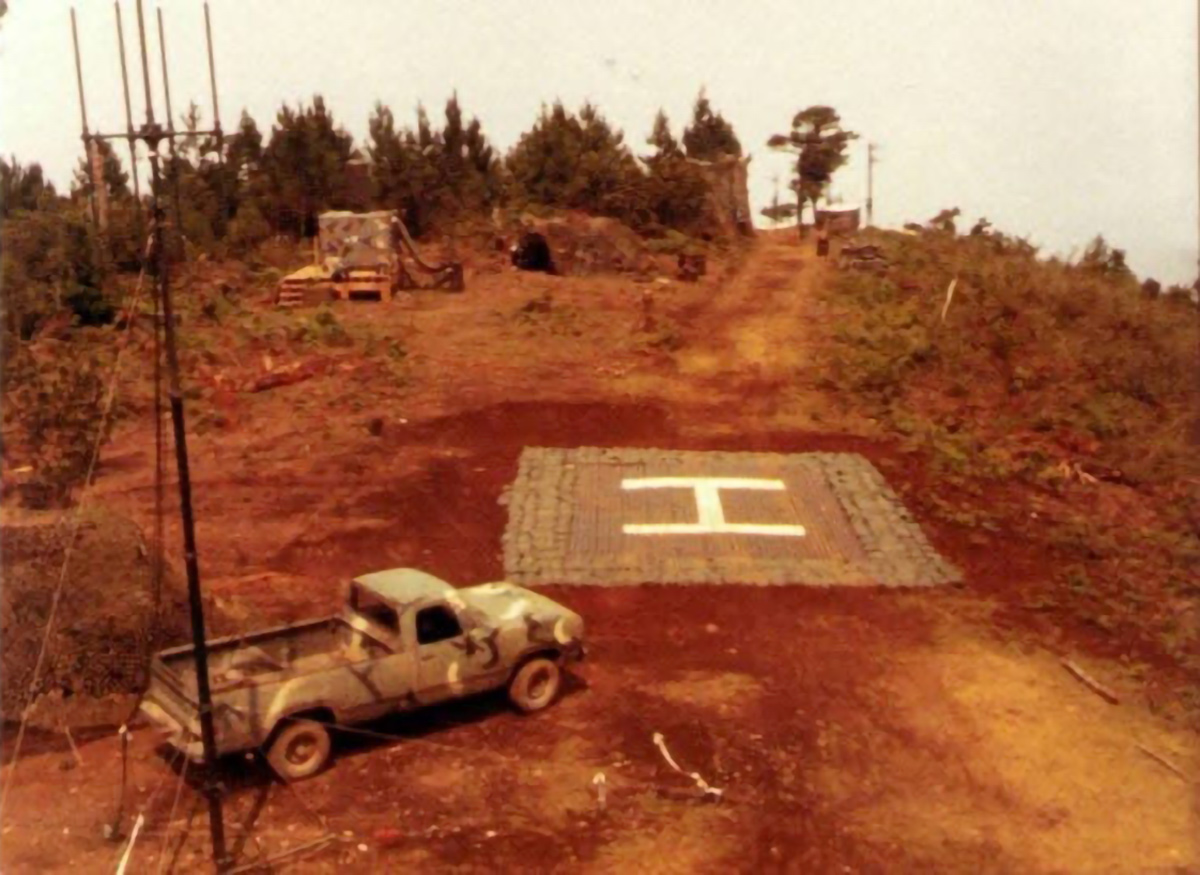
The helipad at the TACAN radar / communications intercept site. (Credit: AFEM for Honduras FB page)
By Greg Walker (U.S. Army Special Forces, Ret.)
Note: Click here to read part 1
Introduction
In the early evening hours of May 13, 1991, a MEDEVAC mission was requested by personnel at the U.S. TACAN radar and communications intercept site atop Cerro la Mole in Honduras. The patient was reported to have a presumed serious but not life-threatening medical issue with descriptions ranging from a back injury, an abdominal condition, or a ruptured hernia. By Joint Task Force – Bravo and the 4/228th Standard Operating Procedures (SOPs) no nighttime aerial MEDEVAC was to take place unless the injury or wound was life-threatening or threatening to loss of vision or a limb. Per the Warrior Operations CQ log for this incident, the request from TACAN was framed as being appreciated (or better put as a favor) if approved. This is because a ground evacuation would take upwards of three hours as opposed to a short flight.
Final authorization for any MEDEVAC request lay with the 4/228th Aviation Battalion commander or his representative should he not be available. On May 13th, with the battalion commander on mid-tour leave, the approving authority was the battalion’s executive officer (XO).
The first attempt authorized by the XO took place in the early evening hours and was flown VFR as the copilot, 1LT Vicki Boyd, was out of NVG currency due to poor flying weather in mid-April/early May. Because of this and by regulations no other member of the flight crew could have NVGs onboard or in use. The pilot, CPT (P) Sashai Dawn, chose to abort the mission after roughly twenty minutes as poor weather and an intense cloud cover of between 3500 to 5000 feet obscured the top of Cerro La Mole/TACAN which sits at 6, 447 feet.
Upon her return to Soto Cano, just 9.5 miles straight line distance from TACAN, the XO and other key staff concurred with her decision and a ground transport began to be arranged. Dawn and her crew (1LT Boyd, copilot, SSGT Linda Simonds, flight medic, and SPC4 William “Buddy” Jarrell, crew chief) were released for the night and returned to their quarters.
Per the official crash report not long afterward the 4/228th XO in concert with JTF-BRAVO initiated what would become a second and fatal MEDEVAC if the weather improved enough for the crew to do the mission. Buddy Jarrell today recalls and stated in the accident report his disbelief when the crew was recalled for a second attempt. Jarrell noted he could not see the lights from the TACAN site from his hootch at Soto Cano. The air traffic controller, in his interview, offered the weather was poor and below safe flying conditions for the first attempt. He, too, could not understand why the 4/228th XO was pushing for a second attempt even as ground evacuation was being authorized at JTF-BRAVO. The tower at TACAN stated in the official record that Warrior Operations was contacting them every ten to twenty minutes after the first aborted attempt and asking for weather updates. TACAN Tower reported ground fog and fifty’ visibility until the last communication with Warrior Communications when they offered the ceiling was now at 1500 feet with three miles visibility.
Overlooked or ignored by the 4/228th XO when he was so advised was this. TACAN Tower was at nearly 6500 feet elevation. The tower personnel could not see what the weather was below the installation and its landing pad. In short, TACAN Tower could not accurately inform Warrior Communications or the 4/228th acting commander of what the weather was at 5000, 4000, or even three thousand feet below their line of sight.
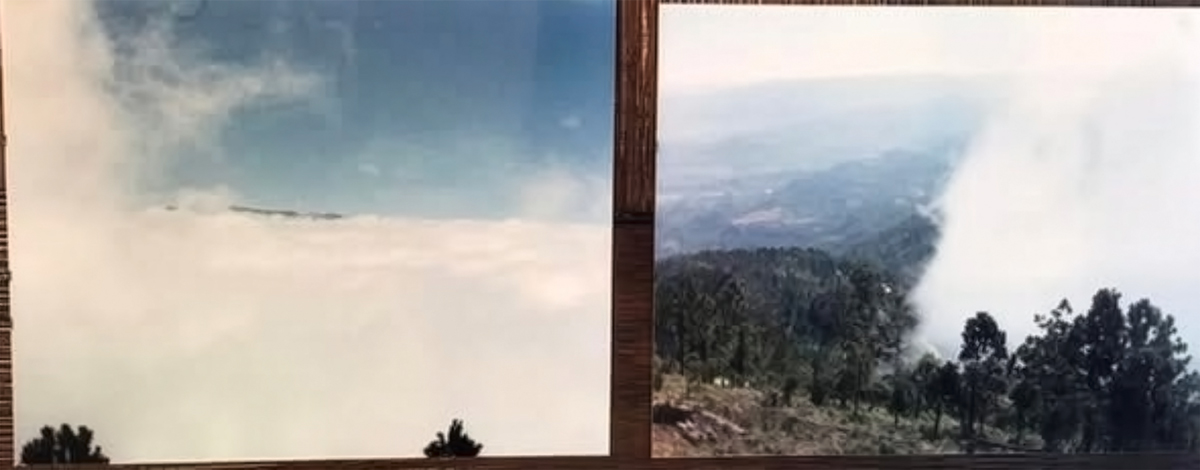
Images of the weather challenges to include cloud cover below the line of sight at TACAN. As CPT Dawn could not see the site’s lights from Soto Cano she relied on her knowledge of cloud cover obstructing a line of sight second attempt, choosing to attempt to come up a long valley to the south which offered a road from La Paz to TACAN. Although the accident report reflects the Warrior Operations Center and Soto Cano tower noting the deviation, no one in authority questioned the pilot or directed her to return to Soto Cano in the knowledge they were not NVG capable. (Credit: AFEM for Honduras Facebook page)
By this time illumination from the moon that night was at 1% and TACAN, in specific, was by SOP not to be flown to or from unless night vision capability was in use by the flight crew. This was especially true if an aircraft was attempting to reach TACAN from the southern rugged, mountainous valley outside of La Paz, Honduras. When CPT Dawn arrived with her crew for the second attempt she informed the 4/228th XO that her co-pilot was out of NVG currency. She also informed him, again, that emergency check light had come on during her return from the first attempt and another helicopter would need to be provided.
The XO offered he would have one of his NVG current pilots fly in 1LT Boyd’s place and they could use a UH-1H Quick Reaction Force aircraft from the 4/228th. After private discussion between the two CPT Dawn agreed to make the second attempt but using her original crew and flying VFR as they could not even have NVGs onboard per regulation.
The XO, contrary to his unit’s SOP and Army Aviation regulations, authorized her to make the flight under those circumstances.
By doing so he essentially issued the crew a death sentence as the 4/228th’s own SOPs for MEDEVAC and Army aviation regulations were clear – no such mission was or could be flown under the weather conditions, crew currency shortcomings, and as “a favor” where the reported injured/ill soldier at TACAN was concerned.
By regulation and per the official accident report CPT Dawn as the pilot in command (PIC) could have and should have rejected the second mission. The PIC has the authority to do just this and the Accident Board assigned responsibility for the crash to her. Offering the reason was that she was distracted between flying the aircraft and attempting to assist 1LT Boyd with navigation as they traveled up the southern valley toward Cerro la Mole/TACAN.
A cursory caution is noted in the report stating aspects of the 4/228th MEDEVAC SOP were not followed (no names or ranks/positions given) and this inattention should be corrected regarding future operations.
Nearly six months of investigation, a dozen reviews of the crash report, photos of the crash site provided other than the few in the official report, and multiple communication and interviews with the sole survivor of the crash and the 571st Medical Company (Air Ambulance) co-located with the 126th Medical Company (Air Ambulance), CPT Dawn’s unit, revealed the following. The official report is rife with inaccurate, selective interviews conducted by the accident team, subjective opinions of CPT Dawn as a person and a National Guard aviator, and clearly slanted to exonerate the 4/228th’s executive officer of any command responsibility or command pressure for the second and fatal MEDEVAC attempt.
However, it was learned from then 571st flight medic Ken Kik, who was an eye-witness to that evening’s events as they unfolded and who indeed joined the four-man JSOC/7th Special Forces Group QRF that finally located, secured, and identified the deceased as well as the sole survivor, a Collateral Board was held as the crash was a Class A event (fatalities). Kik was interviewed by that board and recounted what he had already shared with the Fort Rucker accident investigation team.
The 4/228th’s executive officer was ultimately relieved of his command. As Major General (ret) Kenneth R. Bowra (https://gsof.org/kenneth-bowra-bio/) told the author in part — “Once the XO decided to launch a second attempt, although the wrong decision due to weather conditions, he now went down the slippery slope of high risk by pushing the pilot to fly the mission. Pressuring the pilot in command was yet again unprofessional and poor leadership. Once he was aware the co-pilot was not NVG qualified, another qualified crew should have been used if he persisted to order the mission.
“Again, still would have been wrong to launch. By approving a non-qualified crew, the XO made a fatal decision which was also a violation of regulations. Never let enthusiasm overcome capabilities. Never.
“The XO’s actions resulted in the death of those brave Americans who never, ever, should have launched. He should have been severely punished and not only relieved.”
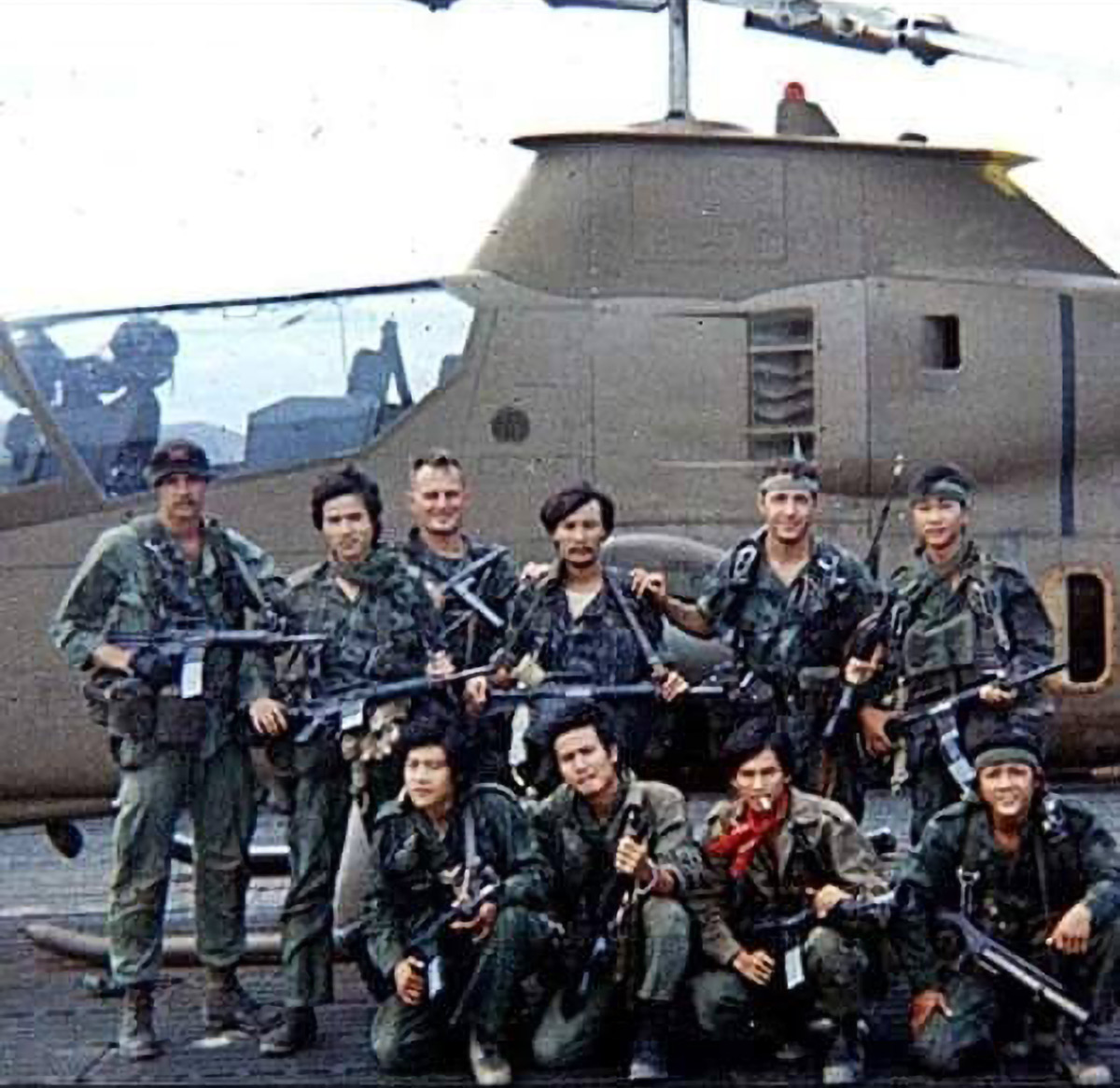
MG (ret.) Ken Bowra (rear, second from right) served with MACV-SOG (CCN) as a One-Zero recon team leader. He is shown here with RT Idaho at CCN. He would later command the 5th Special Forces Group, SOC-SOUTH, and USASFC, as well as a tour with the CIA. GEN Bowra also served in Honduras with a JSOC SMU. The man on his right is Do Ti Quang, Vietnamese team leader, who had served with Lynne M. Black Jr. on October 5, 1968 (https://www.specialforces78.com/9-sog-recon-men-vs-10000-man-nva-division/). Frank Pulley is the tall SF troop on the left. (Credit: MG Bowra Collection)
The crew chief, William “Buddy” Jarrell, an Active-duty Army soldier deployed to Honduras from the 571st at Ft. Carson, and then assigned to the 228th AVN, survived the crash with injuries. This crash marked the first all-female helicopter crew killed since the Vietnam War. “Dawn, Simonds, and Boyd were all deployed with the 126th Medical Company, Air Ambulance (now known as C Company, 1-126th Aviation Regiment, General Support Aviation Battalion) in 1991 to Fort Sam Houston in support of Operation Desert Storm. They were filling in for an active-duty company that deployed to support Operation Desert Shield/Desert Storm. They volunteered and were reassigned to Soto Cano Air Base, near Comayagua, Honduras in mid-April of that year.
Twenty-four days later they were dead.
The following are the interviews this author conducted with Mr. William “Buddy” Jarrell and Mr. Ken Kik. Both remained in Army Aviation after the 1991 crash. Today they are active in the civilian aviation field as respected experts/consultants. Both offer their lives were changed on May 13, 1991, and they continue to honor the sacrifices and memories of CPT Sashai Dawn, 1LT Vickie Boyd, and SSGT Linda Simonds
William “Buddy” Jarrell – crew chief/sole survivor
“I was not scheduled to fly that day but the assigned crew chief was ill so I volunteered to take his place on CPT Dawn’s crew. I knew them and liked them. I was a flight mechanic/crew chief assigned to the 571st out of Fort Carson, Colorado. We were working with the 126th as they had just recently arrived and were trying to get up to speed on MEDEVAC operations in Honduras.
“CPT Dawn aborted the first MEDEVAC attempt to TACAN. The weather and cloud cover below the site was poor. She believed it too dangerous to try to climb any higher with little to no visibility. We had tried flying line of sight to TACAN but the weather once in the area was simply bad.
“When we returned to Soto Cano the crew was released for the night. I was in my quarters when I was notified to return to the flight line. There was going to be another attempt. I did not understand why they would want to do that. Standing outside my hootch I could not see the lights at TACAN at all.
“We had to change helicopters because a warning light had come on in the first bird on our way back to Soto Cano. CPT Dawn met with the 4/228th executive officer (name redacted for the purpose of this story). She told him Lieutenant Boyd’s NVG quals were expired and we would need another helicopter if the mission was to be attempted. The XO offered to replace Vicki with an NVG current pilot from his unit and we could take a UH-1H QRF helo from the 4/228th.
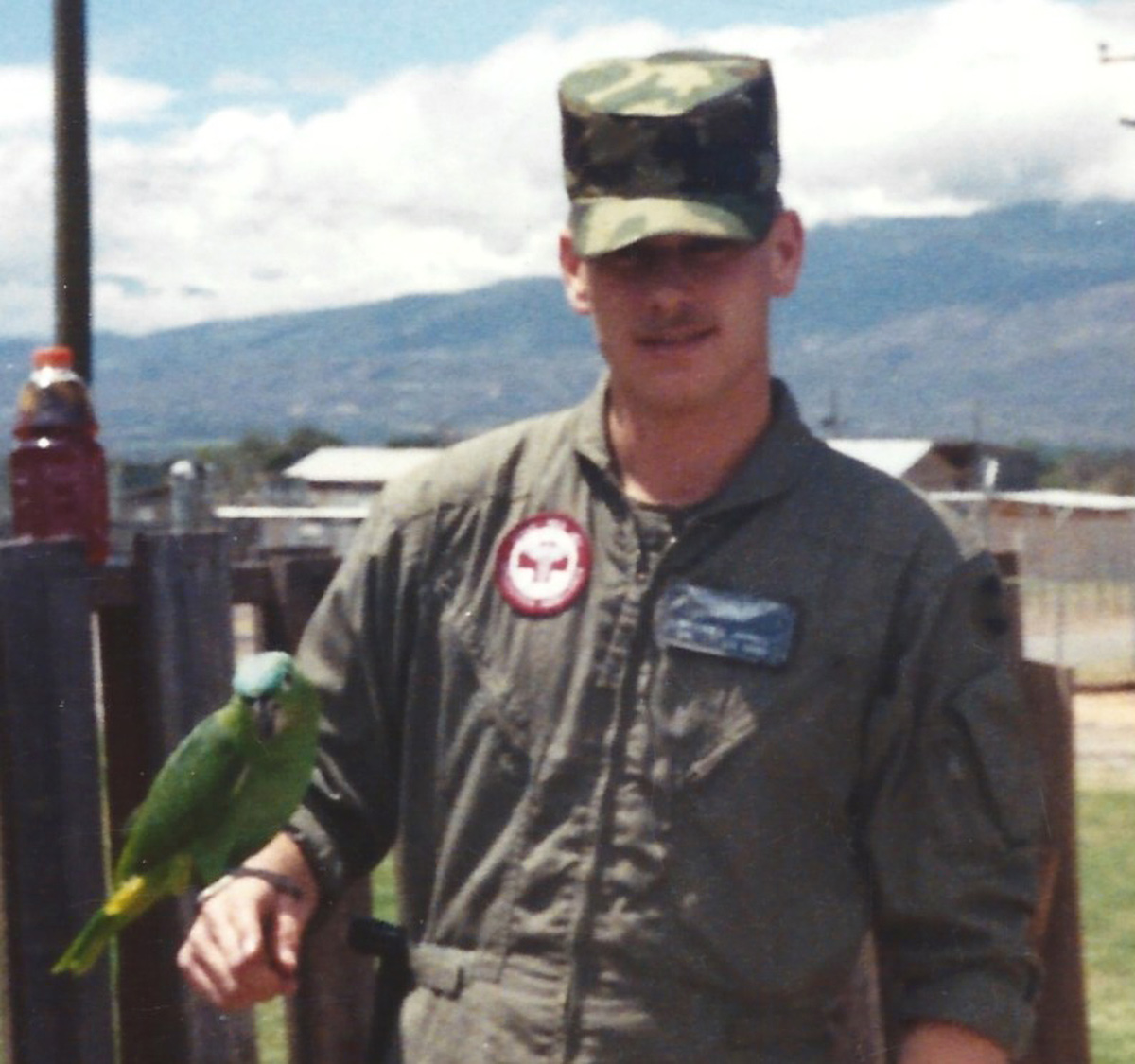
William “Buddy” Jarrell – crew chief / sole survivor
“She said she would rather fly with her own crew and he said “Okay.” We took off and instead of climbing and trying to fly line of sight to TACAN she headed for the town of La Paz, to the south of the mountain [Cerro la Mole). She wanted to use the lights of the town as a guide as there is a small dirt road leading from La Paz up to TACAN. She hoped to find the road and then we would follow it up to the site. The terrain and vegetation is so rough and thick that you often simply lose sight of any road you may be trying to locate or follow, especially at night with no NVG capability.
“I loosened my safety strap so I could lay down and look out the open door. The belly light was on as it was pitch black after we had located the road. I was seated behind CPT Dawn; Simonds was seated behind LT Boyd. I was looking down and around as we flew up the valley. It was very dangerous. Dawn made several attempts using the clock punch technique. She would enter the start time for each attempt and fly in the direction of the mountain hoping to locate the road leading up to TACAN. Both Simonds and I offered over the internal comms this was becoming too risky and we should abort. CPT Dawn told me to shut up and that we would be making one last attempt.
“As we made the last pass I looked up and saw the mountain [Cerro la Mole] right in front of us. I yelled something and we banked hard left to avoid a collision. I pushed Simonds down into the crash position but she would not stay in the crash position.
“To summarize, we were doing circles trying to find the access road that went the back way to the TACAN site. With every circle we were moving closer to the mountain. I was on my belly looking down trying to find the road, I informed CPT Dawn there was a really big mountain just ahead of us and all I could see were trees. She told me we were going to make one more circle to keep looking for the road. I reiterated that the mountain was really close and she told me to shut up and look for the road. When I told her there was no visible road and the mountain was directly to our front she flared the aircraft but we were moving too fast toward the mountain. On a Huey the blades spin to the left(counterclockwise). CPT Dawn and Boyd started screaming and Dawn banked hard to the left so we were at about a 30-degree angle. The rotor blades spinning as they do cannot supply enough lift and she lost altitude fast. She tried to recover as we missed a second mountain but the valley was so narrow and we were going so fast we impacted a cliff face on the other mountain opposite the one we had just missed. We struck a huge boulder that was sticking out of the mountain side. The crash investigator told me later we were doing about 110 knots at the time of impact.”
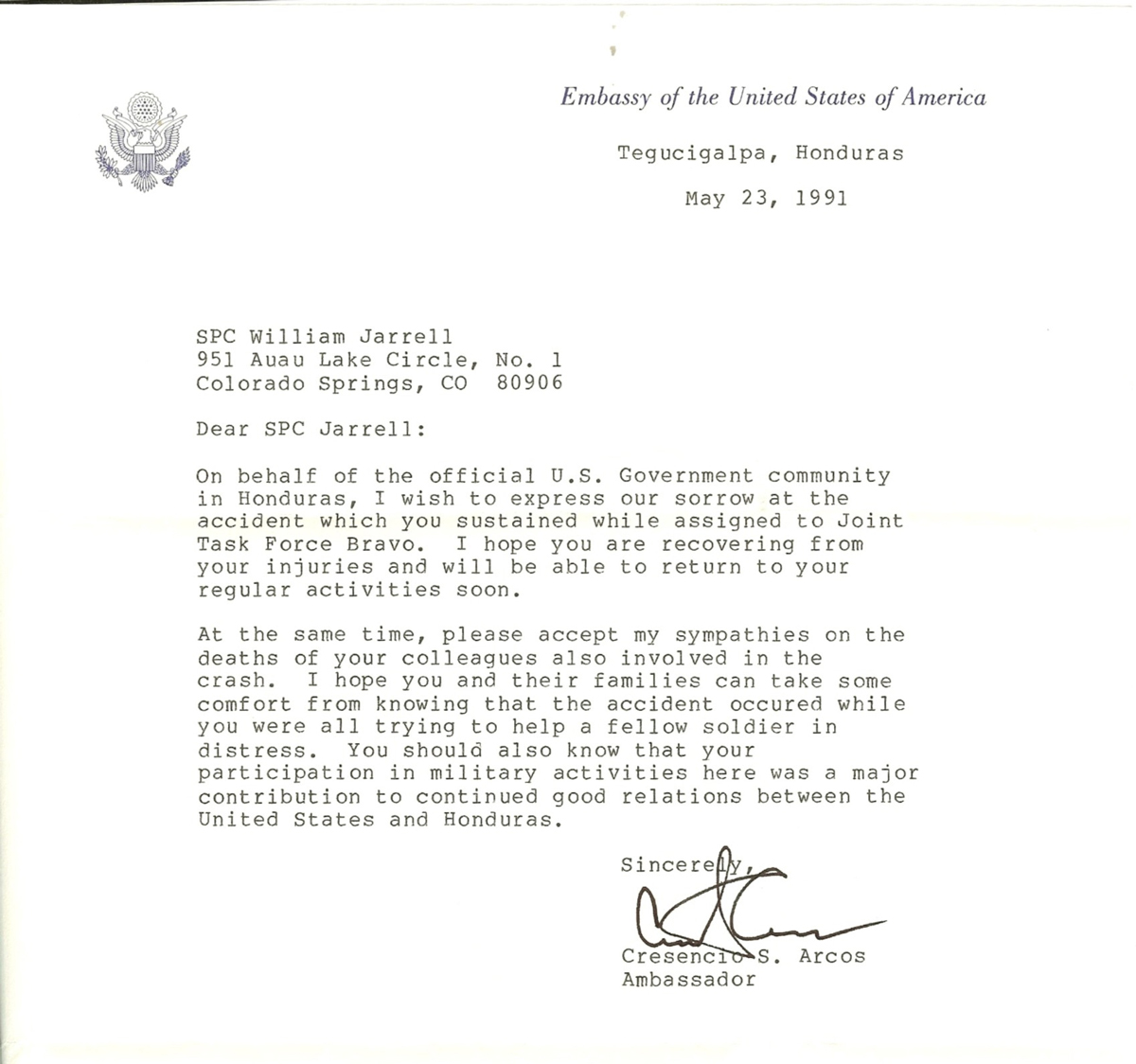
Crew chief and sole survivor Buddy Jarrell in Stokes litter after spending hours alone, severely injured, and wondering if any other crew member might still be alive. (Credit: Ken Kik)
Note: A UH-1H helicopter in a 30-degree bank will lose its ability to sustain or gain altitude unless the pilot takes action to increase the total lift produced by the main rotor system.
Aerodynamics of a Banked Turn
When a helicopter banks, the total lift force generated by the main rotor disc is tilted.
• Vertical Component of Lift: This component directly opposes gravity and is responsible for maintaining altitude. As the bank angle increases, the vertical component of lift decreases.
• Horizontal Component of Lift: This component is the force that pulls the helicopter into the turn (centripetal force).
To maintain altitude in a 30-degree bank, the pilot must increase the total amount of lift generated to compensate for the reduced vertical component. This is typically done by pulling back on the cyclic and/or increasing the collective pitch, which increases the angle of attack of the rotor blades.
Pilot Action Required
If a pilot initiates a sharp 30-degree bank and does not simultaneously adjust the controls:
• The vertical lift component will be insufficient to counteract the helicopter’s weight, and the aircraft will start to descend.
• To sustain or gain altitude during the turn, the pilot must add power (increase collective pitch) and apply appropriate cyclic and anti-torque pedal inputs to increase total lift and remain coordinated.
In short, the helicopter won’t inherently lose the ability to sustain or gain altitude at that bank angle, but it will lose altitude if no corrective control inputs are made. A 30-degree bank is a standard maneuver and is well within the UH-1H’s operational capabilities, provided the pilot manages the power and lift demands correctly.
“I was thrown downhill about three hundred yards. When I came to I could see a river of flames flowing downhill towards me. The fuel cell had ruptured on impact. I remember thinking to myself ‘Great, you couldn’t kill me in the crash so now I’m going to burn to death.’
“I heard someone up above me crying for help. I thought it was Simonds but I was not sure. I yelled back I couldn’t move or get back up to help her but to hang on. Pretty soon I didn’t hear anything else. The fire had almost reached where I was laying. I could not stand up or crawl away. Then, suddenly, the flow of fuel on fire split in half and went around me on either side. Another miracle.
“I knew I was badly injured. I began hearing a helicopter above me flying back and forth. I turned my strobe light on but with all the flames and smoke they did not see it. After I was hoisted out hours later the crew chief who spotted my strobe told me they were on their last pass. He raised his NVGs as they were washing out with all the fire illumination and that is when he saw my strobe! It turns out he was the ill crew chief I had replaced that day. When he heard the MEDEVAC had gone down he had suited up to help with the rescue effort. Another miracle.
“It was Ken Kik, a flight medic with the 571st, who found me. He began treating me. They would not send a MEDEVAC with a hoist in until daylight as they thought it was too dangerous. When the MEDEVAC arrived and the hoist lowered the Stokes litter, I realized it was yet another miracle. I had just repaired that hoist two days earlier.
“When I was transferred to the hospital at Fort Carson the Army tried to medically discharge me before a final recovery report was completed. I told them they couldn’t do that, provided the Army regulations stated why, and I won. They also stopped my pay saying until the crash report/Line of Duty report was finished I would not be paid. My wife was furious; we had bills to pay. I fought that, too, and won.
“I recovered and was determined to be physically fit to remain in service. I retired as an E-7. Today I am living my best life.”
Ken Kik – flight medic, 571st Medical Company (AA)
“One piece to this story that changed my life was that I could have been on this flight. SSGT Simmonds asked me that morning at breakfast if I would swap with her. It’s easy to look back and think what if I had been there and spoken up when they were being pressured to fly.
“I served with Linda in Honduras as a fellow flight medic. My flying background was as a crew chief but had recently transitioned over to the flight medic role due to past USAF medical and Flight Medic training. I was in country about a month before her unit arrived. I remember her as being very nice, we talked often especially during our morning crew shift changes.
“As an experienced crewmember but fairly new Army flight medic I asked her advice and I wanted to learn from those with more experience. She was always willing to help.
“The morning of May 13th I was assigned to the 1st up crew, I had breakfast with Linda and Vicki Boyd that morning. Linda asked if I would swap my 1st up shift with her and I agreed. This is something I think about often since I was supposed to be on that aircraft. What happened after I was informed of the crash, the refusal to let us launch a rescue mission, and when I eventually was able to reach the crash site was a mess, I’m frustrated and a little bitter to this day of how this all played out.
“I had no idea after the first attempt they had swapped from one of our UH-1Vs (due to a chip light activating) to the UH-1H #640 that crashed. Our UH-1Vs had radar altimeters, the UH-1Hs did not. Flying without NVGs definitely was a major contributing factor.“
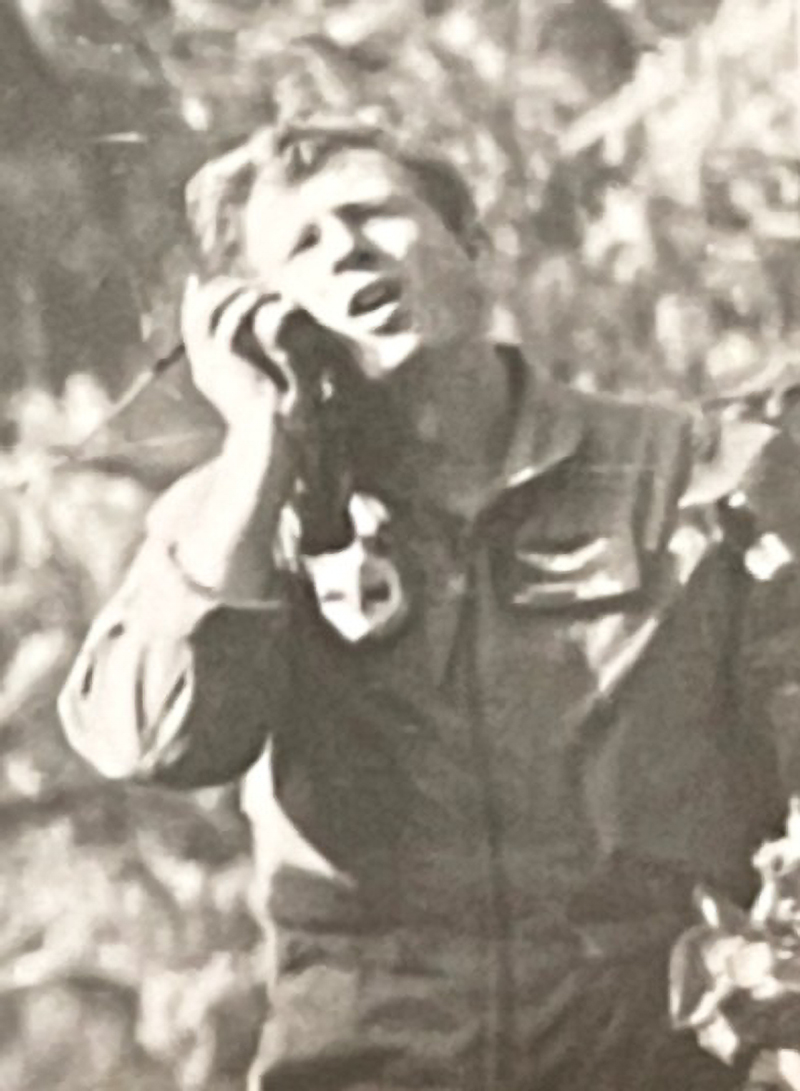
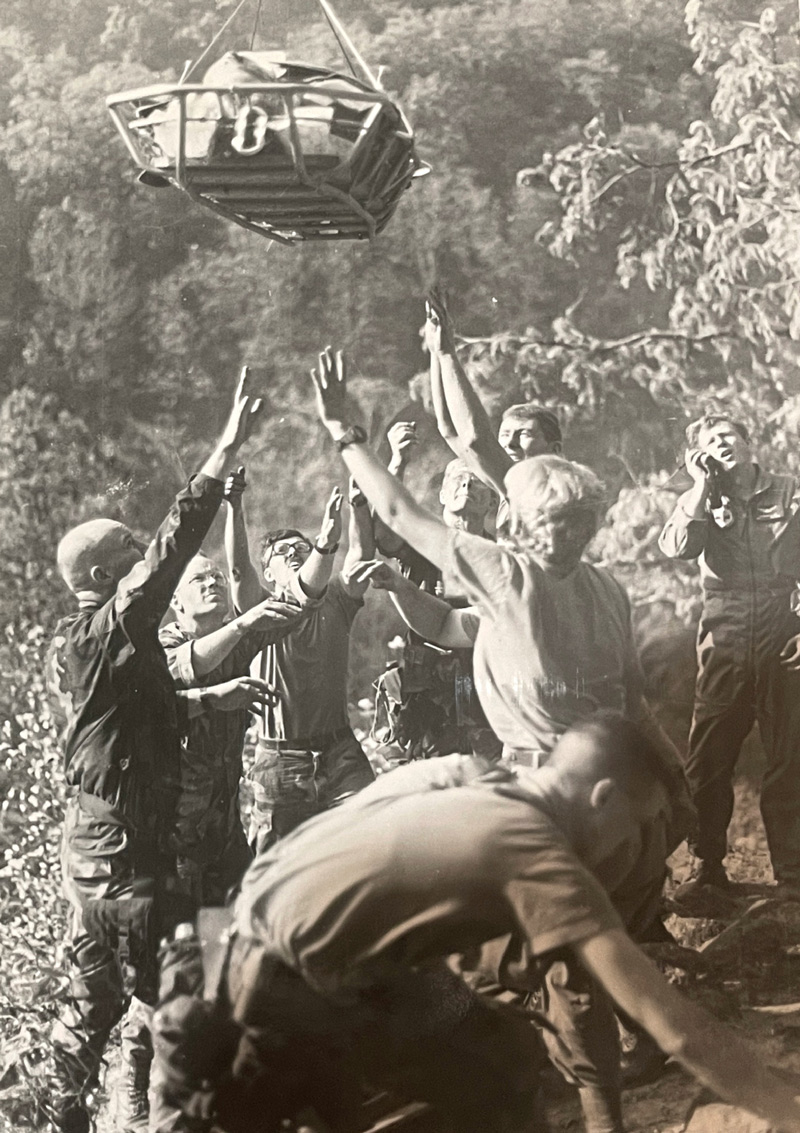
Flight Medic Ken Kik on his PRC-90 as crew chief Buddy Jarrell is being hoisted in a Stokes litter from the crash site. (Credit: Ken Kik)
Note: The UH-1V is a modified version of the H-model, specifically configured for dedicated MEDEVAC and search-and-rescue operations. These conversions were performed by the US Army Electronics Command.
• Role: Solely used for aeromedical evacuation and rescue missions, often operating as “Dustoff” aircraft with a medical command.
• Key Modifications: The primary difference lies in its specialized equipment tailored for emergency response:
-
- Rescue Hoist: Added for extricating individuals from difficult terrain.
- Advanced Avionics: Upgraded with a radar altimeter, Distance Measuring Equipment (DME), and Instrument Landing System (ILS) for improved navigation and all-weather operations.
- Cabin Configuration: Configured with racks for up to six stretchers and a medical attendant, with troop seats typically removed.
- Wire Strike Kit: Later models were often fitted with a wire strike protection system on the nose and roof.
• The UH-1V (and other Hueys) got radar altimeters for crucial low-altitude safety, especially for Night Vision Goggle (NVG) operations and hazardous terrain avoidance, providing precise height above ground (AGL) for landings, nap-of-the-earth flying, and integrating with Ground Proximity Warning Systems (GPWS), making flights much safer in varied conditions where barometric altimeters fall short.
Why Radar Altimeters Are Essential:
1. Precise AGL Measurement: Unlike barometric altimeters (which measure height above sea level), a radar altimeter sends a signal down and times its return, giving the pilot the exact distance to the ground or water surface (AGL).
2. Low-Level Flight Safety: Helicopters often fly very low (”nap-of-the-earth”), where barometric altimeters aren’t accurate enough; the radar altimeter provides critical data for safe maneuvering.
3. Night Vision Goggle (NVG) Operations: The FAA mandated radar altimeters for NVG flights because pilots need precise height information when visual cues are limited.
4. Ground Proximity Warning (GPWS): Radar altimeters feed data to GPWS, triggering alerts if the helicopter gets too close to the ground, preventing accidents.
5. Landing & Takeoff: They offer crucial accuracy for approaching and landing in challenging environments, from fields to ship decks
In Simple Terms:
Think of it as the difference between knowing how high you are above the clouds (barometric) versus knowing exactly how many feet separate your skids from the treetops or water (radar). This distinction is vital for helicopters like the UH-1V, which often operate in dense terrain or at night, making the radar altimeter a critical safety upgrade.
“When we receive a request for help, we will respond to the best of our capability, we will find a way to help if at all possible. Our mission requires risk taking beyond most other aviation units. The five years I spent flying Dustoff was the most rewarding of my military career.
“I always loved working with the SF and other SOF teams. I was never “regular army” material, always bucking the bureaucracy and trying to find better ways to accomplish the mission, I guess that’s why I gravitated to units like MEDEVAC and others with real missions. I was attached to the 160th for short time before back in ‘86 before I volunteered for MFO duty in the Sinai. I had plans of going back to the 160th [SOAR] but decided on Carson because I wanted to train at the US Shooting Center in Colorado Springs to “up my game”. It’s amazing what the 160th has grown into since the mid-80’s.
160th SOAR – https://www.nsa160.com/history/
“ I was attached to the D Co. 160th BN from the 229th AHB in 1986. The 160th became Regimental later in 1987 (I believe). I served with the 571st through June 1995 as a flight medic then left active duty, went back to the aviation maintenance career field, and retired from the Air National Guard in 2005
“I remember someone, I believe it was CW2 Clark Webb, one of our pilots mentioning a QRF UH-60 was going to depart and take a team in to “secure the scene” but there was no mention of medical evacuation. We were really getting frustrated at this point, especially since we knew there was a potential survivor. That’s when I decided it was time for me to get on that aircraft.
“I got on the UH-60 with the four troops already on board, as I’ve mentioned before I was told they were from 7th Grp. Only the five of us were on board as PAX. If there were any briefings before I jumped on board I missed them.
“I was asked if I could rappel by one of them and told them absolutely, I had been to Air Assault school. I remember him saying something like, “well let’s go.” As we flew I was thinking I hope I don’t screw this up, I was going to follow the lead of whatever they did. I’m glad the crew found an LZ. I plugged my helmet into the ICS box and heard the conversations between the pilots and their crew chief, discussions about the crash site area, insertion, looking for a good rappel area, and then finding the LZ. To this day I cannot believe I took my helmet off, with my NVGs attached and left them in the aircraft when we exited. I think it’s because this was just muscle memory, I always took my helmet off when exiting the aircraft on missions because I needed to perform patient care and talk with the patient or people on scene, the helmet would get in the way.
“As we flew I was thinking I hope I don’t screw this up, I was going to follow the lead of whatever they did. I’m glad the crew found an LZ. I plugged my helmet into the ICS box and heard the conversations between the pilots and their crew chief, discussions about the crash site area, insertion, looking for a good rappel area, and then finding the LZ. To this day I can’t believe I took my helmet off, with my NVGs attached and left in the aircraft when we exited. I think it’s because this was just muscle memory, I always took my helmet off when exiting the aircraft on missions because I needed to perform patient care and talk with the patient or people on scene, and the helmet would get in the way.
“We had recently installed a repaired hoist in the 2nd up MEDEVAC bird and were ready to go in but we were told to stand down multiple times by the XO, even when we were told there was a possible survivor with a strobe waving spotted by a UH-60 sent to find the crash site. The team I was now with was only to secure the site until daylight.
“The QRF planned a rappel but we were able to find a landing zone on a road nearby and uphill from the crash site. We hiked our way in, which was very comical at times. I fell and tumbled many times. I would step on what I thought was solid ground and it was a shell of burnt brush and down I would go. I’m still surprised we didn’t get hurt or break an ankle.
“I was unarmed since I was not on 1st up duty that evening and after the crash going to the arms room was the last thing on my mind. The SOF guys were armed and kitted out.
Note: First Up Aircraft
• Primary Mission Ready: This is the aircraft designated as the primary asset for a scheduled mission or training flight.
• Highest Priority: It is the top priority for maintenance, fueling, arming, and final inspections to ensure it is ready to fly at the designated time.
• Go-to Aircraft: If everything goes according to plan, the “first up” aircraft is the one that the crew expects to use.
Second Up Aircraft
• Backup/Spare: This aircraft serves as a fully prepared backup in case the “first up” aircraft experiences a maintenance issue or a last-minute problem that would prevent it from flying on time.
• Ensures Mission Success: The purpose of having a “second up” aircraft is to guarantee the mission or training requirement can still be met without significant delay.
• Lower Priority (but still mission-capable): While it is a backup, it still needs to be fully prepared and ready to fly at the same time or very shortly after the first aircraft. Maintenance and crew efforts are coordinated to ensure this readiness.
In essence, “first up” refers to the primary asset, and “second up” refers to the designated alternate, highlighting a culture of redundancy and mission assurance in aviation operations. MEDEVAC crews per SOP fly armed and in this situation the downed crew was indeed armed—this to protect if necessary themselves and/or their patients. Their weapons were kept in the BN arms room.
“Linda was the first I found and she was killed instantly. When I spoke with Buddy after I found him he thought it was Linda calling out but it had to have been Vickie.
“Vicki was the other initial survivor of the crash. When I found her she was laying next to her armored pilot’s seat, the seat belts were unbuckled, her helmet was off and laying close by, and she obviously removed herself from the seat. She was deceased when I found her. I suspect internal injuries, no major open wounds, or fractures that I recall. I remember her flight suit was torn across lower left abdomen with large abrasions/contusions. It was evident in the report they were trying to cover up she lived through the crash. It was obvious she removed her helmet and exited her crew seat on her own. Her injuries may have been un-survivable, but at least we could have given her a chance. It is amazing anyone survived, that Huey practically disintegrated on impact.
“Had the XO let us immediately launch, hoisted me in, triaged the survivors, and hoisted either Vickie or Buddy out right away, there may have been two survivors and Buddy’s recovery might have been less challenging with immediate care/surgery. It was a quick flight back to Soto Cano, we could have had both in the hospital there in a reasonable timeframe.
“We could not locate CPT Dawn.
“I did not hoist out with Buddy. I’m glad he survived the hoist. I had him strapped in tight. The Stokes had a leg divider so I did not use a backboard as his legs would have been elevated out of the Stokes in an unsafe manner and would be difficult to secure him. I tossed the backboard down the hill. It might still be there. I caught flak for this later by one of the 126th medics but stood my ground on that decision. Once Buddy was off the scene I hiked back up the hill and found a ride back to Soto Cano, heading straight to the hospital to see Buddy.
I later spoke with the ill soldier that was at the TACAN site. He had been lifted out by Eagle 69 as the search for #640 was underway. He was very upset about the crash and blamed himself for it occurring. I explained to him repeatedly it was not his fault.
Note: In a sense he was another casualty of the XO’s poor decision-making process. Survivor’s Guilt is a very real thing and hopefully this young man found help to deal with this tragedy. And clearly there was a 2nd Up aircraft available and fully current crew (NVGs) – why this option wasn’t executed rather than having CPT Dawn’s crew make a second attempt remains a mystery.
“I am not sure when the SF/SOF guys departed, I’m sure they remained on scene longer. By the time I left, there were a bunch of people on the scene. It seemed like not long after sunrise there were troops everywhere including some other medical personnel. At this point we were discussing moving Buddy by ground.
“If an MD was on the scene by that time, I do not recall. I was on my PRC-90 requesting the hoist and stating Buddy was critical. An MD who would call an open head injury and a partial leg amputation plus the massive force of the impact/mechanism of those injuries as “the patient is stable” would be an idiot. Buddy was in what we call compensated shock. His blood pressure was ok but he was slightly tachycardic and very anxious which was concerning, and I did not know if he was bleeding internally. Damn, I still do not know how Buddy survived that night. I’ve worked many trauma cases over the years that even with our advanced care these days have died. Buddy is one tough MF’er.”
Note: According to the Warrior Operations CQ log of the incident, DUSTOFF 01 departed Soto Cano for the second attempt at 2230H. Radio and radar contact was lost with the aircraft at 2255H. At 2300H the QRF from the 2/187 INF was notified and launched. It was unable to locate or land those onboard and returned to Soto Cano. At 2338H, a second QRF launched to locate and secure the crash site. It, too, is unsuccessful. Eagle 69 departed for TACAN at 0107H and upon picking up the ill soldier returned to Soto Cano hospital at 0125H.
At 0220H, the SF/JSOC QRF now including 571st flight medic Ken Kik, lands and begins its search and then the successful discovery of the crash site, two of three deceased crew members (CPT Dawn was at that time presumed elsewhere on the mountainside or possibly captured), and the lone survivor, Buddy Jarrell.
At 0350H, a second ground team is landed by Eagle 69 and arrives at the crash site at 0405H. At 0459H, a lone Honduran was taken into custody by MPs attempting to escape the outer perimeter.
At 0501H, the now onsite medical officer advises Soto Cano the patient appears to be stable and does not require being hoisted out until daylight. There is no mention in the log or in the interview with Ken Kik of his having been on the mountain with Jarrell since roughly 0300H nor advising Soto Cano of the seriousness of Jarrell’s injuries via his PRC-90 radio, this information relayed by the overhead helicopter monitoring the team’s progress. Also not mentioned is Kik’s managing the hoist operation, with Jarrell finally lifted out at 0730H the morning of the 14th.
Twenty-eight witnesses were interviewed by the crash investigators. Only thirteen statements were summarized in the report. Both Buddy Jarrell and Ken Kik’s statements are heavily edited. The final analysis of the crash and its causes, two and a half pages worth, is redacted in the report. Apparently the review board at Rucker didn’t dig what its investigators fully uncovered
Due to name redactions, it is possible but unknown if this individual was interviewed for the accident report, or in some other manner contributed his disparaging thoughts regarding CPT Dawn and/or 1LT Boyd. Regardless, they demonstrate serious unit cultural problems at that time and the practice of laying blame on the doorstep of the dead.
A public relations nightmare
The fatal crash of a MEDEVAC aircraft in Honduras was front page news. In addition, that three female aviation personnel were killed drew even greater attention. The personnel files of all three women were requested by both media and congressional members. The accident report’s conclusion, that CPT Dawn became distracted while attempting to assist her copilot with navigation duties and by doing so flew into the side of a mountain made it a cut and dried event. Pilot error. No more, no less.
In 2025, SFC (ret) Buddy Jarrell recalled what truly occurred adding much of his official statement to investigators was heavily edited.
Jarrell offered CPT Dawn flew to La Paz as they could see the town’s lights. She was hoping to find the road that led up to the TACAN site and simply follow it. They did find the road per both Jarrell, who was lying on his belly looking down and using the aircraft’s landing light for illumination, and the internal communications traffic between Dawn and Boyd as presented in the report.
They had made several attempts to fly up the valley but the terrain and tree cover made it impossible to keep the road in sight. Jarrell recommended to CPT Dawn that they abort the mission as it was becoming too dangerous. Dawn’s response was curt, adding they would try one more time. Jarrell recalls seeing Cerro la Mole appearing right in front of the aircraft. Dawn made a sharp adjustment to the left, placing the aircraft at an estimated 30-degree angle. The MEDEVAC helo began losing altitude while also picking up speed. They missed impacting into a cliff on the west side of the valley, but as Dawn regained control of their decent and began to climb they crashed into the cliff side on the east side of the valley.
Note: The report states CPT Dawn never located the road. But elsewhere in the report the internal communications traffic between pilot and copilot states clearly they had. And Buddy Jarrell’s recollections decades later confirms the road was indeed, for a very short period of time, located and attempted to be followed.
“Page 176 is the summary of my interview (spotted quickly because the aviation experience in the interview part shows my 289 hours as a Crew Chief and 70 hours as a Flight Medic, but the actual positions are redacted). It is definitely a “summary.” Lot of stuff I said, like about Lt Boyd surviving, was left out. Also left out was a conversation about the culture of the 126th Med.
“Reading the accident report about the first attempt by QRF to land and then returning for a medic was puzzling. The report did fill in some gaps. It was really scrubbed of some details.
“The soldier the Medevac was initiated for, [was] definitely non-emergent and could have waited until daylight to fly or come by ground.
“In the days after the crash as everything was sinking in, and I absolutely truly mean this and have told many people, I realized how fragile life was, to never take life for granted, and I continue to live my life fully in memory of Linda. I became interested in aviation safety after this crash and worked on many initiatives to include risk assessment tools and Crew Resource Management (CRM) both in military and civilian life. I went on to retire from the Air National Guard as a Wing Safety NCO. I believe the lessons learned from this crash and others helped prevent other mishaps and saved lives.
“I have often told others that May14th, 1991 was the first day of my new life since I should have been on that aircraft and another died in my place.”
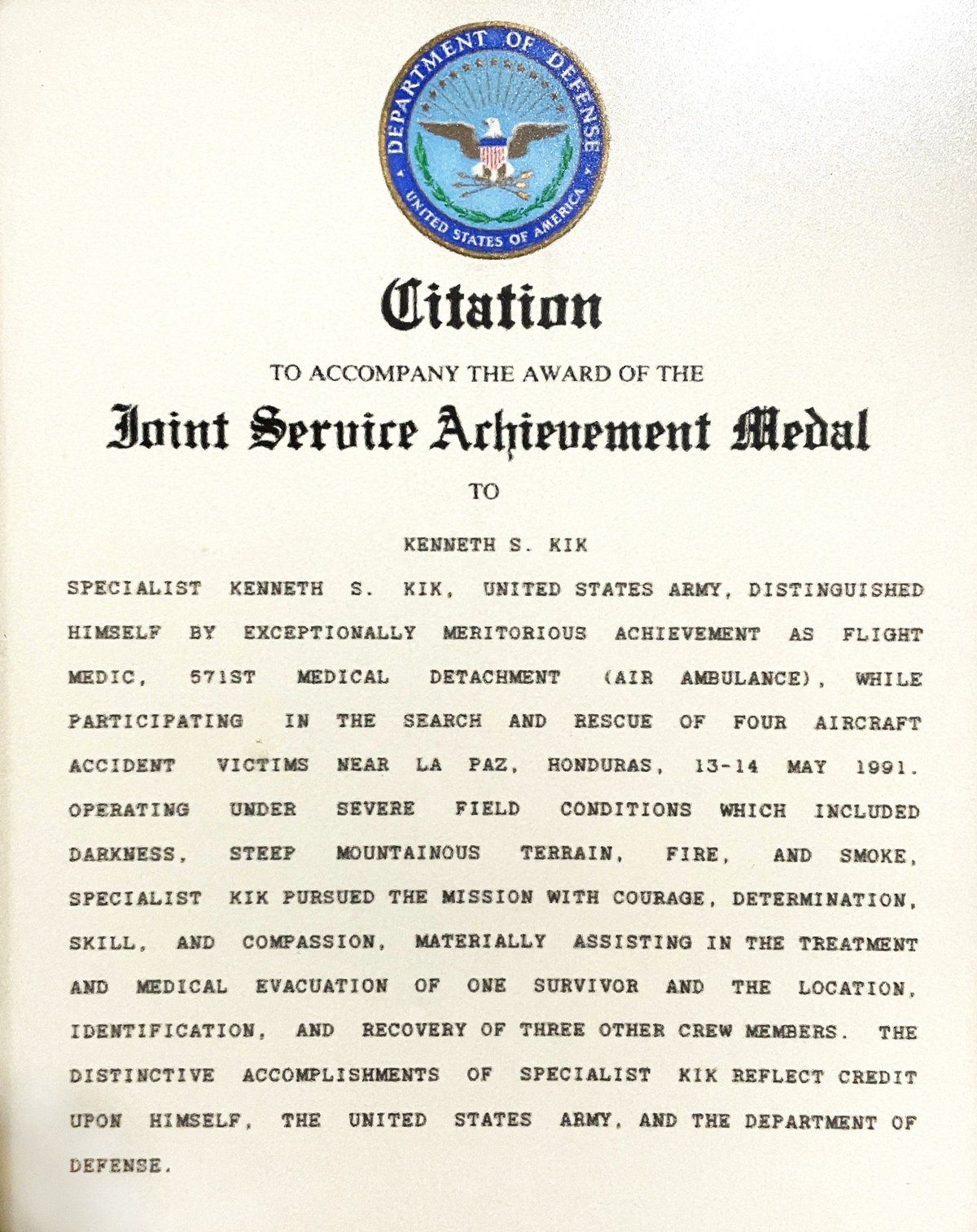
Along with Ken Kik, those JSOC/7th Special Forces Group personnel who accomplished what two attempts by conventional forces QRF could not do the SECWAR at the time issued this impact award in July 1991. The JSAM is a Secretary of War authorized award. It overshadows individual Achievement awards from all Services and is an award commonly associated with JSOC personnel / Special Mission Units. The orders show Kik and a captain from 7th Group and three others, all apparently JSOC personnel. (Credit: Ken Kik)
Air Medals for Heroism Discovered in 2025
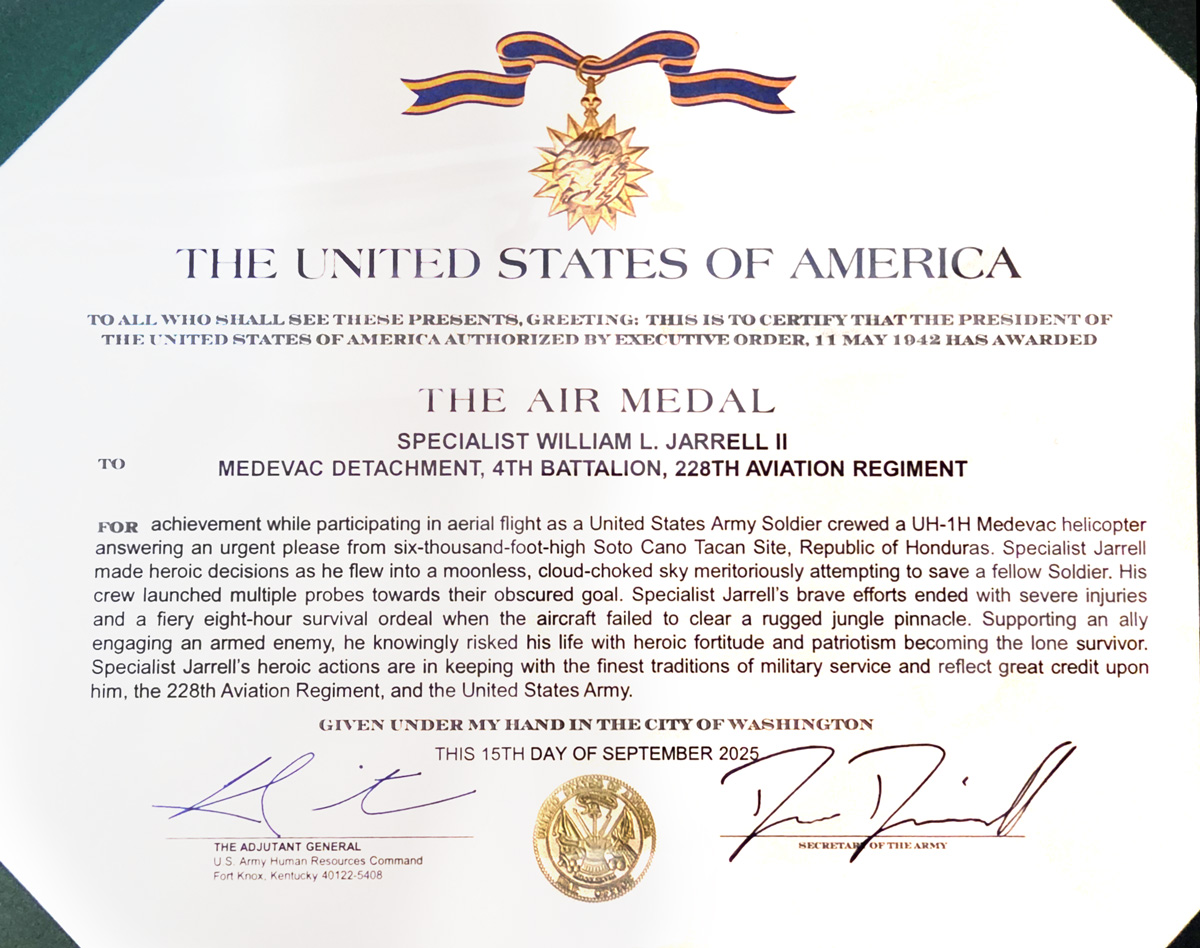
During the research phase for this article the author contacted Army HRC and inquired if the Soldier’s Medal, a peacetime award, might be possible for the MEDEVAC crew? Wesley Tuchtenhagen, CW5, AGWO Advisor to the Adjutant General (TAGD), who had assisted in locating the lost posthumous POW medal for SPC Ernest Dawson (crew chief, 4/228th Aviation Regiment (https://www.specialforces78.com/el-salvador-black-aviator-is-awarded-posthumous-pow-medal/), reviewed the crash report and additional information provided. In doing so he discovered, hidden away in 1LT Vicki Boyd’s personnel file, a properly documented and signed award recommendation for all four of the air crew – three posthumous and one living Air Medal for Heroism.
Because the recommendation had never been submitted, for whatever reason, HRC was authorized by regulation to submit the 34-year-old award packet to its Awards and Decorations board.
On September 25, 2025, all four awards were authorized. The surviving sisters of those who perished have been notified as has Mr. Jarrell.
“Sir,
“All 4x Air Medals were approved by the ADB this week and going through board out-processing now…We will expect engraved medal sets to arrive in the next 3-4 weeks. After that, we can begin mailing all items out.” – CW5 Tuchtenhagen, HRC
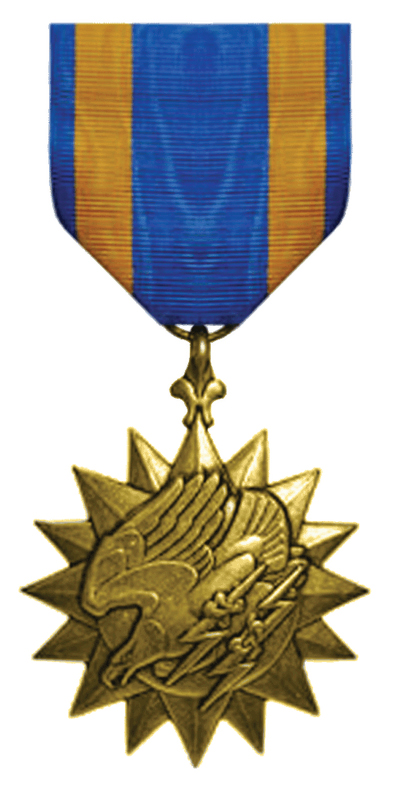
“No Fallen Comrade Left Behind”
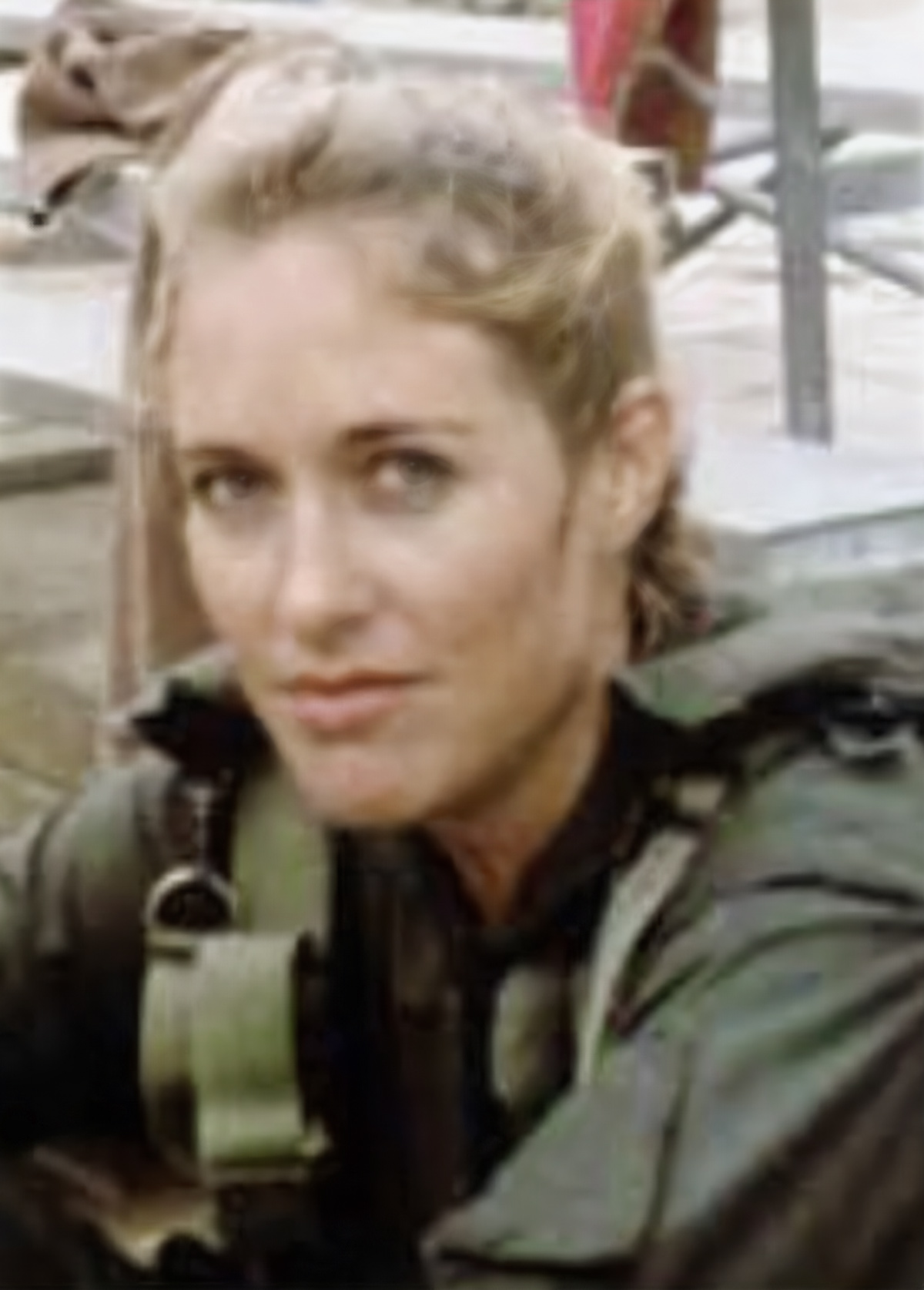
Captain (P) Sashai Dawn, pilot—
Air Medal for Heroism (posthumous) 2025
CPT Dawn, formerly known as Dawna Jayne Meyers, entered military service on 27 January 1975, and completed 39 months as an enlisted person. Prior to her enlistment, she had graduated from high school in California. She attended Officer Candidate School at the U.S. Army Infantry Center, Fort Benning, Georgia, graduating in 1979 with class RC-79.
After graduation, CPT Dawn was assigned as a platoon leader with Headquarters and Company A, 40th Medical Company, Long Beach, California. She was later assigned as an ambulance platoon leader in the same organization. In January 1982, CPT Dawn was assigned as Chief, Company Supply Division, 49th Personal Services Company, Alameda, California. In 1983, CPT Dawn was awarded an associate of arts degrees from San Joaquin Delta College. On 29 August 1983, she reported Officers’ Rotary-Wing Aviator Course (ORWAC) 83-44, Fort Rucker, Alabama, graduating from rotary-wing flight training on 16 May 1984. Her next assignment was with the 126th Medical Company (AA), Mather AFB, California, as an air ambulance platoon leader. CPT Dawn was promoted to captain on 8 October 1990, in the Army National Guard (ARNG). She remained with this unit until 21 November 1990, when the unit was ordered to active duty and attached to the 1st Support Battalion, Fort Bliss, Texas. At Fort Bliss, the 126th Medical Company was tasked to provide three helicopter crews to JTFB, Soto Cano AB, Honduras. CPT Dawn volunteered for this assignment and was selected as a detachment commander.
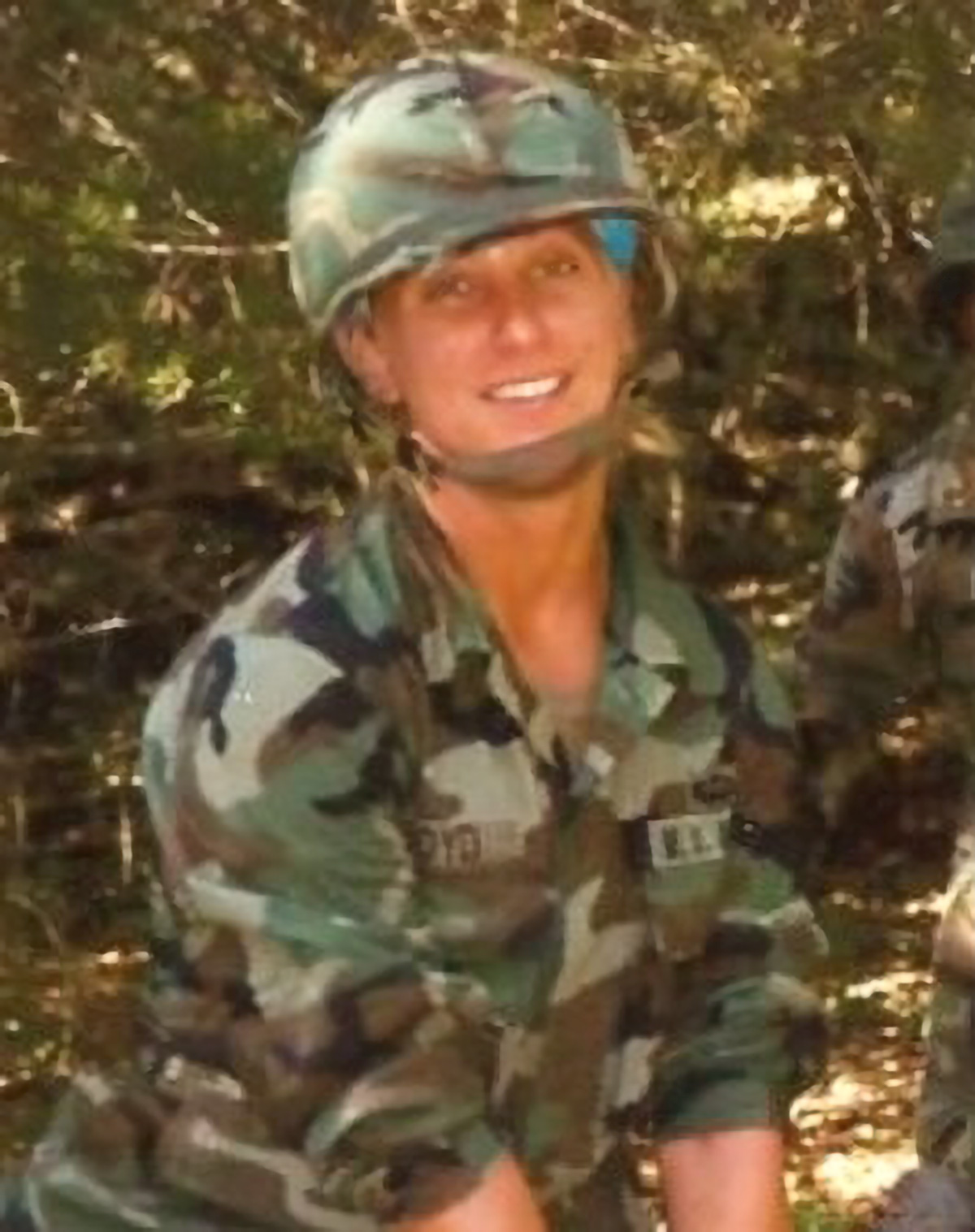
1LT Vicki Boyd, copilot —
Air Medal for Heroism (posthumous) 2025
LT Boyd entered the U.S. Army as an enlisted service-member on 6 February 1981, and served 51 months on active duty as a member of a motor transportation unit at Fort Bragg, North Carolina. While on active duty, she attended a Primary Leadership Course at Fort Bragg, North Carolina, and became airborne qualified in 1981. Upon her release from active duty on 15 March 1994, she entered service with the Alabama National Guard (ALARNG), attaining the rank of staff sergeant.
LT Boyd continued her education, receiving an associate degree from Enterprise State Junior College, Enterprise, Alabama, in 1985. In 1986, she received a bachelor of science degree from the University of Montevallo, Montevallo, Alabama. On 28 June 1986, she received her commission as a second lieutenant, ALARNG, and was assigned as the XO, HHC, 167th Support Command, Birmingham, Alabama. On 22 February 1987, she came back on active duty to attend the Medical Service Corps Officer Basic Course at Fort Sam Houston, Texas. Upon graduation, she was released from active duty and returned to the same ARNG unit in Birmingham Alabama.
On 18 October 1988, she entered flight school at Fort Rucker, Alabama, as a member of Initial Entry Rotary-Wing (IERW) Course Class 89-02. Upon graduation, LT Boyd separated from ALARNG and transferred to California ARNG. On 22 November 1990, she was involuntarily ordered to return to active duty as a member of the 126th Medical Company (AA) and further attached to the 1st Support Battalion, Fort Bliss, Texas, for training. In April 1991, she volunteered for an assignment in Honduras as a member of the Medical Detachment, 4-228th Aviation Battalion, located in Soto Cano AB, Honduras.
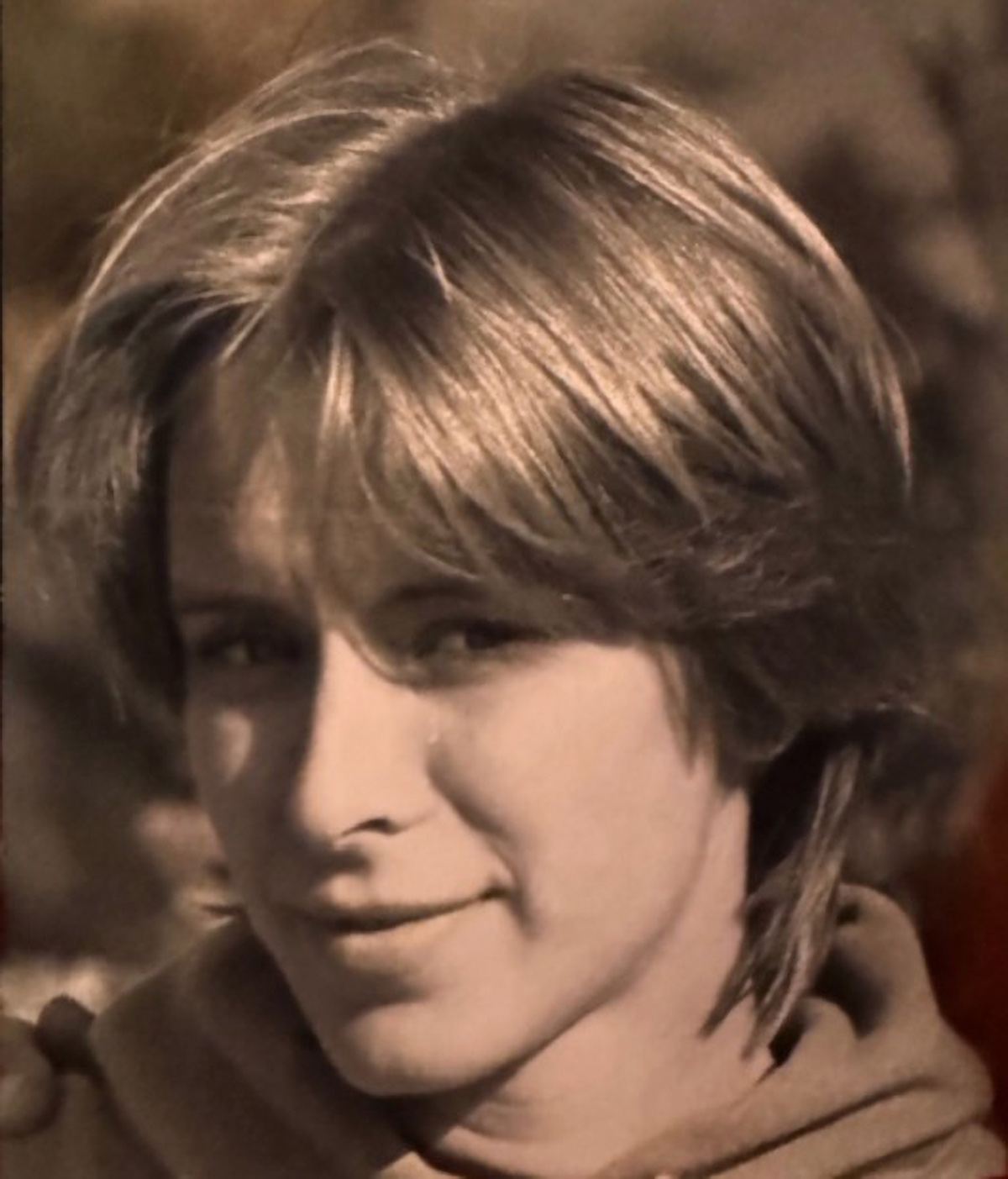
SSGT Linda Simonds, flight medic —
Air Medal for Heroism (posthumous) 2025
SSG Simond had graduated from California State University, Sacrament, California, in 1980, with a bachelor of arts degree in communications. She received her master of communication degree from Loyola Marymount University in 1982. SSG Simonds enlisted in the California ARMG on 28 April 1983. She remained with the CAARNG and was assigned to the 126th Medical Company (AA) as a flight operations coordinator on 28 July 1987, in the rank of staff sergeant. On 27 September 1990, she was reassigned within the same unit as a flight medic, MOS 91B30F.
SSG Simonds was involuntarily order to active duty with the 126th Medical Company on 21 November 1990, for a period of 12 months. SSG Simonds volunteered for an assignment to Soto Cano AB, Honduras, and arrived in Honduras in April 1991.
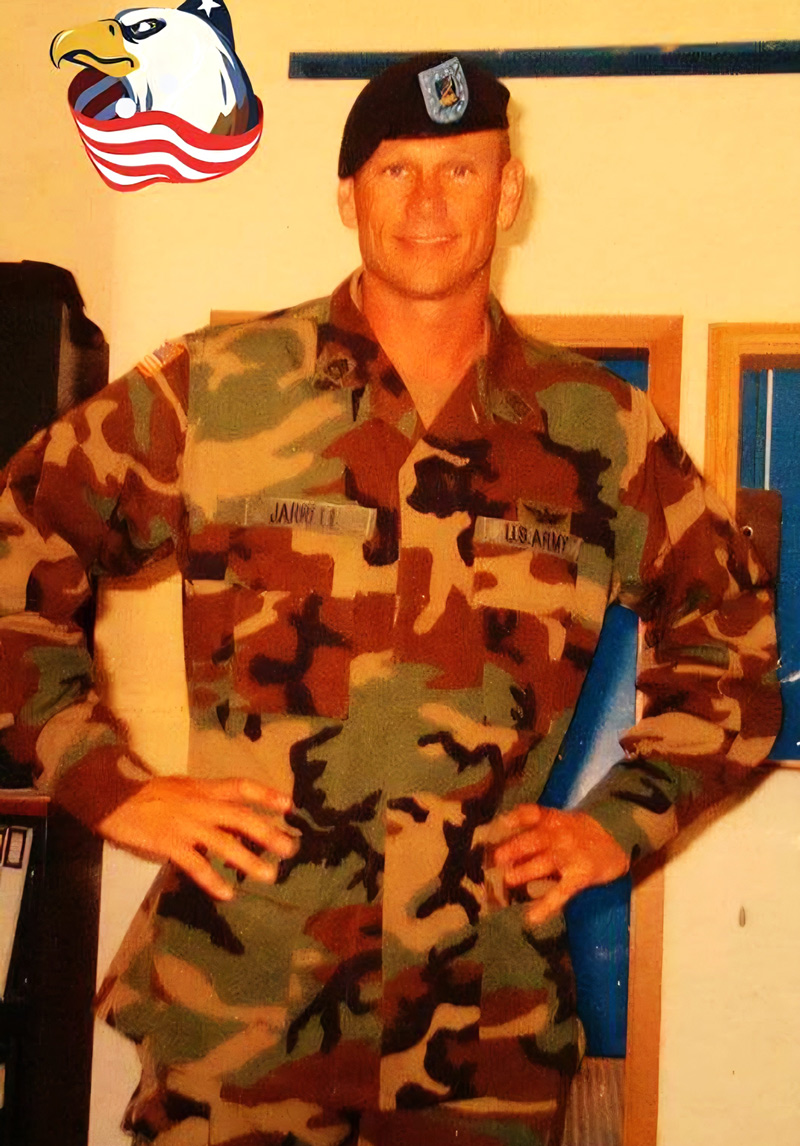
SPC William “Buddy” Jarrell, crew chief and sole survivor—
Air Medal for Heroism 2025
On July 20, 1992, CW3 Ernest McPherson, the past acting MEDEVAC detachment OIC for the 4/228th Aviation Regiment, submitted an awards packet to the Commanding General, U.S. Army Southern Command, in Miami, Florida. Chief McPherson recommended four Air Medals for Heroism, three of these posthumous, for the MEDEVAC crew that crashed on the evening of May 13, 1991, near the highly classified and secured TACAN radio / communications intercept site near La Paz, Honduras.
Never actioned by the Army, the awards packet lay tucked away for thirty-four years in the personnel file of 1LT Vicki Boyd, copilot, who had initially survived the horrific crash. Vicki Boyd died on the mountainside due to the incompetence of the acting commander of the 4/228 at Soto Cano to mount an immediate rescue effort as soon as apparent survivors were observed by an air crew searching for the crash site.
Following an inquiry from myself to Army HRC in the hopes of seeing possible Soldier’s Medals considered for this crew, CW5 Wesley Tuchtenhagen requested the personnel files of each individual after reading the Army’s official crash report as provided to me under FOIA. Tuchtenhagen discovered that soon after the crash an unusual number of congressional and media inquiries had been made to review these files. In an official letter to SFC (ret.) William Jarrell, the sole survivor of the crash, dated December 17, 2025, Major Francisco Bonglo II, Chief, Awards and Decorations Branch, offered the following:
“During a recent review the Army Awards and Decorations Branch discovered an unactioned inquiry from a Member of Congress, which included a recommendation for the Air Medal for Heroism. IAW Title 10, USC 1130, when a Member of Congress inquires on behalf of a constituent, our branch is authorized to waive any timeline requirements associated with the original recommendation and continue processing the award.”
Chief McPherson’s narrative in support of the four awards was concise, specific, and countered the conclusions of the official accident report. In his narrative McPherson pointed out that in the case of crew chief William Jarrell, detached from the 571st Medical Detachment at Fort Carson, Colorado, and assigned to the 4/228th at Soto Cano, his professional aptitude and drive remedied what had been the lowest aircraft readiness rate at the 4/228th prior to the three crews from the CAL Guard 126th MEDEVAC unit who arrived in mid April 1991. This observation supported CPT Sashai Dawn’s near immediate reports back to her commander in California that the crews were not receiving the support they’d been promised prior to their deployment to Honduras.
McPherson pointed out the weather that night was “…so dismal the normally visible destination could not be seen…”. In fact, the weather was so poor the authorization by the 4/228 XO to accept the mission ran contrary to the unit’s own SOP regarding any flights, as supported by the Soto Cano tower information and interviews in the accident report itself.
The recommendation commended Jarrell joining the MEDEVAC effort (the assigned 1st Up crew chief was ill that night) and on both the first and second attempts to reach TACAN acting as a “third navigator” to include studying map charts for a clearer route to the mountaintop when the XO insisted a second attempt be made.
The narrative makes it clear the original MEDEVAC aircraft, a UH-1V, a platform specifically designed and equipped for aerial MEDEVAC missions, had experienced a caution light activating upon return from the first attempt. The XO offered a standard UH-1H from B Company as a replacement. McPherson states “…a less capable UH-1H was flown into the dark sky…”, less capable to include not having air to ground radar instrumentation so the pilots would know their altitude exactly when flying in the mountainous terrain. McPherson points out the cloud-choked and not clear enough. Jarrell attempted to assist the pilots as they flew numerous probes toward the mountain site. At 2313 Hours, the aircraft impacted on a treacherous pinnacle several thousand feet below TACAN.
CPT Dawn and SSGT Simonds were killed instantly. 1LT Boyd survived and was heard calling for help by Jarrell from where he lay nearly 300 meters below the crash site. As McPherson wrote “Over eight hours he stoically endured…He answered the calls of a fellow survivor he couldn’t aid due to his own injuries…He passed out and woke with a pain in his back. This turned out to be from a rivulet of molten metal [flowing downhill from the crash site]. McPherson again does away with the accident report sanitizing the rescue effort to reach Jarrell. “It was a long-winded affair as it took hours before he was hoist-extracted at 0740 Hours to a MEDEVAC UH-1V.”
The ill Soldier at TACAN, per flight medic Ken Kik who joined the SF/SOF QRF team and found / treated SPC Jarrell, was not suffering from a life, limb, or sight injury and could have waited until morning and better weather, or been ground-transported that night as was arranged after CPT Dawn aborted the first attempt due to weather.
Finally, as in all four narratives, McPherson concludes his recommendations with this. “While engaged in supporting an ally countering armed aggressors, he risked his life in a foreign land. With heroic fortitude and tenacity, Specialist William Lee Jarrell II, United States Army, probably came as close as possible to paying the ultimate price for his country. He accepted existing danger in aerial flight with fortitude and courage. Winged Warriors, “Born Under Fire”.
As the official accident report assigned all responsibility for the crash to CPT Dawn and 1LT Boyd, summarizing interviews favorable to such a conclusion and overlooking the significant shortcomings and faults of the 4/228 acting commander that night, awards for heroism simply didn’t fit the narrative presented.
Thirty-four years later this all changed.
ABOUT THE AUTHOR — Mr. Walker served in the 10th, 7th, and 19th Special Forces Groups. He retired in 2005. He is a veteran of the U.S. campaign in El Salvador and Operation Iraqi Freedom. From 2009 until 2013, Greg worked as a case manager and warrior care advocate for the SOCOM Care Coalition. He is a Life member of the Special Operations and Special Forces Associations and affiliated with Military Veterans in Journalism (MVJ).
Great article–been in a 30@ bank (FBNC 1974)–horrible feeling–know you are falling out of the sky–fortunately 82d Avn Bn pilot recovered.
How soon we forget. Circa OCT 83, I was S3 of TF Label Field LOC Salinas, Honduras. We heard gunfire coming from top of Tiger island, ~6 miles away, ~2100. (Tiger Island is a volcano, steep, hard to climb in the daylight, no LZ then). JTF-B calls and says “launch an immediate response force.” I refused this mission… Reason: we tried a UH-1 one-skid landing approach earlier in the day–it was very hazardous. And they wanted us to do it at night under fire?! Recipe for disaster! MSG Norm Taitano investigated the next day–USMC squad had panicked in the dark and shot themselves up, incl FPFs.