An Excerpt from
I Walked With Heroes by Jerry Guzzetta
CHAPTER XIII:
Operation Tailwind
By Jerry Guzzetta
An excerpt from I Walked with Heroes by Jerry Guzzetta, published by Authors Book Publishing, 11/18/2023, pages 185-206.
CHAPTER XIII:
Operation Tailwind
While in High School I was acquainted with a guy named Michael E. Hagan. I graduated in 1967 and he in 1968. I joined the Army in 1968 and so did he. We knew each other in high school, but were not what you would consider friends.
We did not hang out together, or even have the same friends being a year apart. We should have been two years apart but when I was in the second grade at William Orr School my parents put me into Catholic school for the third grade. That is where the nuns put me back in second grade because they said I did not learn anything at public school. So, I got to do second grade twice. Then back to public school for the fourth grade. That was just great!
Now all my friends were a grade ahead of me. That really sucked.
Getting back to public school and Santa Fe High School where I met Mike Hagan, we happened to have the same gym class together. The only class we both could get an “A” in.
I went to basic training at Fort Ord and so did he, in a different company. I went to jump school at Fort Benning Georgia and so did he, in a different class. I went to Special Forces Training at Fort Bragg North Carolina. So did him, but in a different class.
But in early 1970, we bumped into each other at Command and Control Central with MACV SOG in Kon Tum Vietnam. It was not until then you could call us friends. He was with a Hatchet Force and I was with a recon team. We were there for two months before we ran into each other.
CCC Special Forces Camp was divided into two sections with the main highway running through the northwest end of the camp. Hatchet Forces and other platoon-size units were on the east side of the camp and recon units were on the west side of the camp.
I believe recon was on the west side of the camp because that is where the bar was located.
The platoons did their training with their one hundred-plus men separate from that of recon units. Recon units were small in comparison with a maximum of eight men and a few reserve Montagnards. Recon was two or three American SF and six Montagnard tribesmen. While Hatchet Forces ran with over one hundred Montagnard or Mnong Special Commando Units (SCU, pronounced Sioux). But at night when the highway was closed, the perimeter was formed and every combat recon team, platoon, Hatchet Force, or whatever, had their turn on either ambush outside the perimeter or guard duty. Recon teams had both.
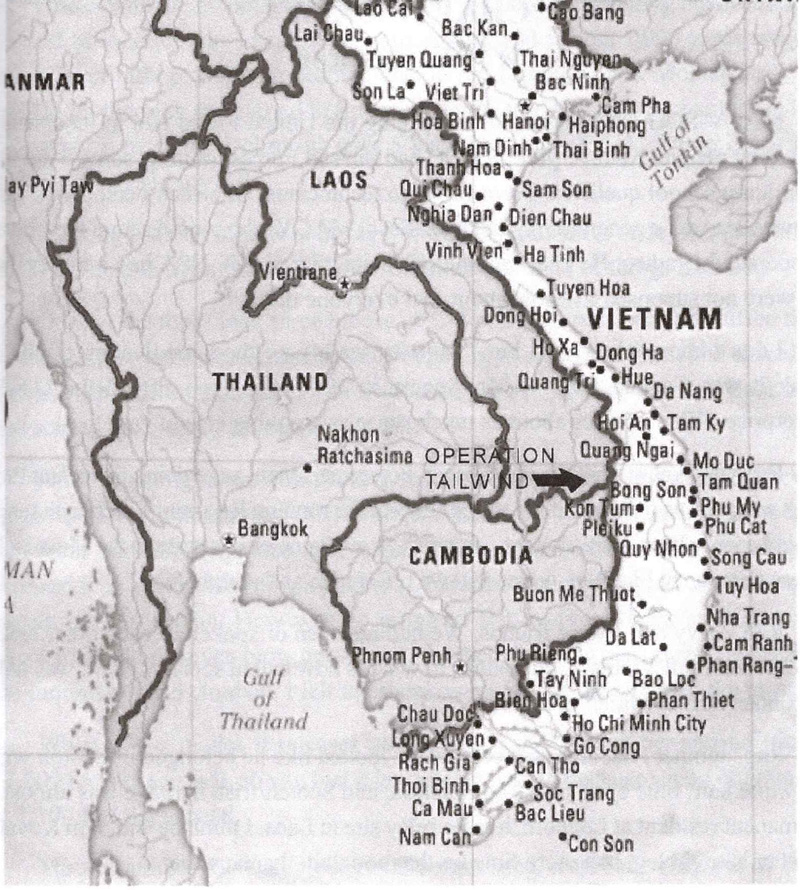
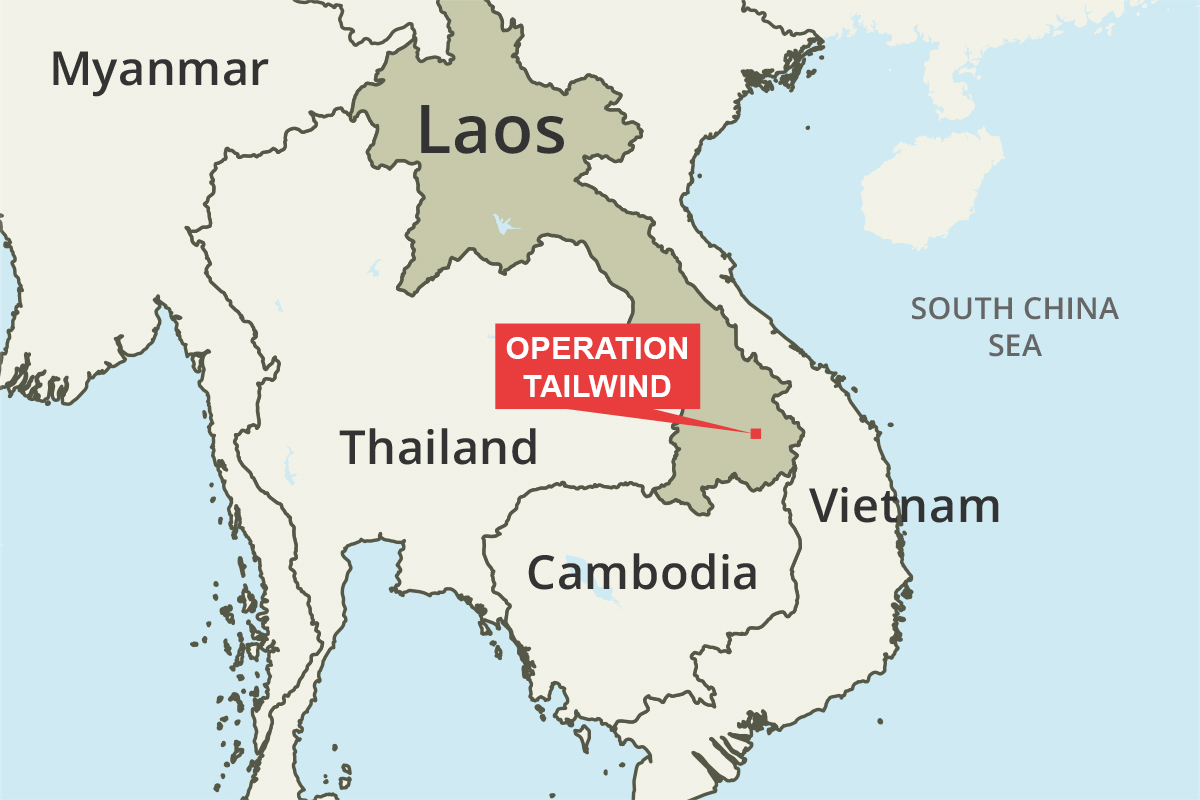
In September of 1970, came a new mission for the Hatchet Force. A road interdiction in Laos, called Operation Tailwind.
There have been a lot of things written about this operation. Books by people who were never there. Like reporters from CNN, the New York Times, Time Magazine, and many others who accused Special Forces of using Sarin Gas to kill the enemy. In this case, North Vietnamese. This is because of the uncorroborated, nonfactual story of the mission of Operation Tailwind.
The major allegation was that Sarin Gas was used and/or the mission was to kill or capture American defectors thought to be in the village located inside Laos. These allegations triggered a landslide of investigations by the Department of Defense, Senators, reporters, and the mainstream media. Not the least of it, was the HBO special fictional series based on Operation Tailwind and the litigation that followed in the U.S. District Court in Northern California. Americans who were named, and their pictures published for the world to see, sued the reporting media for defamation after CNN and Time Warner printed a retraction of their stories stating there was insufficient evidence to prove the allegations made.
There were interviews of the people who were at CCC and on the mission like Mike Hagan, John Plaster (who was not on the mission but was at CCC), and others including myself.
One sunny afternoon, long after the war ended, I called Mike Hagan and asked him to meet me. While we were deciding where to meet, he suggested a coffee shop that I was not familiar with and I suggested a restaurant that he had no idea where it was. We finally decided to meet at Santa Fe High School. The only place that we were both familiar with.
Once there, we walked around a bit, looking at how the school had changed over the years. There was no longer a senior square (where underclassmen had to walk around it, or risk being stuffed into a trash can). We looked at the bars that now surrounded the school to keep out the interlopers. After these two old guys got tired, we sat on the planters in front of the school, under the flagpole, where I told him I wanted to do a story on Operation Tailwind and all the crap that was stirred up about the Sarin Gas and American Defectors.
He said, “Sure, why not, I relive it all the time anyway. It might as well be put down so people will know what happened even after I am gone.”
“Mike,” I said, “that is why I want to do the story in your own words. The way you remember it. Not the way some reporter would fictionalize it. Just from the way you saw things back then.”
I told him, “Sometimes I cannot remember why I walked into the kitchen, but I can remember every shot that was fired at me. Every shot I fired back and every man I saw doubled over into the fetal position and the face of every friend I had on RT Pennsylvania and how lucky I was. I remember each thought and picture in my mind of things I wish I had never seen. Also, every thought I had about Kandy Leach, a girl I dated right here at this school. She used to live right down the street from here.”
“Yeah, me too,” Mike said with a sigh.
I immediately said, “Don’t tell me you knew her too.”
“NO, no, no, I didn’t mean it that way, I didn’t even know her, I was just……”
I started laughing and he called me an ass after he realized what I just did to him. With that, he started talking to me like Vietnam was yesterday. I think for both of us it was just like it was yesterday.
“It was September 11, 1970. It was hot, muggy, dusty, and uncomfortable. You know? Just a typical day in beautiful Vietnam just like the days before and the days after the mission…”
The Hatchet Force was staged at Duc To. On the morning of the 11th, the force was flown to a landing zone near the Laos village of Chavane. Mike Hagan and I were there with fifteen other Americans and about a hundred Montagnards. There were three Sikorsky CH-53 Sea Stallion helicopters and a dozen Cobra helicopter gunships, plus an Air Force contingent.
The Marines had never lost a CH-53 Stallion and were the perfect choice for the insertion into Laos. They were the only helicopters with the range and capacity to carry the Hatchet Force into battle. Even though the pilots did not have any cross-border experience there is nothing that could have been said the pilots would not figure out within the first few seconds of being shot at.
The mission objective was to draw the enemy away from a large CIA force that was pinned down about forty miles to the east. They were trying to retake ground that had previously been overrun by the North Vietnamese, code name Operation Gauntlet. The Hatchet Force was to create hell behind the lines so the NVA force would have to withdraw from one battle to take on the threat to their supply line caused by the Hatchet Force.
1st LIVE IN-PERSON – Interview with Jerry Guzzetta MACVSOG CCC’s RT IOWA & RT PENNSYLVANIA
If you haven’t yet visited Bud Gibson’s YouTube channel “The Reconnaissance Cast” do it now! Click on the image above to view the episode in which he interviews Jerry Guzzetta live and in person!
Operation Gauntlet was a five-thousand-man force of irregular troops and half were to retake the Bolovens Plateau that had been overrun. The other half was to disrupt communications and the supply line in Southern Laos. The mission was conducted between September 3rd and September 23rd of 1970.
As the Hatchet Force set down on the LZ, they headed west towards the tree line and the jungle to take cover. The Force led by Captain Eugene McCarley did not stay on the LZ but started moving at a fast pace. Less than five hundred yards off of the LZ they came upon a bunker line filled with ammunition and rockets.
A demolition team set time delay fuses and blew it all to hell. There were numerous secondary explosions. Mike Hagan said that stuff cooked off for the next six or eight hours.
The Force kept going and as they went, they ran into small units of NVA. Each time they managed to fight them off with the use of ground fire and the help from Cobra Gunships, A-1E, and Specter C-130 Gunships. But with each encounter, Montagnards were wounded. Some were seriously wounded, which impeded the fast movement of the Hatchet Force.
Capt. McCarley kept them moving. If they stopped and the NVA found them, McCarley’s Force would be pounded by artillery that was known to be in the area. It was the same artillery that was sending up the triple AAA at the aircraft.
As the Force moved along the mountain side, they were able to look down on the Ho Chi Minh Trail. The area McCarley was looking at was covered with a large force of NVA soldiers and numerous Russian trucks.
The A-1E Skyraiders were sent in with bombs and guns that destroyed the trucks and routed the infantry into the jungle.
But McCarley still needed to get the wounded evacuated. So, a CH-53 Stallion was called in with medics, Staff Sergeant John Padgett and Sergeant John Browne. I did not know Browne, but I did know Doc Padgett. He would come into the R.O.N. bar and get a little hammered with my roommate, Blue, and me from time to time. Padgett was tall. As I remember, he was over six feet tall and stood eye to eye with Blue. He was always smiling and quick to laugh.
After what happened next, he would later tell Blue and me that God must have been in one of the empty seats of that helicopter. Because as they started to pick up the helicopter started receiving heavy ground fire and was forced to lift off. As the helicopter started to climb out, a B-40 rocket tore through the side of the helicopter and punched a hole in the gas tank, where it lodged, but did not explode. The hole was the size of a bowling ball. The helicopter flew a few miles and was forced down in a clearing.
Doc Padgett said he was covered in fuel from the ruptured gas tank. It was a miracle they did not blow up. A few minutes later, another helicopter landed and picked up the crew and the medics. Although shaken, no one aboard the chopper was hurt. That was the first CH-53 the Marines had ever lost.
As the second rescue helicopter started to lift off, it began to take heavy fire from small arms and some larger caliber anti-aircraft guns. It picked up the survivors and flew away, only to be crippled and forced to land in another clearing a few miles away.
Both multi-million-dollar aircraft were later bombed by the Air Force and destroyed.
A third helicopter landed and picked up the crew members from both downed helicopters. The third chopper got away without taking any hits.
Another helicopter lost during the battle was an Army AH-1F Cobra attack helicopter. This helicopter cost about seven million (1969) dollars. This helicopter was also completely destroyed by the Air Force after being shot down and the crew rescued.
By then, it was late and the light was beginning to fade. As the Force took defensive positions for the night, the NVA started to probe with small arms and B-40 rockets. By nightfall eleven of the sixteen Green Berets were already wounded.
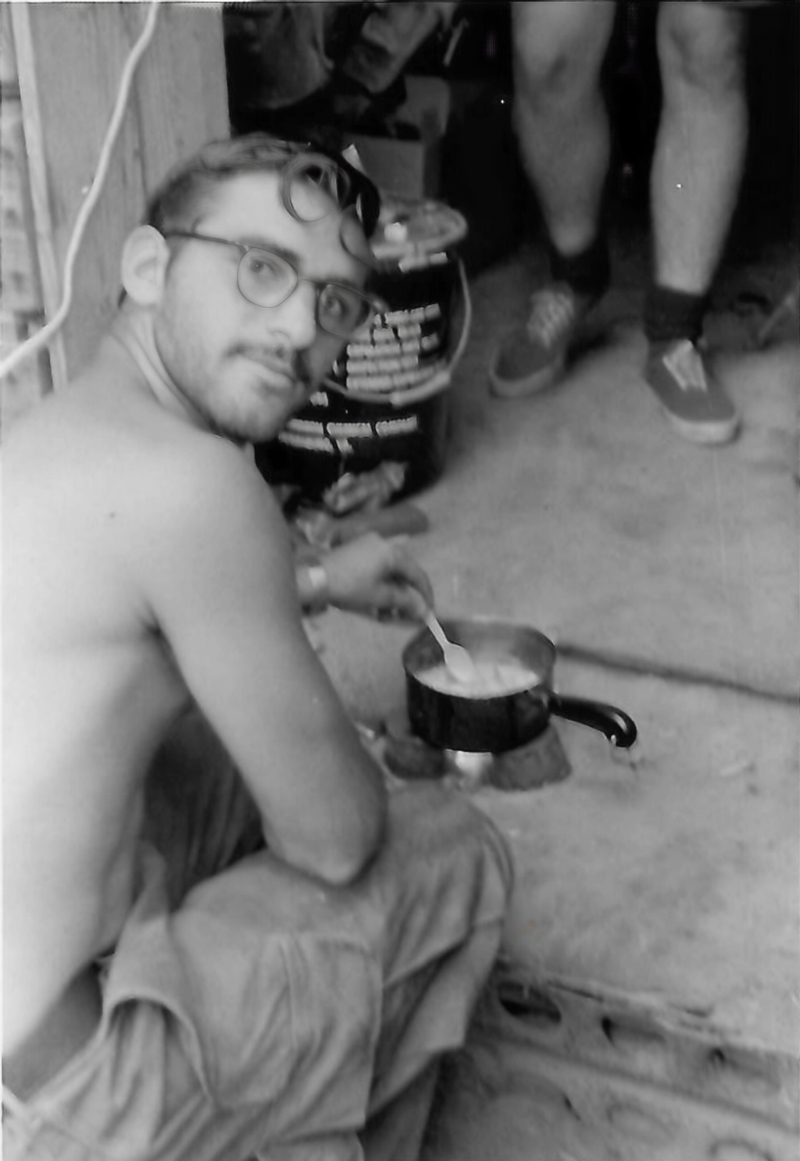
Jerry Guzzetta cooking with plastic explosive.
My friend, Mike Hagan, said it was not a serious shrapnel wound, it just hurt like hell. Those little pieces of hot metal under your skin make sitting down a real bitch. Then Mike Rose came by and cut a hole in the ass of his fatigues, so it was not only uncomfortable, but it was also now air-conditioned with tape covering the wound. Hagan said he did not know what hurt worse, the shrapnel going in or the medic taking it out back at Kon Tum.
By the next morning, on September 12th, everyone was tired because the NVA had kept everyone up all night trying to figure out exactly where the Hatchet Force was. Captain McCarley then moved the Force to higher ground after evading the NVA that day.
They dug in on a ridge that overlooked a well-used road. That night they suffered through the enemy probing again. As the NVA closed with the Hatchet Force, they were greeted with Claymore mines and a red stream of 7.62 cal. Bullets from the miniguns on the C-130 in orbit above the Force.
It was now clear that the NVA knew exactly where the Force was located. A B-40 rocket fired on the team exploded, wounding the Medic Rose and Craig Schmidt. It also injured two Montagnards.
Gary Rose, the medic, crawled to the two Montagnards and treated the serious wounds they had received. One rocket, four wounded.
By then all sixteen American Green Berets had been wounded. All were treated by Gary Rose. He ran through gunfire to treat the wounded Americans and Montagnards, even though he was wounded himself.
Captain McCarley knew on the third morning the NVA would hit them and hit them hard. So, before it got light, he got the Force moving west again. They had moved over ten miles from the original landing zone. Every man there was exhausted. Mike Hagan said he just wanted to lay down and sleep right there on the jungle floor. He was tired, out of water, dehydrated, and low on ammunition even after taking ammunition from a wounded Montagnard who was too injured to fight.
After about an hour, they came upon another bunker complex that had more ammunition that the NVA had ready to be shipped south and east into Vietnam. Nothing sounds sweeter than the sound of secondary explosions. The Force was a thousand yards away from the blast and Hagan said he could still feel the shock wave. He said it was a good feeling knowing that shit would never make it to Nam and kill Americans.
Mike also said, “We were too afraid to use the NVA ammunition because they could not be sure that the ammo had not been salted by a recon team and the shit would blow up on them. That ‘Eldest Son’ crap was all over the place.”
Day three brought new challenges. They came across a massive bunker complex. The retreating NVA took positions in the complex but fled as the Hatchet Force assaulted. Two of the bunkers remained occupied and kept fire on the Force while other enemy soldiers withdrew.
Heavy fire from the Force kept the enemy from firing from the bunker while Hagan and Montagnards flanked the bunkers and destroyed them with hand grenades. It was Hagan’s squad that assaulted the bunker.
Mike Hagan said he saw a tall blond guy at the bunker complex that he thought was Russian running with two Chinese into a bunker. Hagan said they ran underground and were blown up by Lieutenant Van Buskirk, one of the platoon leaders.
Day four found Medic Rose treating more wounded than he could possibly handle, but he did and kept people alive while ignoring his own wounds. Rose had now treated over half of the Force for wounds, saving their lives. Rose had been wounded three times but kept working.
When things quieted down, a search of the complex found it to be capable of holding a battalion-size force. As the NVA withdrew, they left behind trucks, mortars, over ten tons of rice, and a command bunker that was located below ground that yielded several pounds of intelligence.
In the underground bunker, there were maps covering the dirt walls. There were also boxes containing hundreds of pounds of paperwork and other intelligence. McCarley ordered the intelligence to be carried out.
The trucks were destroyed in place and white phosphorus grenades were set off on the rice tonnage as the Force departed. The livestock was also killed as a food source for the enemy.
By now, over sixty of the 120-man Force were treated by medics, some wounded multiple times.
Covey riders flying overhead reported large enemy forces closing in on the Hatchet Force and it was time for the Force to be extracted with its wounded and treasure trove of intelligence.
It was up to Captain McCarley to get the Hatchet Force out. He moved to a landing zone that was in a small valley but found that the hills surrounding the clearing could easily be defended by the NVA firing down on the Forces being extracted.
As McCarley moved to another landing zone, the Force was attacked by small units of NVA who were acting as a delaying force to hold the Hatchet Force in position while a larger unit moved in. The Hatchet Force still had its firepower intact and had something the NVA did not. That was air superiority. McCarley called in A-1E and jet fighter aircraft to clear the path for the Force. Cluster bomb units (CBU) and Napalm were dropped.
An A-1E pilot observed a large unit of NVA massing on a main road and dropped his ordinance directly on the NVA, scattering the unit with Napalm, bombs, and tear gas canisters. The single aircraft scattered hundreds of NVA that were closing in on the Hatchet Force.
The Force moved to a second landing zone that was on higher ground in less hilly terrain. McCarley was advised that CH-53 helicopters were enroute to his location. The Force was still taking small arms fire, but the fire was neutralized with air power.
Within the hour, a CH-53 landed and the most seriously wounded were loaded with boxes of intelligence from the bunker complex. The large Sikorsky helicopter lifted off safely.
This left just under half the Force still on the ground. McCarley then moved the remaining men to another landing zone as directed by the Covey rider.
Hundreds of NVA were now amassing all around the last forty men still on the ground. With help from above (and it was not God), the Force kept moving. That help was from Cobra gunships and F-4 Phantom jets that laid down dozens of canisters containing CS gas.
CS is Chlorobenzalmalononitrile (you will notice there is no “S” in the scientific name). The “C” is for Corson and the “S” is for Stoughton, the two scientists who first synthesized the gas in 1928. CS is really not gas. At room temperature, it is a powder but when activated it looks like a smoky gas.
This gas is a blinding irritant that is ten times more powerful than CN and the effects last up to eight hours. CS also comes in a powder form that will lie dormant until disturbed. CS will force the eyes of the recipient to be closed. This blindness is only temporary, but can cause permanent respiratory damage in large concentrations. Despite this, it is considered a less than lethal weapon. Besides, the NVA did not have standing or an attorney to sue because remember, they are not in Laos, and neither were we.
During Operation Tailwind, CS Gas was used to blind enemy anti-aircraft gunners and disorientate the enemy. The NVA had not been trained with or exposed to tear gas.
Several canisters were dropped on enemy soldiers and CS was also delivered by F-4 Phantom jet fighters in rockets.
The enemy troops were being pounded with everything the aircraft carried. Cluster bombs, rockets, tear gas, Napalm, high explosive bombs, mini guns, and 40 mm cannon fire from the Cobras and Claymore directional mines from the Hatchet Force while the Force moved to yet another landing zone.
As the Force led by Captain McCarley broke out of the jungle onto the next landing zone, the CH-53 Stallion was overhead and on approach to land. The last forty men piled onto the helicopter and lifted off as small arms fire and mortar shells rocked the LZ.
The objective of the mission was to disrupt enemy lines that would cause the NVA to withdraw from the battle with the CIA Mnong forces that were trying to retake a plateau that had been overrun. That was exactly what was done.
By the time it was all over, the Hatchet Force had three Montagnards KIA, thirty-five wounded. All sixteen Americans were wounded. The NVA lost one hundred forty-four soldiers to the Hatchet Force with an unknown amount wounded. An estimated three hundred NVA were killed by air power, with an untold amount wounded. Three CH-53 Sea Stallion helicopters were also lost during the mission.
The brass in Saigon could care less about anything else, it was the three lost helicopters that cost millions of dollars each. Now the big decision was, who were they going to dock to pay for them? I do not know how much a CH-53 Sea Stallion helicopter cost in 1970, but an estimate is about sixty-two million dollars each. At 1998 prices, they cost eighty-nine million dollars each.
Phantom and other jet fighters flew over six dozen sorties dropping tons of bombs, rockets, Napalm, and tear gas. The A1-E aircraft flew over twenty-eight sorties and there was an unknown number of Cobra helicopters that flew support and a C-130 gunship aircraft that constantly remained over the troops on the ground.
A few weeks after the mission, Mike Hagan and I were having a beer at the RON bar with a few of the pilots that flew the mission. The bar was open and no one paid for a drink that night. Hagan and I were sitting in the room that I shared with Blue because the bar was full. I told him I was now a short timer with only one hundred fifteen days left on this tour and that I really could not wait to see my girlfriend after being apart for a year.
Mike told me that after six months someone else had probably moved in and was having sex with her and wearing my clothes. He was joking, but as it turned out he was half right. My clothes would not fit the guy. Years later, we sat on a planter in front of Santa Fe High School and laughed about it. Mike said he could never forget the date of the mission. Although it had no meaning at the time, in later years it did. It was on 9-11.
But the story does not end here, in 1998 a CNN reporter said in a special report called The Valley of Death based on Operation Tailwind that Special Forces used Sarin gas on North Vietnamese soldiers to affect the extraction of the American Forces on the ground. It also stated the objective was to locate and kill American defectors who were known to be in the area.
The article also stated that the Special Forces destroyed a village, and killed civilian men, women, and children. They also killed American defectors and used Sarin nerve gas to suppress enemy fire to extract the friendly forces. This was repeated by Time magazine with the headline, “Did U.S. Drop Nerve Gas?”
Naturally, this stirred the pot twenty-eight years after the mission took place. Therefore, the Under Secretary of Defense interviewed everyone he could contact. This included all the Generals from MACV, the head of SOG and the medics, including Gary Rose.
Colonel Sadler, the SOG Commander, gave the Secretary a full briefing of the mission because Sadler was the one that planned it.
Captain Eugene McCarley, the commanding officer of the Hatchet Force told the investigators the Force was almost out of ammunition. The spotters in the aircraft above could see the enemy massing for an attack and called for tear gas. At no time was gas even requested by anyone on the ground. The gas was used to rout the enemy forces, to prevent the forty men on the ground from being overrun so they could be extracted and it was CS gas, not Sarin.
CNN said it was a village the Hatchet Force went into. Captain McCarley said it was not, it was a compound with bunkers and a logistics area. Not a village. The fifty-four people killed were combatants, not civilians. They were Viet Cong and regular NVA troops, in uniform.
Medic Rose was also interviewed by the DOD and in a statement copied from the record, Rose vividly recounted the final hours of the mission as the SOG force moved to the evacuation point:
“We got hit with gas. It was CS [tear gas]. I know what CS is from basic training. It is like a skunk. Once you smell it, you never forget, even if it is fifty years later. It was definitely tear gas. I was wincing, my eyes watered, and my nose and lungs burned. You turn your face into the wind and it clears. My wounded were in distress. I never saw any evidence of nerve gas. It was CS! It is criminal to say our own Air Force would drop nerve gas on us!”
Rose later added: “I’m living proof that toxic gas was not dropped on us that day. Nobody showed any signs of exposure to toxic gas.”
Some of the ground troops were exposed to the gas and all knew it was tear gas. From the experience a soldier receives in basic training going into the gas house, you never forget the smell or the burn from the gas.
In the report submitted to the Department of Defense, Sergeant Hagan was the only person who reported seeing any Caucasians. He claims that when the SOG forces entered the base camp area, he saw “a blond-haired guy, two Chinese, and at least one Russian.” He believes the “blond guy” was a Russian who went down a “spider hole” and was blown up by Lieutenant Van Buskirk. Hagan told me he tried to shoot the blond guy, but only got off two shots and had to change magazines. By then, the guy was down the hole.
He also said that he sucked in some of the tear gas and used the remainder of his water to wash his eyes, but it still hurt to breathe and he only got a small dose because the wind shifted and blew some of the gas in his direction. The four Montagnards he was with looked like they were playing a game of follow the Leader. Only one of the Yards could see and the other three, with each having a hand on the other’s shoulder being led because they were out of water and could not wash out their eyes.
All of the Americans that were on the team were interviewed either in person or over the telephone and none reported the use of nerve gas.
The existence of American defectors at the enemy location was also debunked by the evidence.
In an interview with the head of the Joint Chief of Staff and the Pentagon former SOG Commander, Colonel John Sadler, former SOG Commander U. S. Army then retired stated when asked about American defectors that there was no presence of Americans. There was a standing imperative order, that if you saw POWs, the POW became your primary mission, regardless of what mission you were on. Further, there were known to be only two American defectors and they were not at this camp.
The CNN reporter also suggested that “war crimes” were committed in the use of Sarin gas and the killing of civilians in a village the Special Forces had overrun.
The only problem with that was that the Special Forces did not encounter a village, it was a bunker complex and logistics area for the North Vietnamese 559th Transportation Group. Fifty-four enemy combatants were confirmed killed while they were defending the complex. Not one civilian casualty was reported.
The major problem that CNN could not overcome was the use of Sarin Gas or any other nerve agent. Sarin Gas returns to powder form and contaminates the soil where it lands.
At the Jewish prisoner-of-war camps in Germany and Poland, you will not find any birds in the area. Nothing other than plant growth. If one were really interested, a deep soil sample would be the prudent thing to do. But I am not the one to tell a major worldwide news agency that is known for its veracity how to conduct an investigation. But, and there is always a “but,” CNN investigators never contacted the North Vietnamese.
The Americans did. In the reports from the PAVN, there is no mention of deadly chemical agents ever used.
The following is from the official Department of Defense Report. “The Defense Prisoner of War and Missing Personnel Affairs Office also reviewed the People’s Army of Vietnam’s (PAVN) official history of military operations on the Ho Chi Minh Trail; the PAVN’s official history of the 968th Volunteer Infantry Division; and the PAVN’s official history of its Chemical Command.”
The use of a deadly chemical agent is something that should not be overlooked.
The CNN report did have consequences for the military. It was partly responsible for the military suspending the use of tear gas in combat.
During this conflict, when a six or eight man reconnaissance team was put on the ground behind enemy lines, the team did not want to make contact with the enemy. All the training deals with how to break contact with an enemy. Recon teams cannot win a sustained battle. The use of tear gas was a great asset to use in order to evade the enemy forces and let the team escape and evade.
Tear gas saved many American lives. Including mine. If it were not for tear gas, our eight man recon team would have been overrun and someone else would have to write this story.
Thanks to CNN, tear gas can no longer be used for fear that it might lead to an escalation to more deadly chemical agents.
I will never understand the logic behind this thinking. You can use Napalm and cluster bomb units to drop on an enemy. You can use rockets filled with small steel darts that will screw up someone’s day. You can use a fifty-caliber round that can take off an enemy’s limbs and dismember him. But you cannot use less than lethal tear gas, which will not kill the enemy (even though the enemy would wish he were dead after breathing in CS gas). Next, the military brain trust will ban bullets because they might kill someone.
CNN did pay a price for its reporting errors. Both CNN and Time Magazine hired a constitutional attorney from New York to conduct an internal investigation.
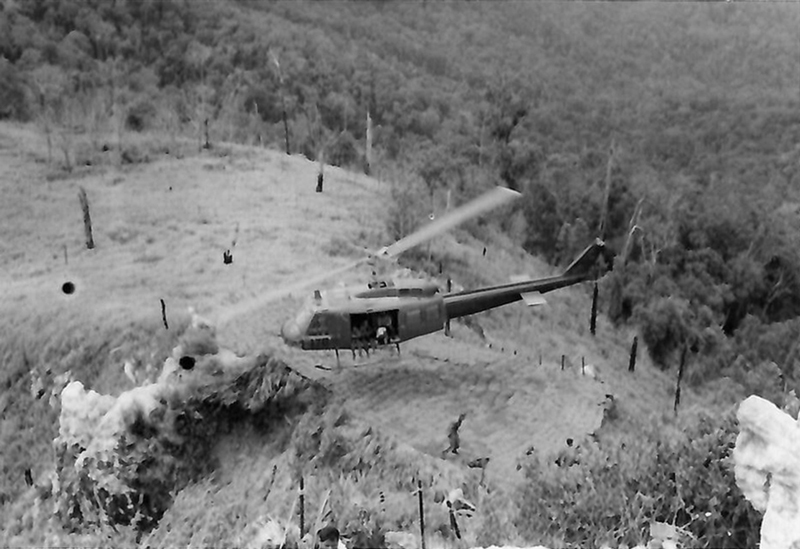
It was the conclusion that the journalism was flawed and the report should be retracted with apologies made to those targeted by the reporting of unconfirmed allegations.
CNN fired the two producers of the report, April Oliver and Jack Smith, when they refused to resign. The senior producer of CNN, Pam Hill, resigned. Reporter, Peter Arnett, was reprimanded and then quit and went to work at NBC.
CNN issued a retraction after it was accused of misquoting sources and showing their pictures. In July of 1998, CNN’s president and CEO stated that the allegations made in the aired The Valley of Death and the related reports cannot be supported and there was insufficient evidence that a deadly gas was ever used.
Further, it could not confirm that American defectors were targeted or if they were even there in Laos.
This was after they quoted and released names and pictures of who they claimed were their sources. You will notice what was not said. The report stated there was not enough evidence to support the allegations. Not that Sarin gas was not used, and less than lethal tear gas was.
My friend and classmate, Michael Hagan, was really pissed off and filed suit against the cable news for defamation. So did a lot of other people that CNN outed. The court then combined all of the civil cases against Cable News into one Tailwind litigation.
After eight years of litigation, the Ninth Circuit Court of Appeals (in California) ruled that the story, The Valley of Death, did not defame anyone and ruled in favor of the defendant news organizations.
Sitting on the planter in front of the school, I could tell that I had opened an old wound. It was not my intention to upset Mike. I could tell that in his mind he was reliving Tailwind.
PTSD is real. The bullet wounds and shrapnel wounds that are on your body heal and are forgotten. The mind is just like a file cabinet. Sometimes the file you do not want to use stays quiet. But every once in a while, you run across it and there it is in living color and the scab is ripped off the wound and again it bleeds. The memory is just as vivid as the day it occurred.
To paraphrase Shakespeare, “Then he will strip his sleeve, show his scars, and say these wounds I had on Crispin’s day…. Old men forget, yet all shall be forgotten.”
When you look back at Tailwind, you can Monday morning quarterback and say, the CIA had five thousand men and split their force and could not stave off the NVA. So, they sent in one hundred and ten men from MACV-SOG to do the job. I’ll leave that logic to the mathematicians. One hundred men to draw off an enemy that five thousand men could not stave off.
One night while I was sitting inside a bunker smoking a cigarette, in walked Mike Hagan.
“How you doing Guzz?” “Good Mike, pull up a sandbag and have a seat.” This was a few weeks after the mission when my recon team had guard duty and he was walking back from the mess hall with a beer in his hand. I really felt that I owed him and everyone else on Tailwind an apology for the water balloon drop. So, I told him what had happened.
That is when he started talking about the mission. He said the night before the drop that his squad had dug in. They had no sooner stopped when the NVA started recon by fire to find the company. He said that bullets started cracking so close to his ears he had to hold his nose and blow outward to equalize the pressure. “Crack! Crack! Crack! Boom!” were the sounds of the AK-47s, punctuated by the explosion of an RPG.
Mike said he had dug a little hole to fight from, but when that shit started happening, he was going to dig his way to China.
Mike then thought about that and said, “China, hell I would have to dig north, screw it, I’m going home, and I started digging to California.”
I told him they probably would have gotten him for desertion.
He told me that would have been okay with him as long as he was somewhere other than where he was. He added that within the hour the hole was almost deep enough to stand in.
Mike was kidding, of course. He was a squad leader on Operation Tailwind. Talking to Mike over forty years later he was still a little angry that prior to the mission they were told one thing and after the mission they found out that the CIA was trying to regain ground that had been overrun. The CIA had five thousand men. They had split their forces and sent half to take back the ground and the other half somewhere else.
According to Hagan, the CIA Army were getting their ass handed to them, so MACV sent in just over one hundred men to raise hell to draw the NVA from the CIA’s five thousand men to the one hundred men from MACV SOG.
Hagan chuckled as he said, “It worked. What were they thinking? We were lucky we were not all killed, instead we only had three KIAs.”
Hagan received his Silver Star for taking his squad and flanking the NVA machine gun bunkers and eliminating the threat to the company.
My friend, Michael Hagan, died on May 29, 2023, at age 72 from complications from Agent Orange. He fought the failure of multiple organs like the lion and warrior he was. Fifty-three years after Operation Tailwind, Vietnam is still killing us. Mike had a Silver Star, two Bronze Stars, and three Purple Hearts.
It was fitting that he, a true warrior, died on Memorial Day. That battle not only won Mike a silver star, the medic, Gary Rose, another Alabama boy, received the Medal of Honor.
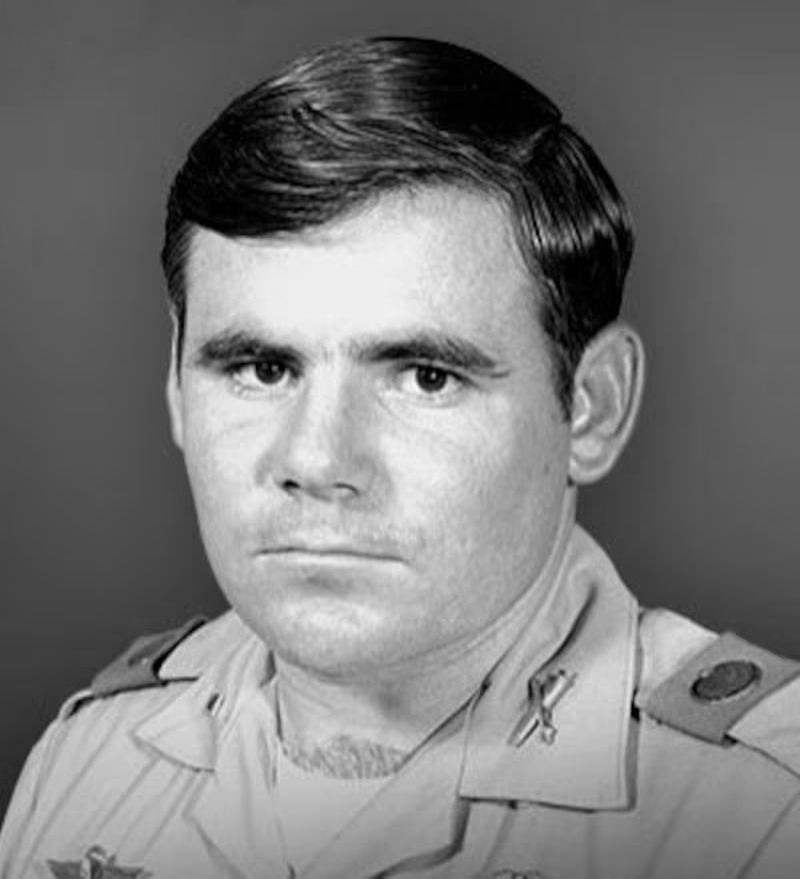
Gary M. Rose
In September of 1970, MACV had another brainstorm and called it Operation Tailwind. Rap Peavey was again at Leghorn doing a magnificent job fighting boredom and monotony and doing a real good job of it watching the A1Es expend the remaining ordinance they were carrying on a nearby rock formation because they did not want to land with it. Once again, he plugged in his recorder and captured the sounds of battle as another SOG member was earning a Medal of Honor. Although it was unknown at the time.
An operation of this size had to pass through many hands, some of those hands belonged to the Walkers.
Gary M. Rose was then a Sergeant at CCC FOB 2 in Kon Tum. I knew him like I knew everyone else on the FOB. We all ate at the same mess hall and drank at the same bar, if you did not drink you went to the bar to hear what other team members had to say, and if nothing else, socialize or just stop by to see what was going to get broken.
I did not really know Gary Rose. I knew of him, his name, what he did. We were at the same place at the same time. Now, I guess today you would call him a co-worker. But oh, what work we did.
Of all the people at Kon Tum, I never would have the foresight to pick Rose as the person who would receive the Medal of Honor.
As I said before, quiet and unassuming, and never brought attention to himself, just a guy doing his job.
In Operation Tailwind, Sgt. Rose was a medic flying into the battle on one of the Large CH-53 Sikorsky (Sea Stallion helicopters). These helicopters were armored, and until that day, the Marine pilots flying them, had never lost a Sea Stallion on an insertion before. That day, flying for Special Forces they lost three.
Later, after the mission, the Marines sent word, they would only come to our aid, but would not put a force on a helicopter insertion ever again after what happened on “Tailwind.”
Later, after the mission, the Marines sent word, they would only come to our aid, but would not put a force on a helicopter insertion ever again after what happened on “Tailwind.”
Sitting around the table, at the R.O.N. bar, other members of the mission were talking about the helicopter and how it had taken several hits when a B-40 rocket or Rocket Propelled Grenade (RPG) had penetrated the skin of the ship and lodged in the gas tank and ruptured it. JP-4 fuel was pouring all over them and all of the bells and whistles were going off in the cockpit as the pilots were trying to maintain control before it blew up.
The Pilot had to put the bird down in a clearing not far from the inserted team. Later, the helicopter was destroyed by the Air Force, who bombed and used napalm on it.
Myself and anyone else at the table, who was not on this mission, just listened. Mainly because this shit is exciting and starts the adrenalin pumping a little. With the FOB full of adrenalin junkies, a shot, a beer and a little adrenalin is just what the doctor ordered to harden the arteries.
Most of us are still excitement junkies, even now at our age. Hell, I was planning to ride a Brahma Bull to celebrate my 65th birthday, but I fractured my neck while training to go to Iraq as a bomb technician (at age 63). That ended that, but I still went to Iraq. I did not know my neck was fractured until I started having trouble with my hands and feet eight months later. I just thought I had a whiplash that would not go away.
On the day of the mission, Sgt. Gary Rose, the medic, did what he did best. He started saving people’s lives, after just surviving a controlled crash landing aboard a Marine helicopter.
Once on the ground, Rose ran through machine gun, mortar, and rocket fire to aid the wounded. While other members of the force were under cover, Rose was exposing himself to enemy fire to get to the wounded.
Rose was then wounded by a rocket propelled grenade. Despite his wounds, he continued to expose himself to enemy fire to get to the wounded. This occurred over a period of three days.
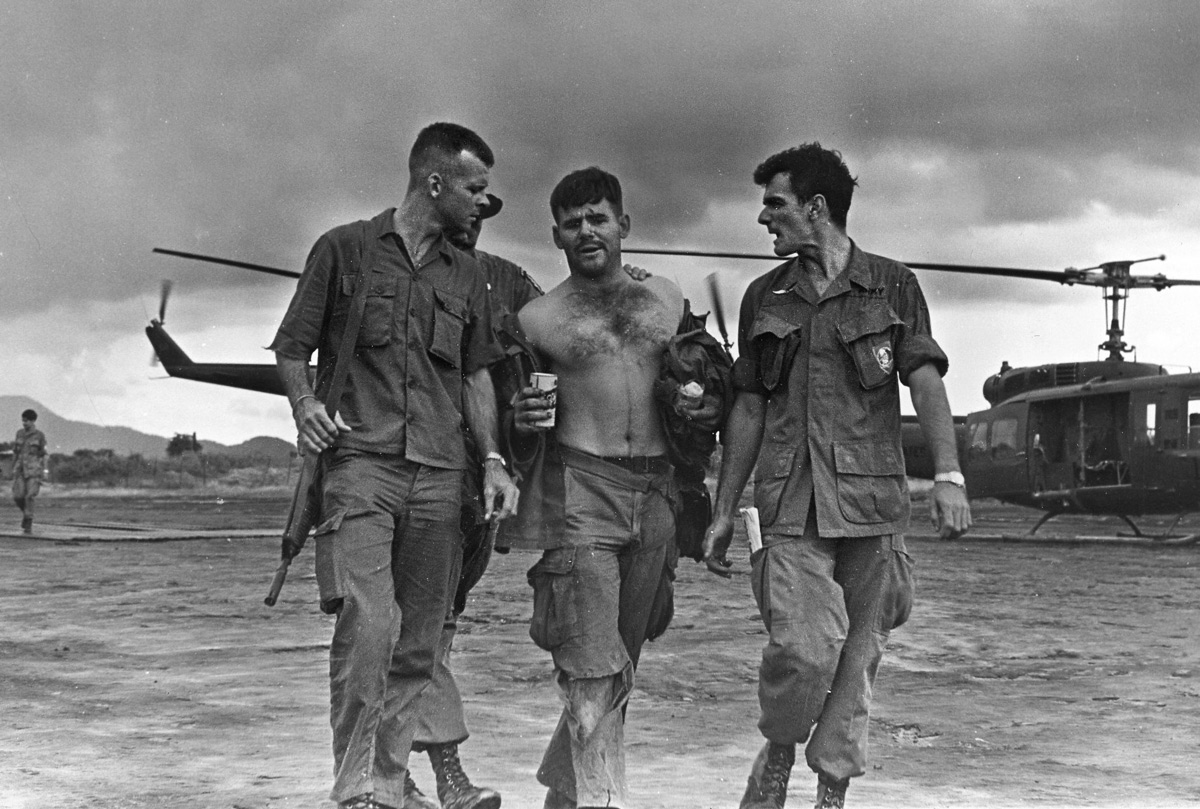
U.S. Army Sgt. Gary M. Rose is helped from a helicopter landing area after Operation Tailwind, 1970. (U.S. Army photo by Ted Wicorek)
What the citation did not mention was that the Hatchet Force ran out of water by the end the first day, because of enemy fire they could not be resupplied.
Americans from CCC filled up these long tubes with water. They were about four feet long and around eight inches or so, round and were the flexible plastic, like an air mattress. These tubes were to be filled with water and dropped at low altitude to the troops in contact.
We were told these tubes were tested and they worked. What they did not say was they were tested from a hovering helicopter and dropped from about fifteen to twenty feet to the ground.
We filled about twenty and loaded them on two helicopters. The plan was to fly over the team and drop the tubes with more ammunition over the team, so the helicopters did not have to touch down.
Two things, the Marines dropping the tubes and ammunition had never done this before. Neither had the pilots. The other thing was no one told them, or us, to drop the ammo first before dropping the water. By now you can see where this is going.
The helicopters, all loaded with ammunition and water, headed off into the sunrise. As the helicopters got over the teams on the ground, out came the water, then the ammunition. But because the ground fire was so heavy, the helicopters slowed to about sixty knots, but never stopped. What water tubes did not break on impact were hit by the ammo crates. Luckily, not all the tubes were destroyed. Out of the twenty or so tubes that were dropped, a few survived. The Force had just enough water to barely get by for the day.
What we did was fly over a thirsty company of men, bombard them with water balloons, and then tried to kill them with 40-pound crates of ammunition. We were lucky no one was injured. The ammunition got delivered but the water would have to wait.
The water was not just for drinking, it was used to clean wounds, cool the mortar tubes, machine gun barrels, and put in the LRRP rations that needed water to reconstitute them.
The water was not just for drinking, it was used to clean wounds, cool the mortar tubes, machine gun barrels, and put in the LRRP rations that needed water to reconstitute them.
So far that day, Rose had been wounded and shot down in a helicopter, he would later be wounded again, and shot down again. Before finally being airlifted out on the last helicopter.
This happened in 1970. Forty-seven years later, a white-haired Gary Rose finally received the Medal of Honor. I suspect it was delayed thanks to the CNN report and HBO special. He was put in for a Medal of Honor, but it was downgraded to a Distinguished Service Cross, then upgraded like it should have been in the first place.
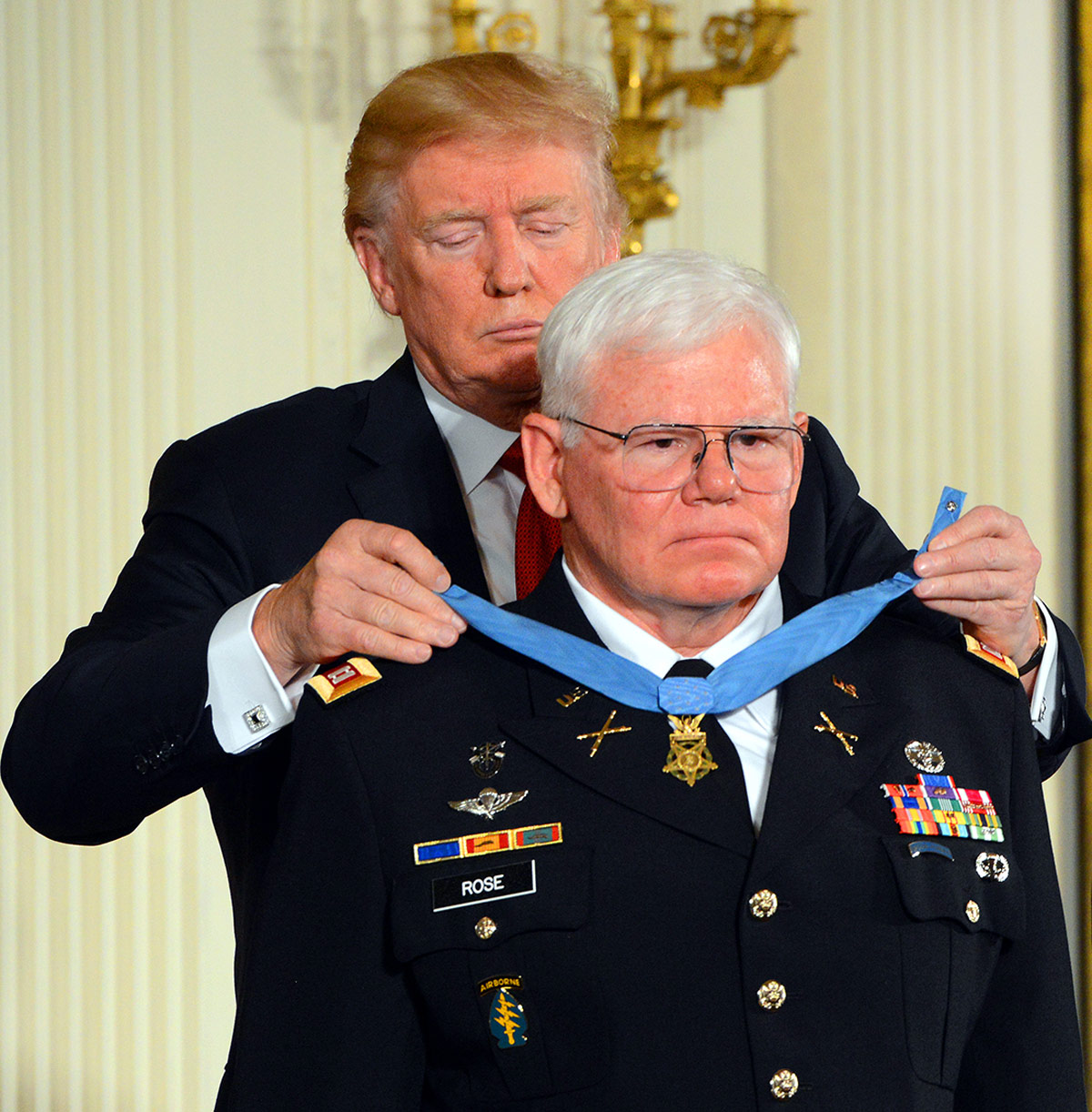
President Donald Trump places the Medal of Honor around the neck of Capt. Mike Rose, during an Oct. 23, 2017 ceremony at the White House, in Washington, D.C. (U.S. Army photo by C. Todd Lopez)
His citation reads: The President of the United States of America Authorized by Act of Congress, March 3, 1863, has awarded in the name of Congress the Medal of Honor to Sergeant Gary M. Rose United States Army.
For conspicuous gallantry and intrepidity at the risk of his life above and Beyond the call of duty: Sergeant Gary M. Rose distinguished himself by acts of gallantry and intrepidity while serving as a Special Forces Medic with a company-sized exploitation force, Special Operations Augmentation, Command and Control Central, 5th Special Forces Group (Airborne), 1st Special Forces, Republic of Vietnam. Between 11 and 14 September 1970, Sergeant Rose’s company was continuously engaged by a well-armed and numerically superior hostile force deep in enemy-controlled territory.
Enemy B-40 rockets and mortar rounds rained down while the adversary sprayed the area with small arms and machine gun fire, wounding many and forcing everyone to seek cover. Sergeant Rose, braving the hail of bullets, sprinted fifty meters to a wounded soldier’s side. He then used his own body to protect the casualty from further injury while treating his wounds. After stabilizing the casualty, Sergeant Rose carried him through the bullet-ridden combat zone to protective cover.
As the enemy accelerated the attack, Sergeant Rose continuously exposed himself to intense fire as he fearlessly moved from casualty to casualty, administering life-saving aid. A B-40 rocket impacted just meters from Sergeant Rose, knocking him from his feet and injuring his head, hand, and foot.
Ignoring his wounds, Sergeant Rose struggled to his feet and continued to render aid to the other injured soldiers. During an attempted medevac, Sergeant Rose again exposed himself to enemy fire as he attempted to hoist wounded personnel up to the hovering helicopter, which was unable to land due to unsuitable terrain.
The medevac mission was aborted due to intense enemy fire and the helicopter crashed a few miles away due to the enemy fire sustained during the attempted extraction.
Over the next two days, Sergeant Rose continued to expose himself to enemy fire in order to treat the wounded, estimated to be half of the company’s personnel.
On September 14, during the company’s eventual helicopter extraction, the enemy launched a full-scale offensive. Sergeant Rose, after loading wounded personnel on the first set of extraction helicopters, returned to the outer perimeter under enemy fire, carrying friendly casualties and moving wounded personnel to more secure positions until they could be evacuated.
He then returned to the perimeter to help repel the enemy until the final extraction helicopter arrived. As the final helicopter was loaded, the enemy began to overrun the company’s position, and the helicopter’s Marine door gunner was shot in the neck. Sergeant Rose instantly administered critical medical treatment onboard the helicopter, saving the Marine’s life.
The helicopter carrying Sergeant Rose crashed several hundred meters from the evacuation point, further injuring Sergeant Rose and the personnel on board. Despite his numerous wounds from the past three days, Sergeant Rose continued to pull and carry unconscious and wounded personnel out of the burning wreckage and continue to administer aid to the wounded until another extraction helicopter arrived.
Sergeant Rose’s extraordinary heroism and selflessness above and beyond the call of duty were critical to saving numerous lives over that four-day time period. His actions are in keeping with the highest traditions of military service and reflect great credit upon himself, the 1st Special Forces, and the United States Army.
To learn more about the author, Jerry Guzzetta, please visit his website IWalkedWithHeroes.com.
Leave A Comment