for the 82nd Anniversary of D-Day
In early 2026 several members of SFA Chapter 78 began discussing the idea of sending a Delegation of Chapter members to the 82nd Annual Anniversary of the D-Day Invasion in Normandy, France. Tom Turney was charged with researching options and ultimately it was decided that the Delegation would travel to Normandy with a non-profit that has been taking WWII Veterans back to Europe for years. This group, Walk Among Heroes (https://www.walkamongheroes.org/), is an amazing group and anyone considering traveling to attend future D-Day Anniversaries or other activities they host honoring Veterans would be well advised to travel with them.
The Chapter 78 Delegation that traveled to France included Chapter 78 President James McLanahan; immediate past president Aaron Brandenburg and his wife, Kathleen; Bob and Arlinda Crebbs; Tom and Jill Turney; Robert Casillas; and recent Q-Course graduate Connor Wynn (a pseudonym used to protect active operational security).
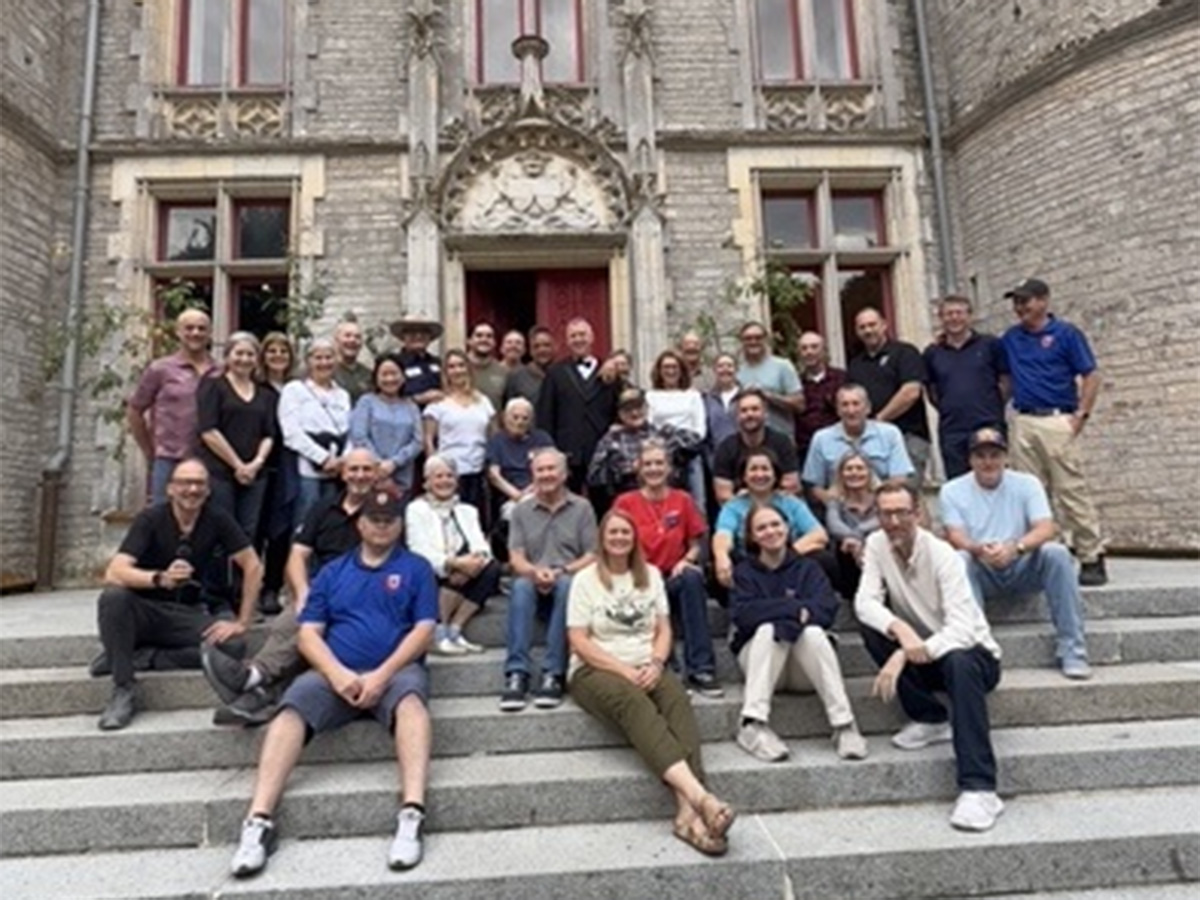
Walk Among Heroes D Day Group 2026
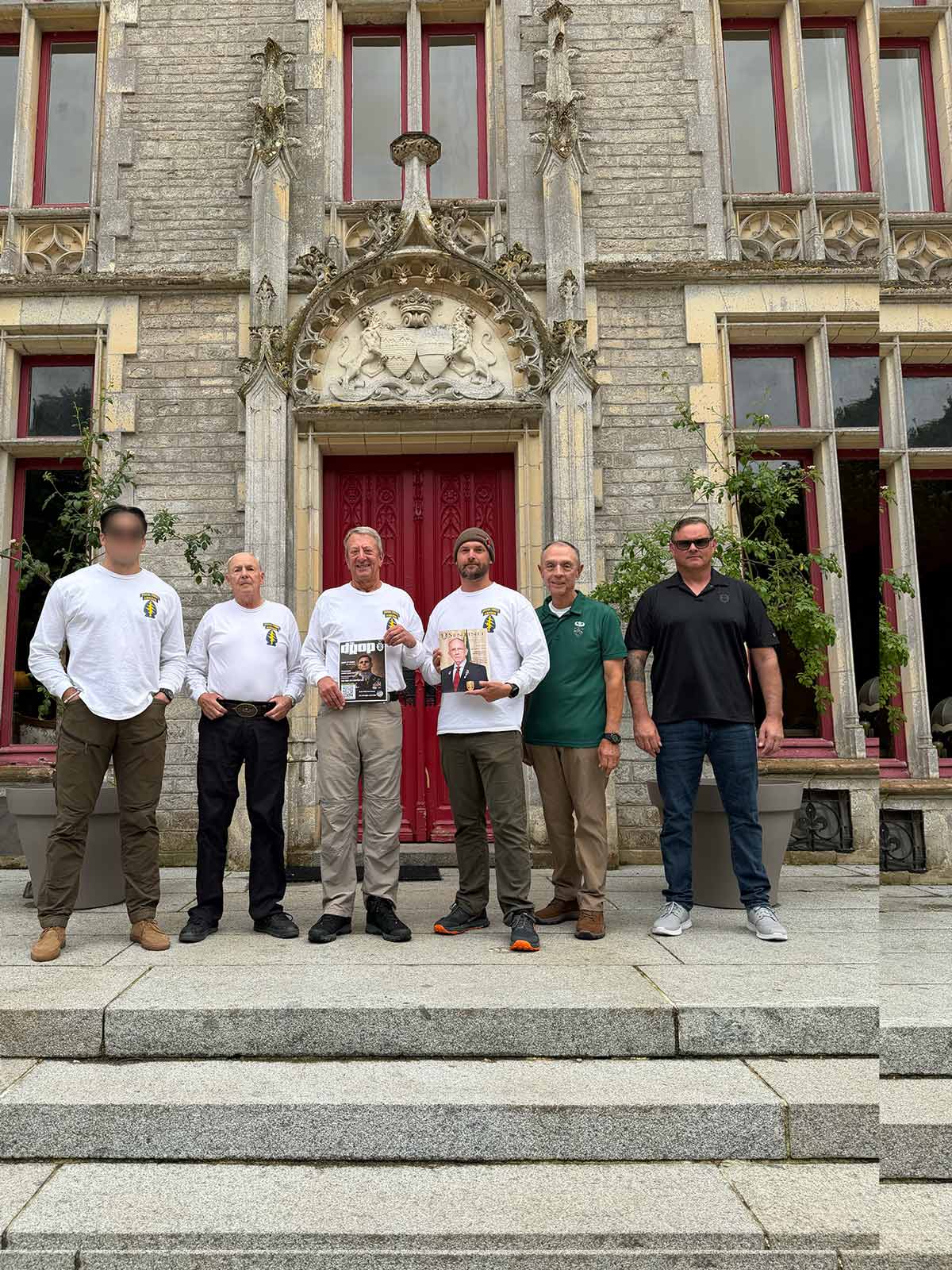
Chapter Delegation at our Chateau holding The Drop and the Sentinel.
As part of our Walk Among Heroes group, besides the Chapter 78 Delegation, were two WWII Veterans accompanied by family members (Courtesy of Walk Among Heroes), as well as others who had signed up to attend the trip organized by Walk Among Heroes. The two WWII Veterans (the “Pair of Jacks”) were:
Jack Boeki (102)
Born in the Netherlands, Jack Boeki was just 15 years old during the Nazi occupation of Europe. Repeatedly hunted by the Nazis, he escaped capture an incredible ten times through courage, quick thinking, and help from the Resistance.
As hiding places disappeared, Jack escaped to France, where he became involved in espionage operations with the highly secretive Office of Strategic Services (OSS), the organization that later became the CIA and laid the foundations for Special Forces.
Following a critical mission, the OSS sent Jack to the United States, where he enlisted in the U.S. Army Counter Intelligence Corps. On D-Day +2, Jack landed on Utah Beach with a team of agents and advanced alongside Allied forces through France and into Germany. His duties included locating, interrogating, and arresting Nazi operatives and war criminals.
Jack’s journey from hunted survivor to American intelligence agent reflects extraordinary resilience, courage, and determination. Throughout his life, Jack has dedicated himself to sharing the lessons of freedom, survival, and leadership. As a Holocaust survivor, liberator, World War II veteran, speaker, and author, he continues to inspire future generations through his testimony and public appearances.
His story remains a powerful reminder of the value of freedom and the strength of the human spirit in the face of tyranny and war.
Jack (with the assistance of his daughter, Anna-Lea and his son JJ), has written a book over the past 20 years which will be released later this year. The book is called From Fugitive to Freedom, and is available for pre-order on Amazon.
Jack Hugman (99)
At just 18, John “Jack” Hugman answered the call of duty, enlisting in the U.S. Navy in November 1945. As a Seaman First Class stationed at the Yokosuka Naval Base in Occupied Japan, Jack played a vital role in transforming a former Japanese kamikaze submarine factory into a key supply hub for American forces.
Working alongside the Navy Seabees, Jack operated German-made hammerhead cranes to unload cargo ships, manage critical inventories, and coordinate rail transfers of supplies to Army and Air Force bases across Japan. His two years of service helped lay the foundation for a peaceful post-war presence in the Pacific.
He was honorably discharged in 1947, having made a lasting mark in the early efforts of American rebuilding abroad.
Walk Among Heroes D-Day Group 2026
Each Chapter 78 Delegation member was assigned a day to be the scribe responsible for summarizing the day’s activities which would then be compiled into a story for the Sentinel. What follows are the write-ups for each day, with the name of the person writing about that day. You will note that Aaron Brandenburg has written most of the daily logs as most of us deferred to him based on his superb writing skills—thank you Aaron!!
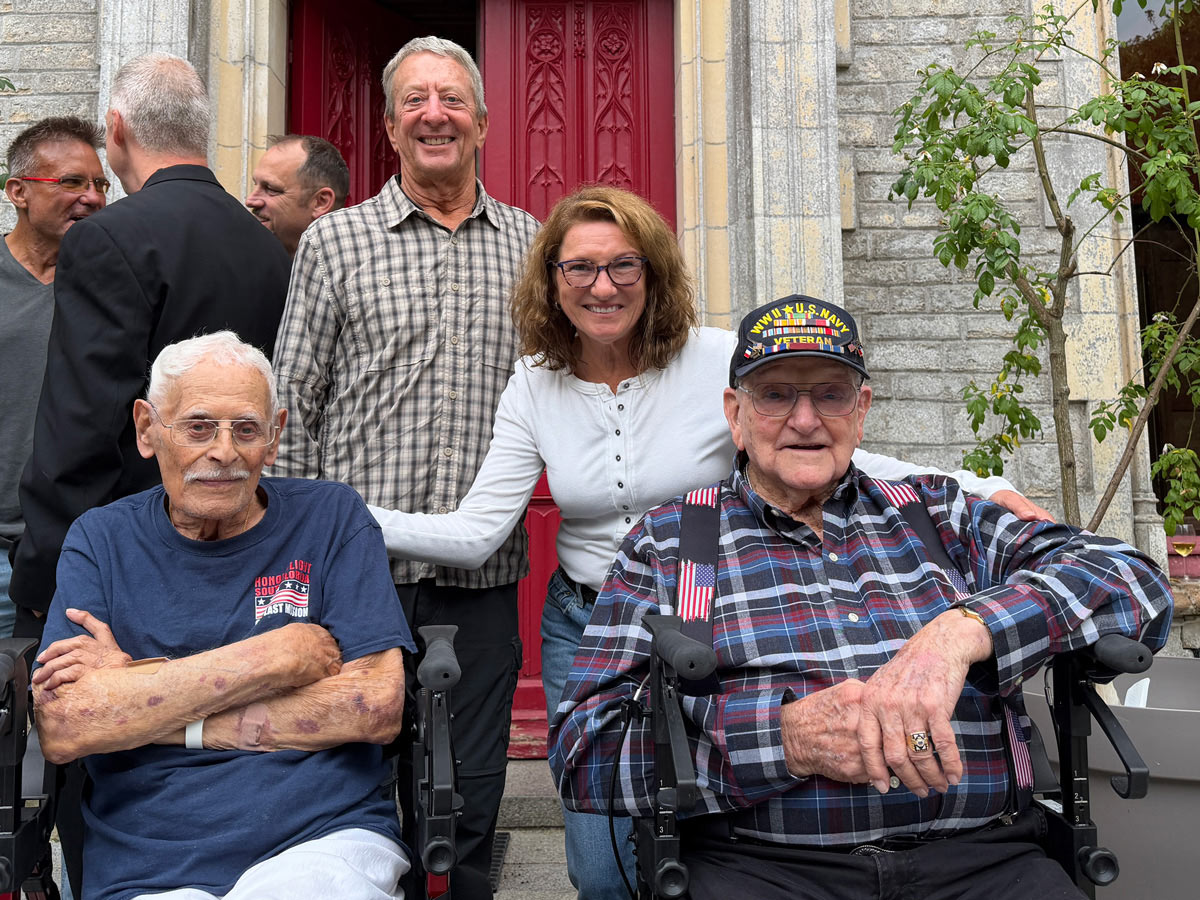
Left to right, Jack Boeki, Tom and Jill Turney, Jack Hugman
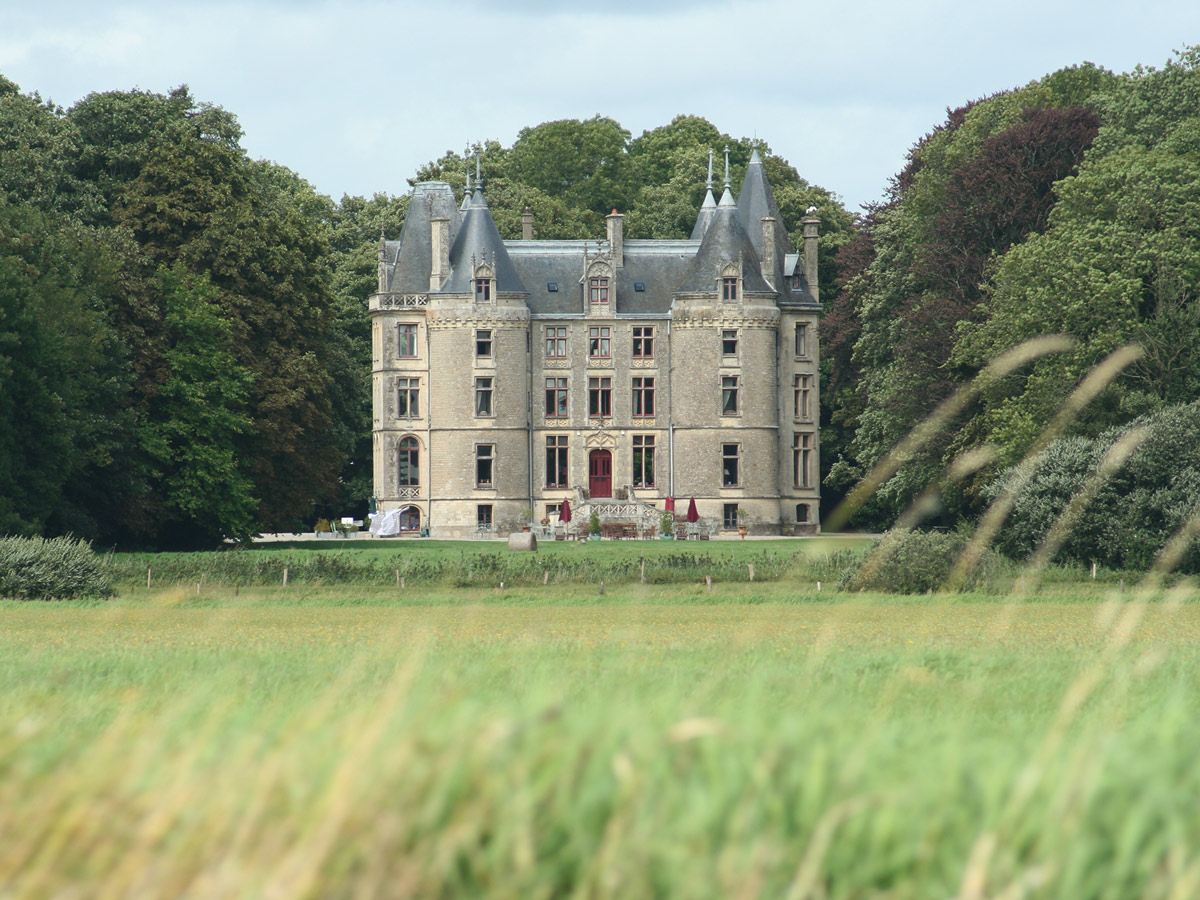
Château de l’Isle Marie
1 June 2026 – Aaron Brandenburg
We were picked up from our hotel by a volunteer from Walk Among Heroes. He was a former Navy SEAL, and we would hit it off from the moment he opened the van door. We drove for approximately 3:30 hours to the Château de l’Isle Marie, where we would be staying for the next 7 days. During the drive, I was daydreaming and staring out the window; I couldn’t help but marvel at the beauty of the French countryside. Similarly, I found myself asking why there had been so many significant wars and conflicts fought on these lands suited for a painting rather than carnage.
Eventually, we left the paved road and entered a dirt driveway lined with towering trees on both sides. Approximately 500m later, the path opened onto the site of the Château de Isle Marie. The Château is a magnificent structure both in size and grandeur; it remains a historic 300-acre estate in Picauville, Normandy. With origins as a 9th-century Viking fortress, the castle grounds have remained in the d’Aigneaux family lineage since the 11th century. Through time, the building has housed Vikings, French royalty, Nazis, and Allied leadership after the invasion. Now, for the week of 1 June to 8 June 2026, it will host all 22 guests, including two WWII veterans, Jack Boeki and Jack Hugman, as well as volunteers from Walk Among Heroes.
2 June 2026 – Aaron Brandenburg
At 0600, we departed the Château en route to Normandy Beach, approximately fifteen miles away. It was during that short drive that the true magnitude of the trip began to settle in. What had started as an opportunity to visit historic sites had evolved into something much more profound. We weren’t simply going to see a beach; we were about to stand on the very ground were ordinary young men accomplished extraordinary things and forever changed the course of history. It was here, on this sandy beach, that the selfless strived to repel tyranny and create lasting peace.
The sky was gray, it was cold, and there was an occasional drizzle that reminded me of the opening scene of Saving Private Ryan. We were the first tourists on the beach, and oddly enough, it was peaceful. The waves in the distance are crashing against the now-white sands, seagulls are overhead, drifting in the water-soaked wind, and several horses are in a fast trot, pulling carriages across the beach. It is a stark contrast to what I had expected to see; knowing the horrors that had unfolded in a place of such beauty is almost unsettling.
I begin to picture the ramp lowering, those 18 to 19-year-old boys stepping off the Higgins boats into chaos, and suddenly the statistics of D-Day become faces. The bluffs are no longer lines on a map, the tide is no longer just a photograph, and the beach is no longer history but a place. Mothers and fathers imagine their sons, and grandparents remember how young they were on that day. Even those who don’t consider themselves emotional are overwhelmed with tears of gratitude.
Wiping a tear from beneath rain-speckled, foggy glasses, I whispered, “Thank you.”
We departed Omaha for Pointe du Hoc, and with it came a dramatic change in scenery. Gone were the sweeping sands, replaced by a landscape permanently altered by war. The earth was pitted with massive artillery craters from eighty-two years ago, as though Normandy itself refused to forget what had happened on those cliffs.
Looking over the edge down at the water, I’m in disbelief. It is hard to believe that 225 Rangers scaled the 100 ft cliff under machine gun fire. Using, by today’s standard, primitive gear, ladders, ropes, and grappling hooks. It is one thing to hear the stories; it’s a whole different story to look down and realize that there was no cover and concealment.
Walking into the bunkers at Pointe du Hoc stirred a different emotion than standing on Omaha Beach; it was more a feeling of unease than of sorrow. The thick concrete walls and the rusted remnants of war made the fighting feel intimate. It was impossible not to imagine both young American and German soldiers occupying these dark and stale places. There is an eerie silence inside the bunkers, the air feels heavy, and almost sacred. Instinctively, we remove our hats, our conversations are reduced to whispers, and we pause a little longer than intended. These concrete bunkers were built to withstand everything imaginable, except the 2nd Ranger Battalion.
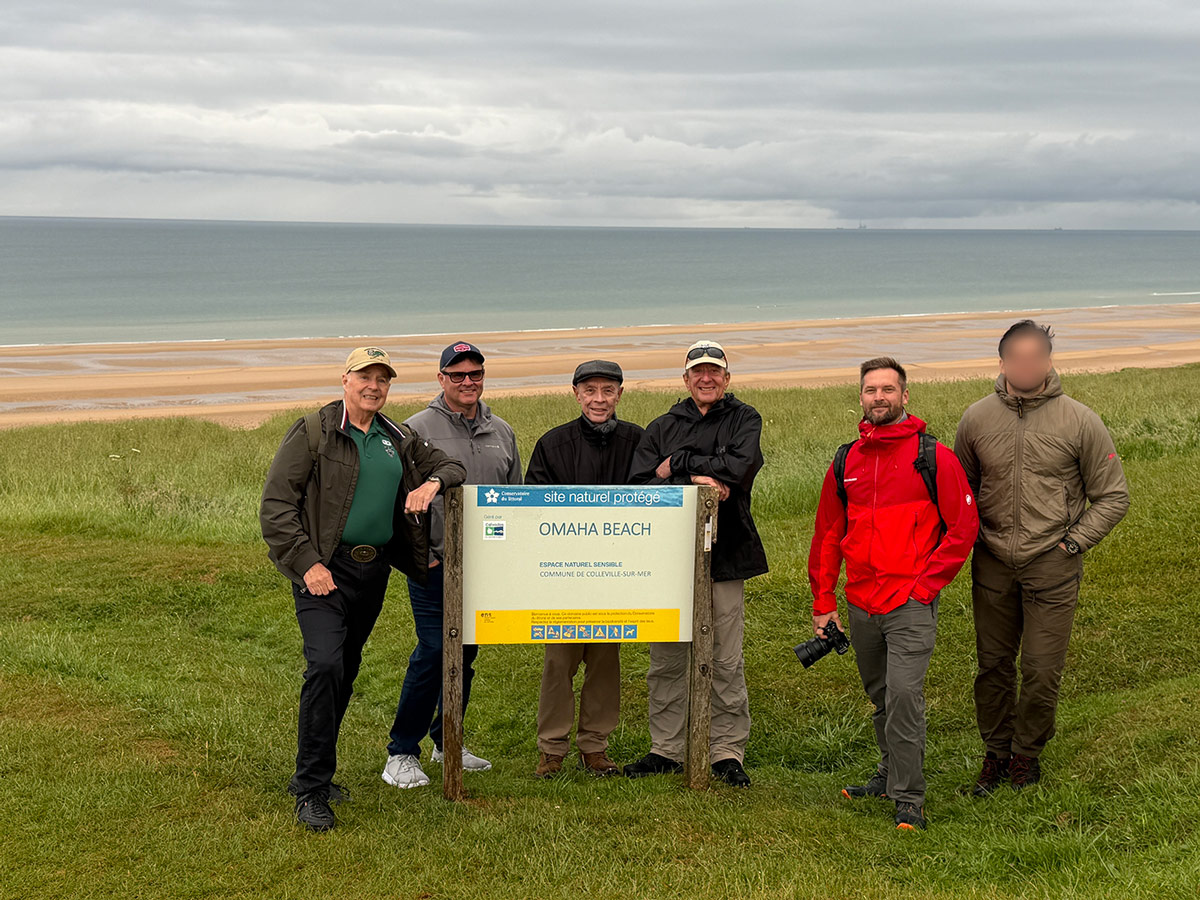
Chapter 78 Delegation standing above Omaha Beach
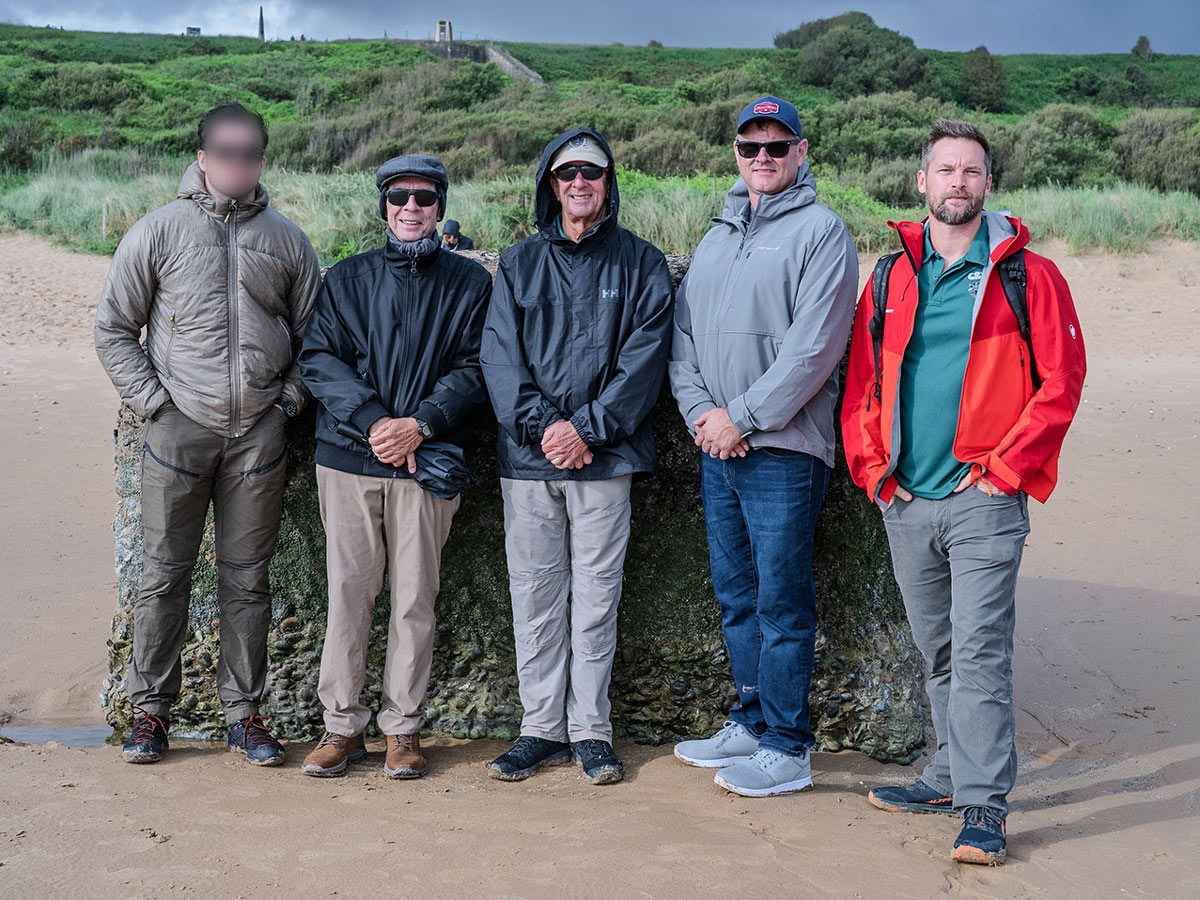
The Chapter 78 Delegation on Omaha Beach at Shay’s Rock looking up the hill where German machine gun emplacements were concealed.
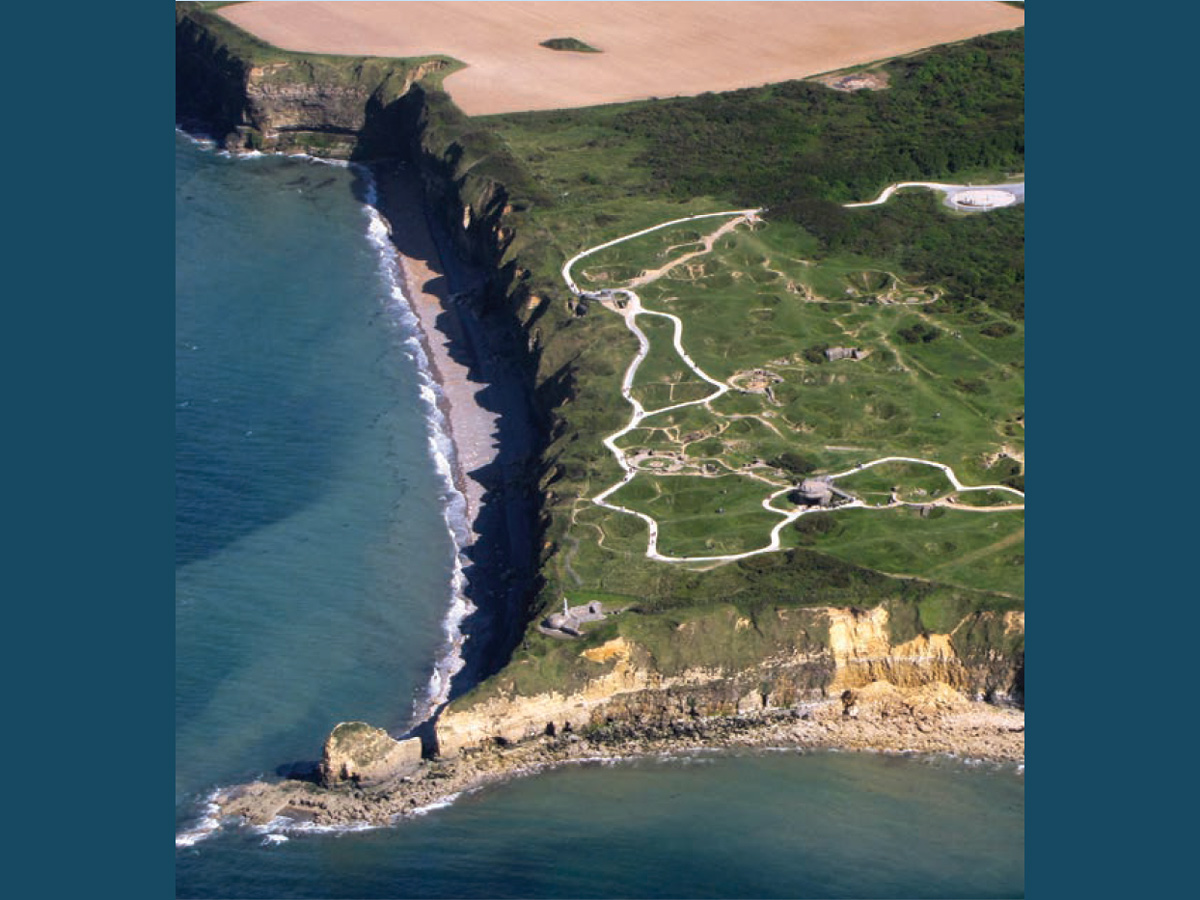
Aerial view of Pointe du Hoc
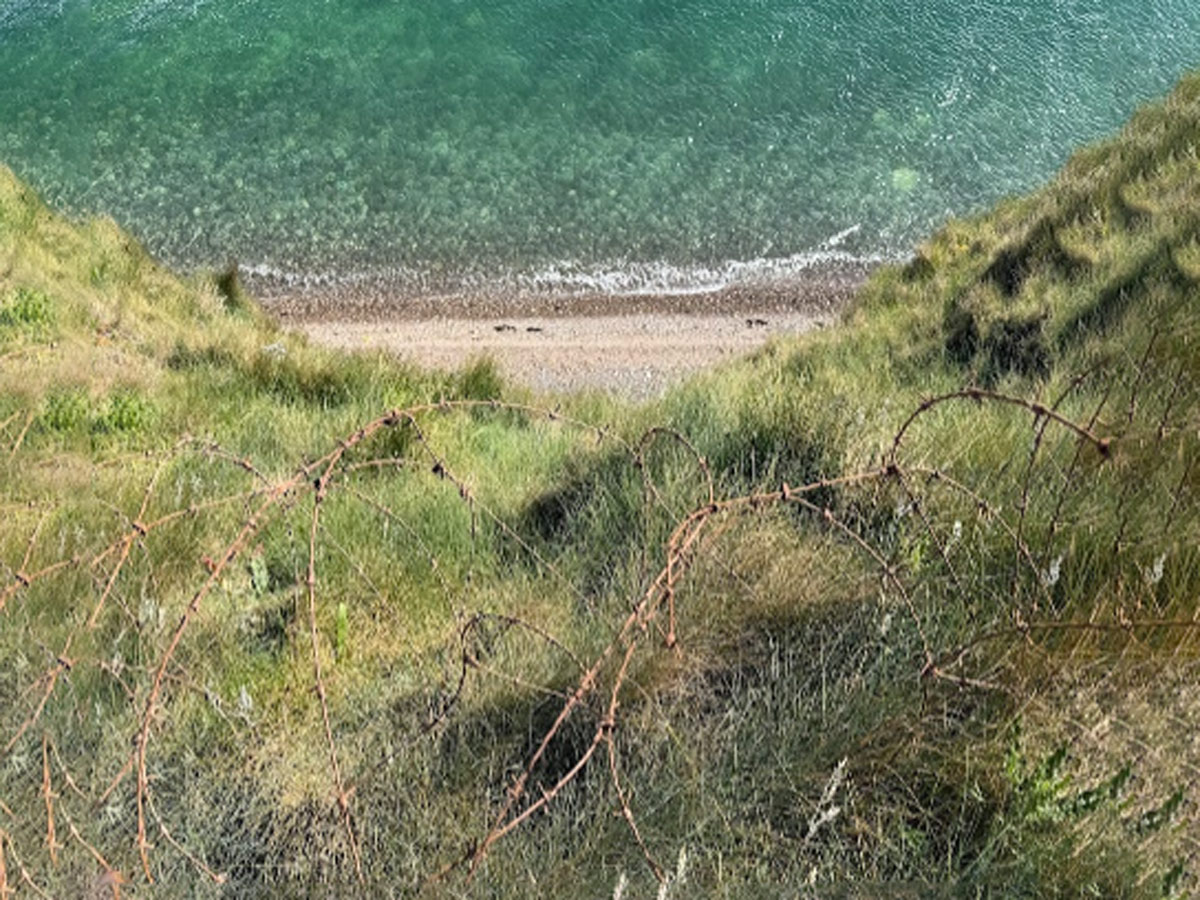
View from above where the 2nd Ranger Battalion scaled the cliffs.
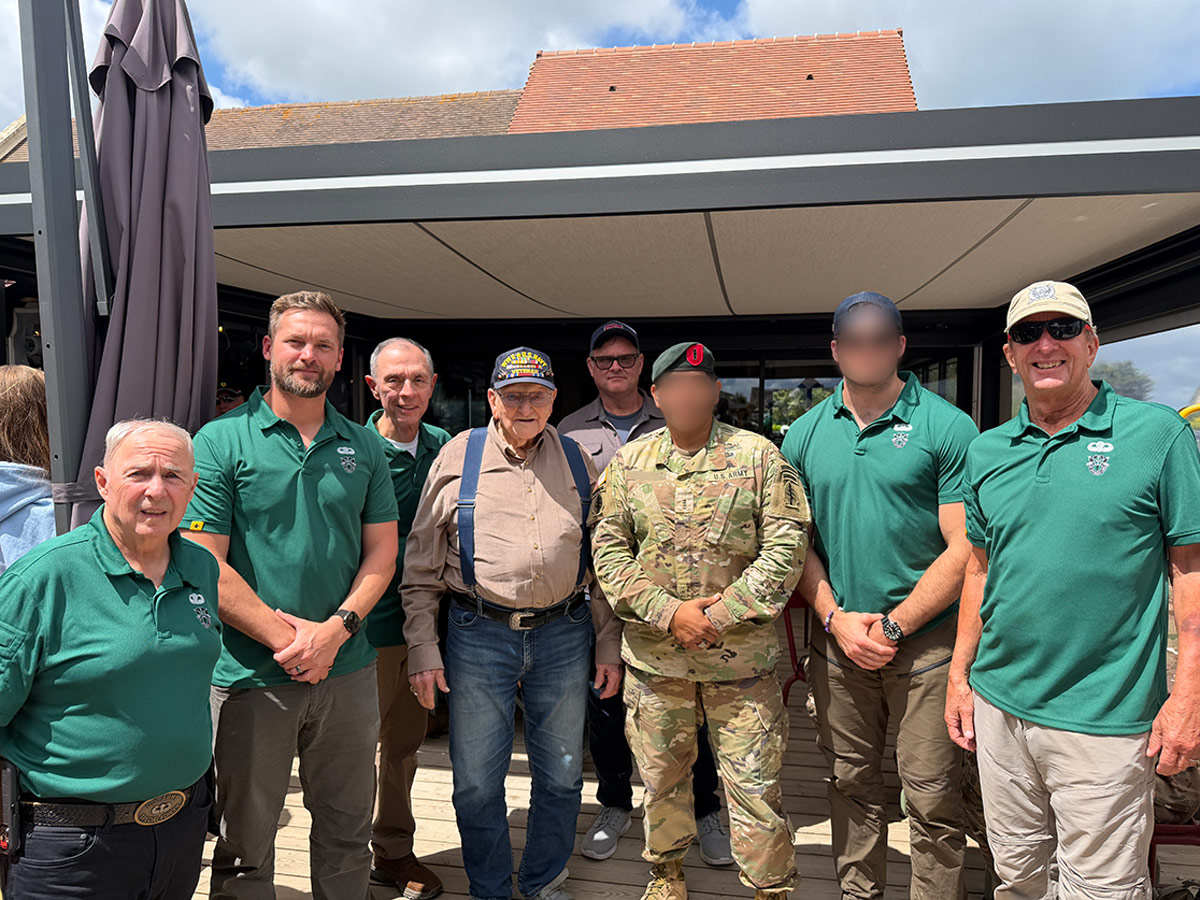
Lunch at Omaha Beach where the Delegation ran into an active duty SF Trooper who was having lunch with his son.
The afternoon took us to Utah Beach which evokes a different emotion.
The beaches are wider and flatter; they seem less imposing. While it was windy, the atmosphere felt lighter, almost celebratory. We still felt immense gratitude, but there was a sense of relief mixed with it.
Utah Beach is also where Jack Boecki landed on D Day +2 and it was a very emotional moment for him on his first visit back.
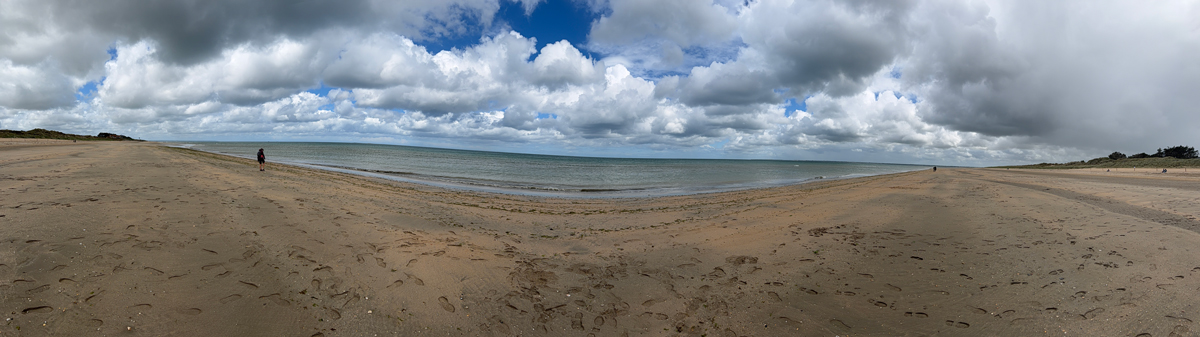
Utah Beach
Troops on D Day were shuttled to the beach on Higgins Boats.
The story of Utah Beach is one of adaptation against all odds. Almost nothing went according to plan on Utah Beach. The chaos of the naval gunfire, smoke, and winds caused the first wave of troops to land 2000 meters from the intended landing zone. Rather than failure, Brigadier General Teddy Roosevelt Jr. stayed calm and famously said: “We’ll start the war from right here.”
In truth, Utah Beach reflects a truth familiar to most soldiers: No plan survives first contact, victory often belongs not to the side with the perfect plan, but to the side that adapts the fastest.
3 June 2026 – Connor Wynn
Our day began before the gates opened at the Normandy American Cemetery.
At 0830, in the quiet hours before the first visitors arrived, our Walk Among Heroes group was granted access to the American Cemetery overlooking Omaha Beach. There is a stillness to the Cemetery that is difficult to describe. The rows of white marble stretch toward the horizon, interrupted only by the sound of the wind and the distant surf below.
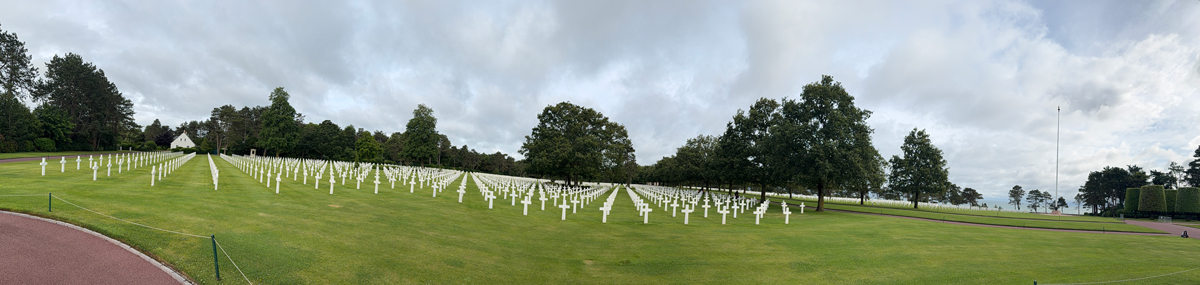
Normandy American Cemetery
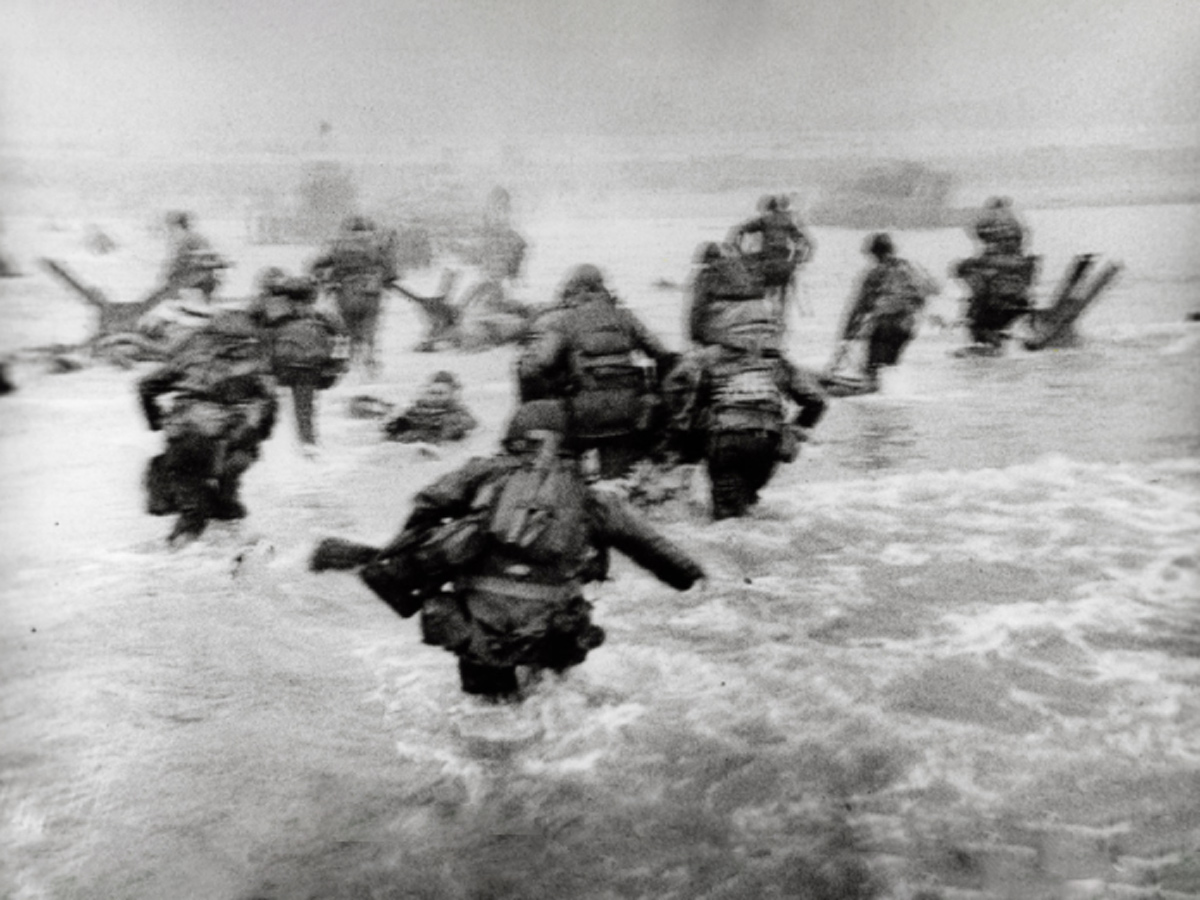
D Day View from Higgins Boat Landing. (Photo by Robert Capa; Public Domain)
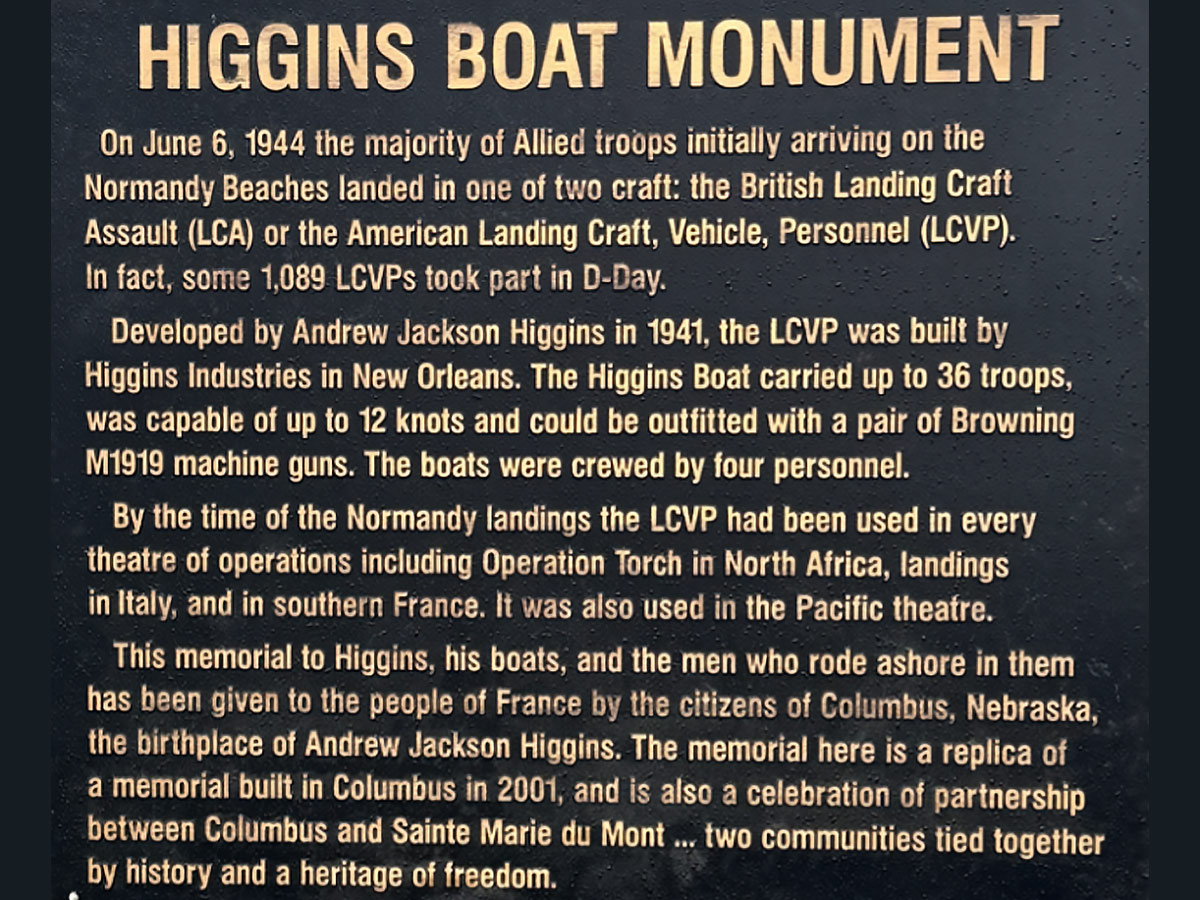
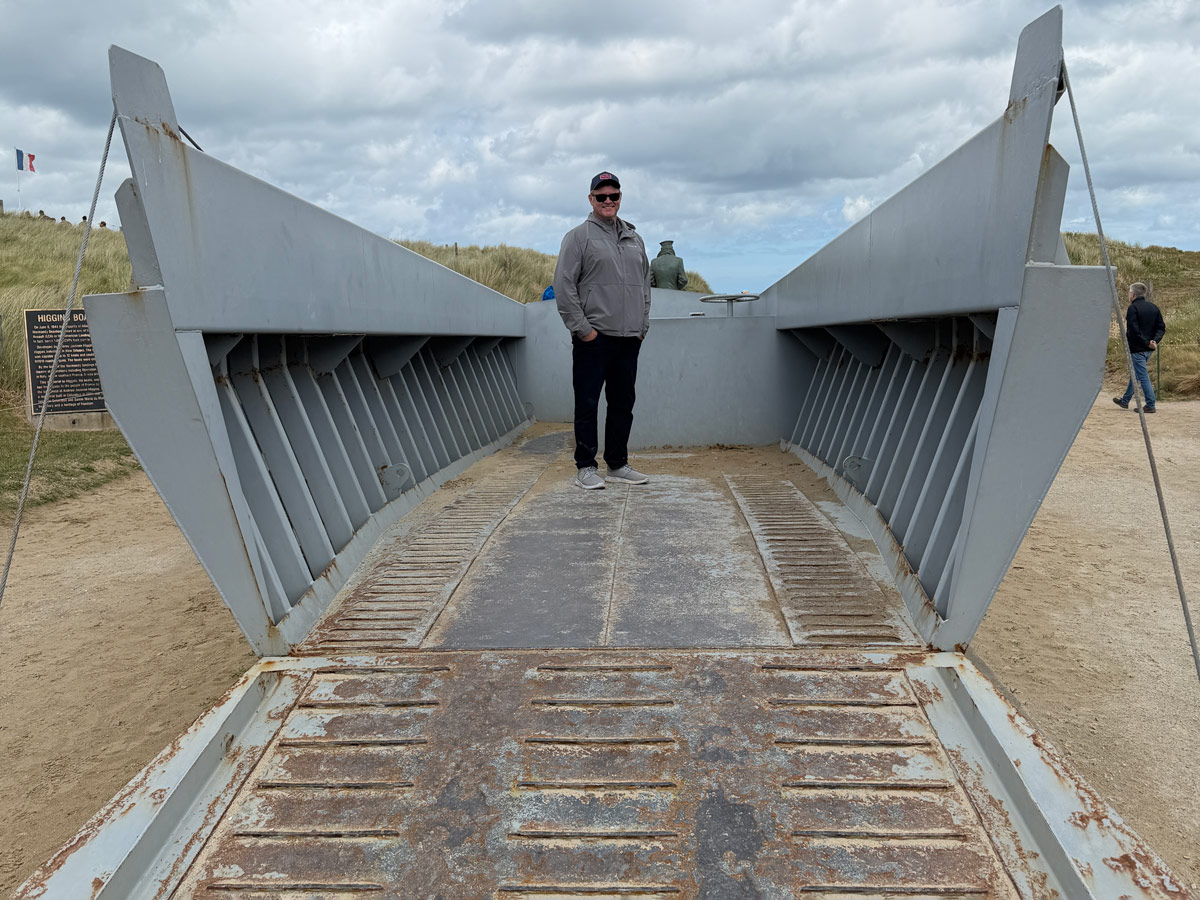
Chapter member Aaron Brandenburg standing in a replica Higgins Boat.
That morning, we raised two American flags. The first was carried aloft by World War II veteran Jack Hugman alongside Chapter members Tom Turney and James McLanahan. The second was raised by Jack Boecki and me. For me, the moment carried particular significance. Jack Boecki served in the French Resistance and later with the Office of Strategic Services. As a Green Beret, it is impossible not to recognize the lineage. The OSS remains part of the foundation upon which Special Forces was built. Standing beside one of those men beneath an American flag in Normandy was a reminder that our regiment’s story did not begin at Fort Bragg, it began in places like this.
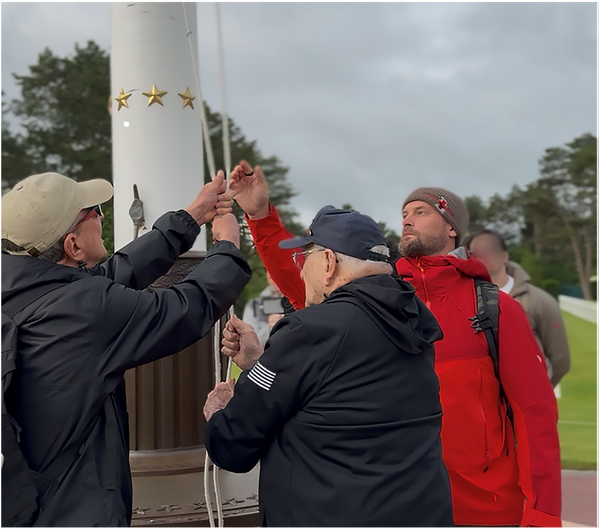
The first flag was carried aloft by World War II veteran Jack Hugman, alongside Chapter members Tom Turney and James McLanahan.
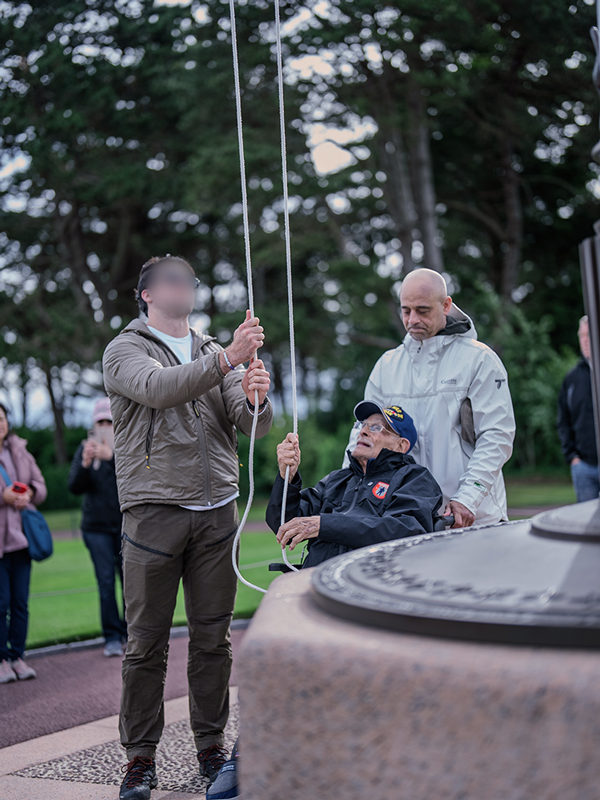
The second flag raised that morning by WWII veteran Jack Boecki and Connor Wynn.
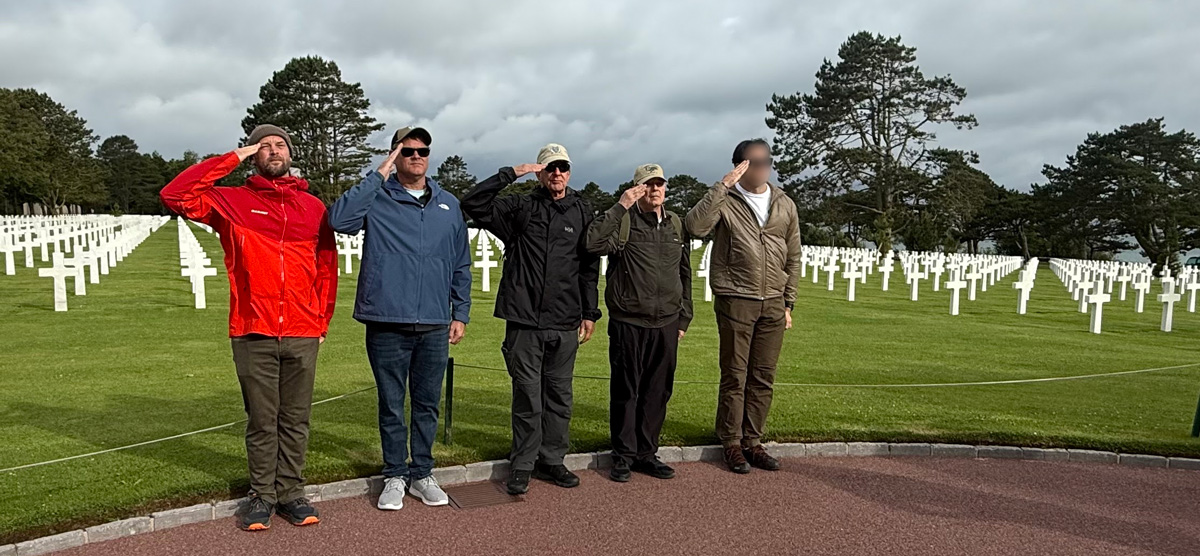
Chapter 78 Delegation Saluting the Colors after the Flag Raisings
After the ceremony, our French guides, Chloé and Emma, led us through the Cemetery.
We moved from headstone to headstone while Jack Hugman and Jack Boecki paused at each grave, rubbing sand across the carved letters—a Normandy tradition that brings the inscriptions into sharper relief.
At each stop, a life story was shared, briefly transforming a granite headstone into a person once again.
First was Nathan Baskind, a young lieutenant killed in Normandy whose remains went unidentified for nearly eighty years. Through modern DNA analysis, he was finally identified and laid to rest under a Star of David in 2024. Eight decades later, his story lived on.
A few rows away were Norman and Robert Lantow, brothers buried side by side. Nearby rested Robert and Preston Niland, whose family’s wartime story would later help inspire Saving Private Ryan. Looking across the cemetery, it became impossible not to notice how many families sacrificed more than one son.
The story of Ollie Reed Sr. and Ollie Reed Jr. was equally striking. Father and son. Buried together in Normandy. Two generations who answered the same call and now rest together overlooking the beachhead they helped secure.
We stopped at the graves of twin brothers Julius and Ludwig Pieper. Ludwig was buried first. Julius remained missing for decades before being identified and finally reunited with his brother seventy-four years later. Their story was a reminder that for some families, the war’s final chapter did not close until well into the twenty-first century, and many family members passed without closure.
One stop carried particular weight. We stood at the grave of Technician Fifth Grade Edward Morozewicz, an Army medic killed on Omaha Beach. What made the story remarkable was not only how he died, but who remembered him. Morozewicz had served alongside fellow medic Charles Shay, the Penobscot tribal member whose actions on D-Day would later earn recognition in both the United States and France. The two men were close friends. When Morozewicz was mortally wounded on Omaha Beach, he died in Shay’s arms. For decades afterward, Charles carried the memory of that moment.
Our hosts from Walk Among Heroes had spent years getting to know Charles before his passing in December 2025. Following his death, they made a commitment to continue one of the traditions most important to him: visiting Eddie’s grave whenever they came to Normandy.
As we stood before the headstone, it struck me that the story was no longer just about June 6, 1944, it was about lifelong friendship, loyalty and memory.
Standing at Eddie’s grave, it was impossible not to think about Charles Shay holding his friend on Omaha Beach, and about the fact that he was burdened with that memory for the rest of his life. The scale of the war is staggering, yet the sacrifice is always personal.
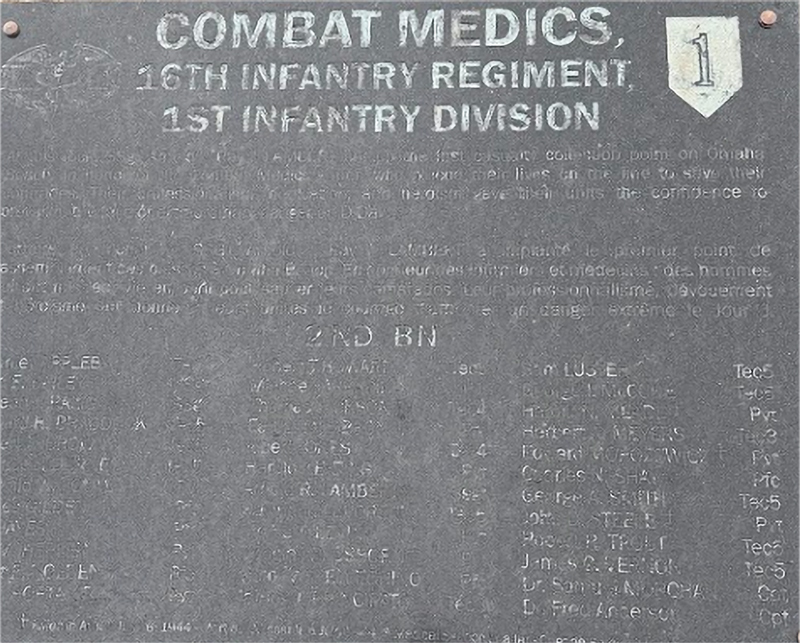
Memorial to Combat Medics on Omaha Beach
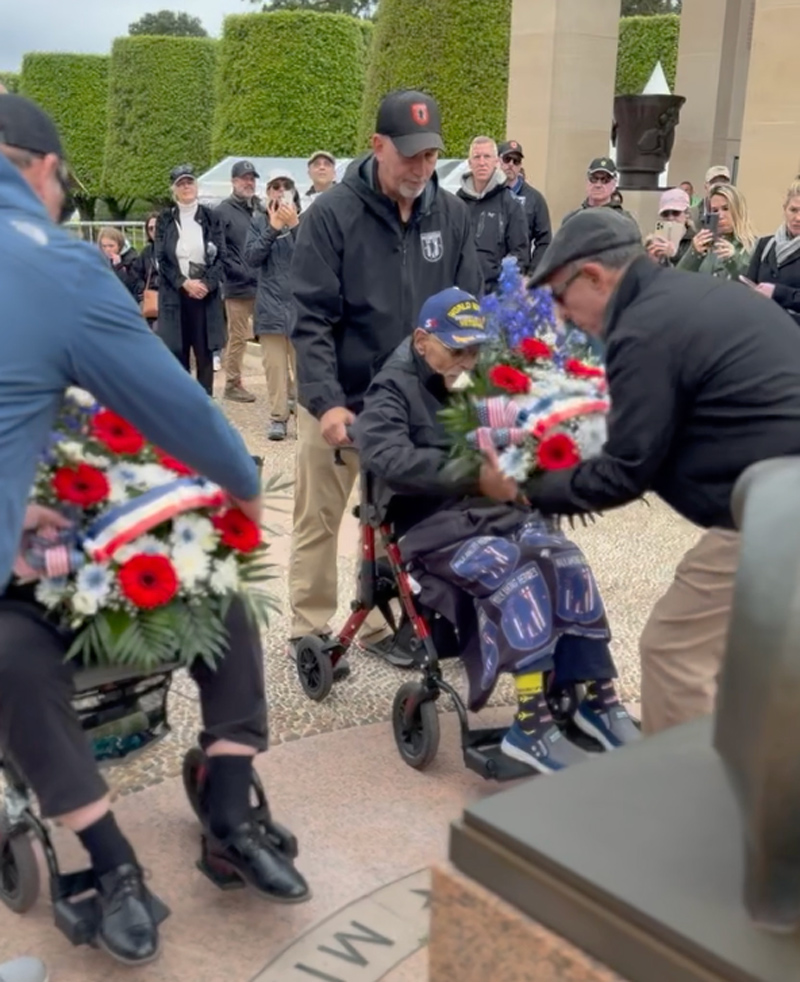
Chapter members Aaron Brandenburg and Robert Casillas helping the “Pair of Jacks” lay wreaths.
Following the tour, we attended a wreath-laying ceremony at the foot of The Spirit of American Youth Rising from the Waves statue. Aaron Brandenburg and Robert Casillas had the honor of placing the wreath with Jack Hugman and Jack Boecki.
As the event concluded, a group of French schoolchildren approached. Their teacher, visibly emotional, asked whether the children might greet the veterans.
Within moments, the children surrounded Jack Hugman and Jack Boecki, greeting them with hugs, handshakes, prepared drawings and smiles that crossed generations and oceans.
It was one of many reminders throughout the week that Normandy’s memory of June 1944 is not confined to museums or anniversaries. It remains alive in the people. Eighty-two years later, French schoolchildren still understand that their freedom was purchased by young Americans who crossed an ocean, protecting a continent they had never visited and a people they had never met.
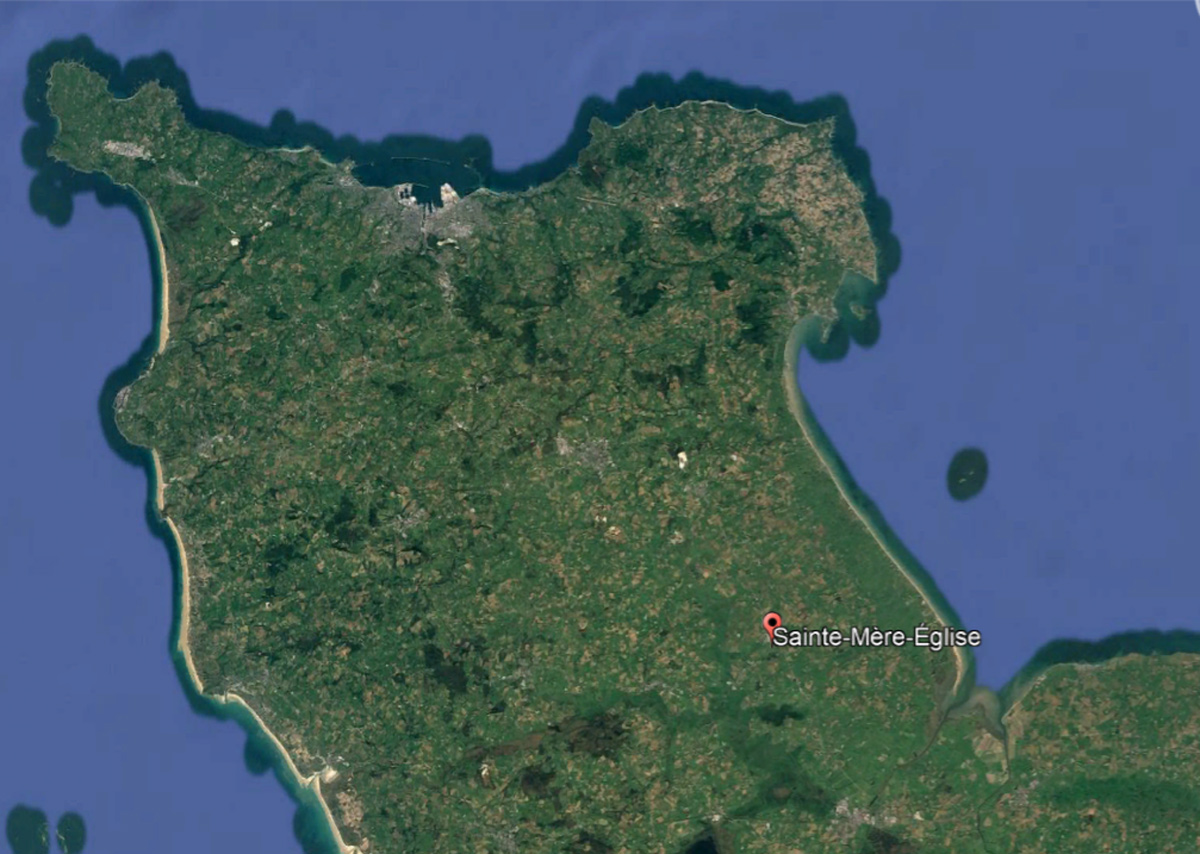
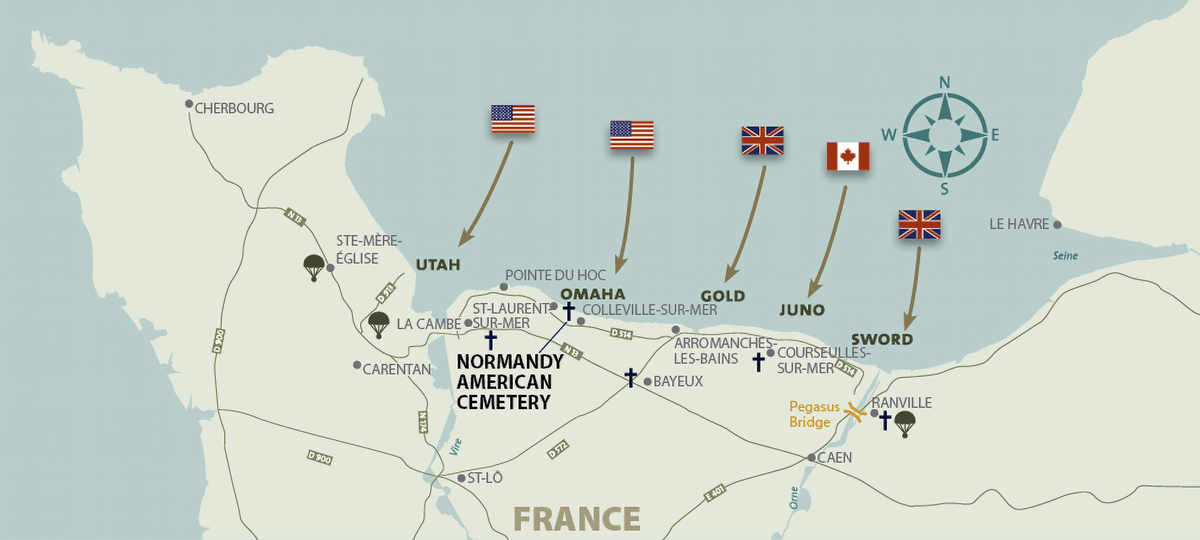
From Colleville-sur-Mer, we traveled to Sainte-Mère-Église, a town inextricably linked to the story of America’s airborne forces. Shortly after midnight on June 6, 1944, paratroopers of the 82nd and 101st Airborne Divisions descended into the darkness around Sainte-Mère-Église. Their mission was to seize key road networks, secure the approaches to Utah Beach, and disrupt German defenses before the amphibious landings began. A fire burning in the town square illuminated descending paratroopers, making them easy targets as they drifted toward the ground. Some landed directly among German positions. Others landed on rooftops, in gardens, and in the middle of firefights. The church stood at the center of it all, a silent witness to one of the most chaotic airborne assaults in military history.
By dawn, Sainte-Mère-Église had become one of the first towns liberated in France and the first town liberated by American airborne forces. Today, American flags still hang from storefronts and memorials and photographs are woven into daily life. The affection for American soldiers is not performative, and the people of Sainte-Mère-Église do not just remember the liberation, they live with it.
One of the most memorable stories belongs to Private John Steele of the 82nd Airborne Division. As German and American gunfire erupted in the town square, Steele’s parachute became entangled on the church steeple. Unable to free himself, he hung suspended above the battle for hours, feigning death while fighting raged beneath him. A parachute still hangs from the church tower today, ensuring that no visitor forgets the chaos of those opening hours. Inside the church, we heard lesser-known stories and admired the stained glass windows picturing paratroopers.
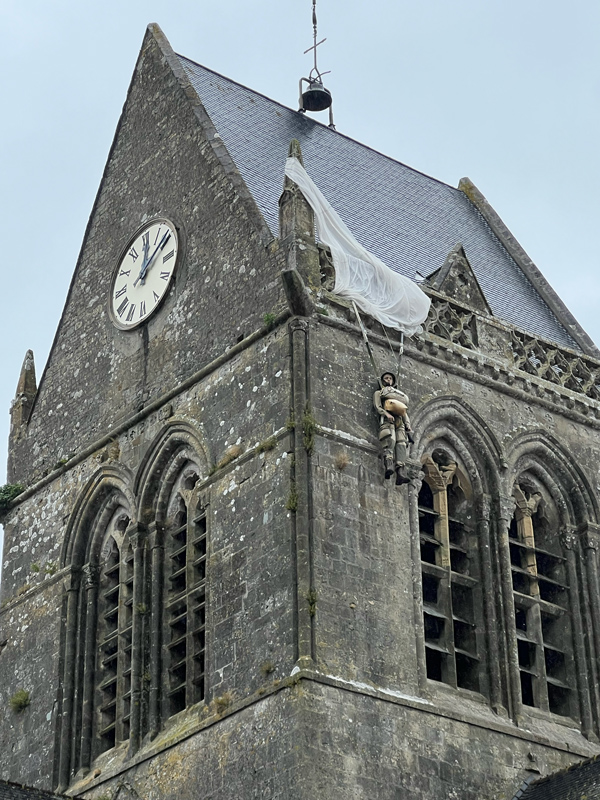
Permanent memorial to Jack Steel.
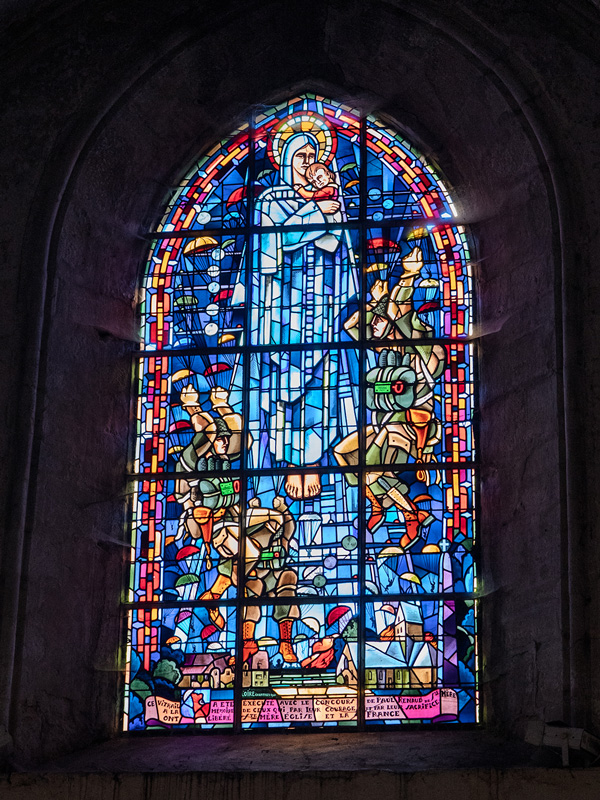
Stained glass window with Paratroopers.
By afternoon, we gathered at an Airborne Memorial in the town square. Veterans, active-duty paratroopers, local citizens, French officials, and visitors from around the world stood together before the monument dedicated to the airborne soldiers who descended into Normandy before dawn on D-Day. The ceremony reflected not only on the accomplishments of the 82nd and 101st Airborne Divisions, but on the enduring bond between Normandy and the Americans who helped liberate it.
Throughout the day, I found myself struck by the contrast that exists throughout Normandy. The atmosphere is vibrant, the cafés are full and the streets are lined with flags.
Yet beneath that energy is something deeper: a quiet, solemn reverence.
You see it in the cemetery, in the schoolchildren carrying hand-drawn pictures for veterans, in the townspeople who continue to decorate their homes with American flags more than eight decades after the war, in the way the people of Sainte-Mère-Église speak about American paratroopers as if they arrived yesterday.
For those who serve or have served, Normandy offers something more than history: it offers perspective.
The names etched into marble at Colleville belong to young men who never had the opportunity to grow old. Yet their legacy remains visible everywhere—in the flags, the memorials, the churches, the schoolchildren, and the enduring gratitude of a people who have never forgotten who came to help liberate them.
Green Berets often speak about standing on the shoulders of the giants who came before us. Among the rows of marble overlooking Omaha Beach, the meaning of that phrase became impossible to miss. And for an entire day, we walked among them.
4 June 2026 – Aaron Brandenburg
Another layer of history, emotion, honor, and remembrance as we paid our respects to the young men who sacrificed their lives to save the world from tyranny. We started the day at a C-47 Memorial Garden site near Picauville, France. The aircraft took a direct hit during the D-Day airborne assault, and all 20 men aboard were killed.
The site itself sits in an unassuming field on a small farm surrounded by hedgerows. At ground level, the silhouette of a C-47 has been etched into the earth and backfilled with black slate rock bordered by timber edging.
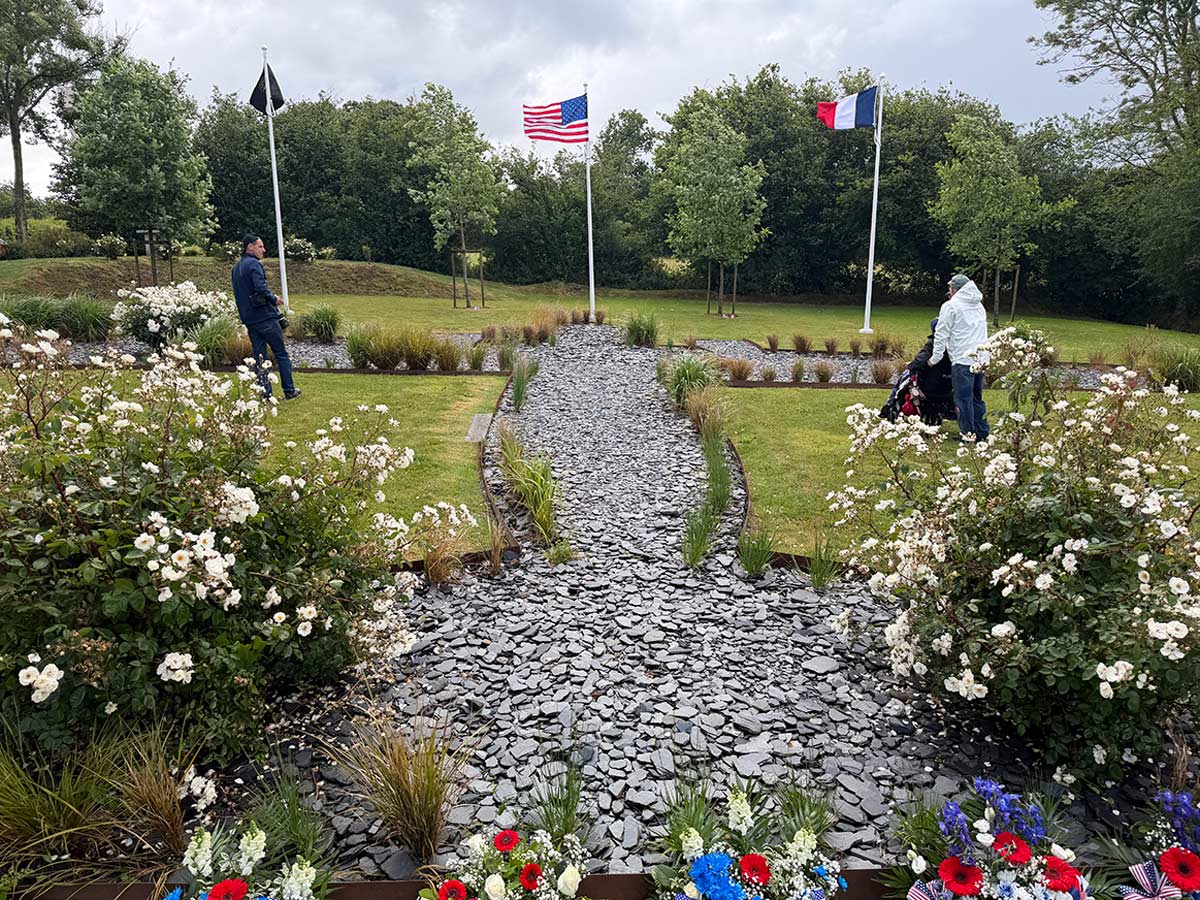
C-47 Memorial Garden
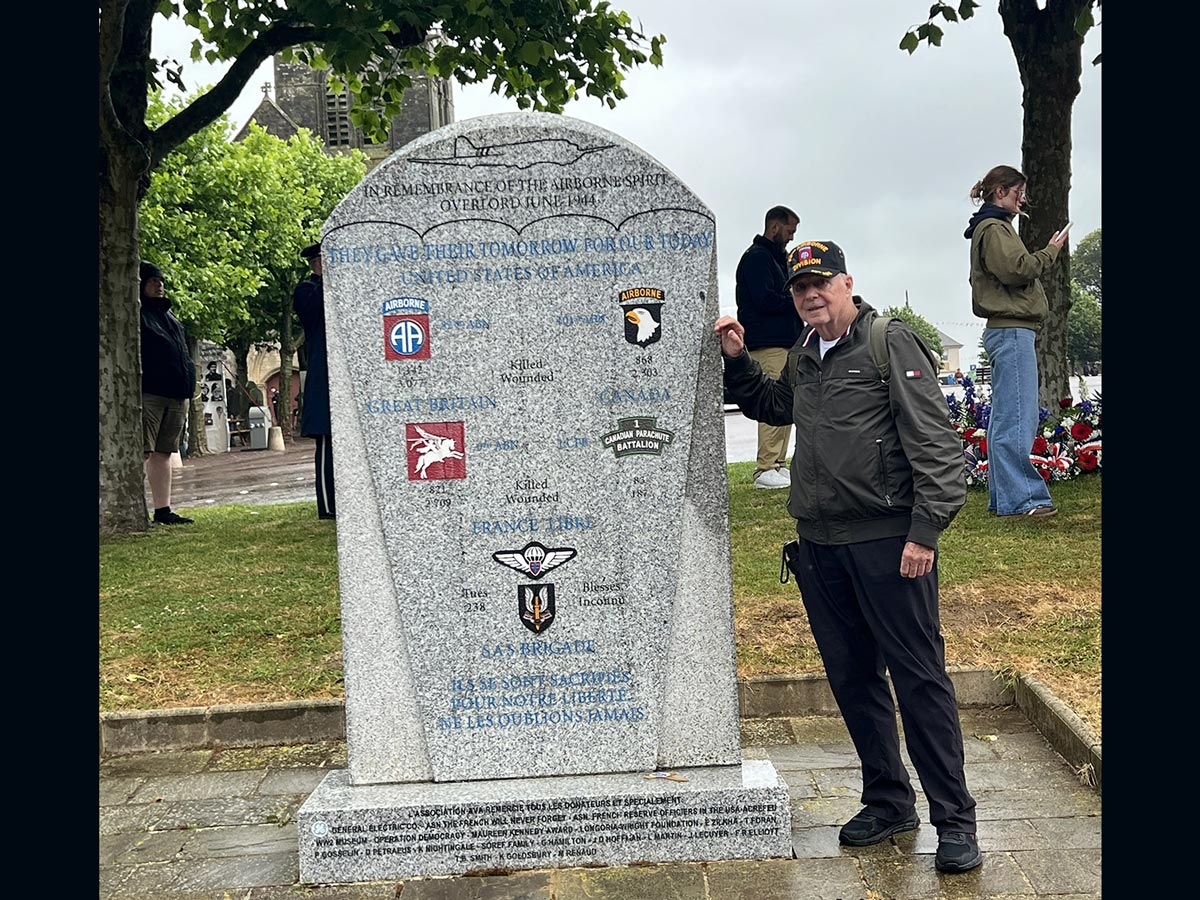
Chapter Member Bob Crebbs at the Airborne Memorial.
The Shaw family imported Virginia Tulip trees and planted four of them in an arch at the nose of the aircraft, symbolizing the four pilots who led the way. At the tail of the aircraft, the remaining sixteen trees form a V-shape, representing the paratroopers who were lost that fateful day. From above, the Virginia Tulip trees create the shape of a fully deployed parachute, paying homage to the 101st Airborne. May the souls of those men forever fly with the eagles, a symbol of freedom.
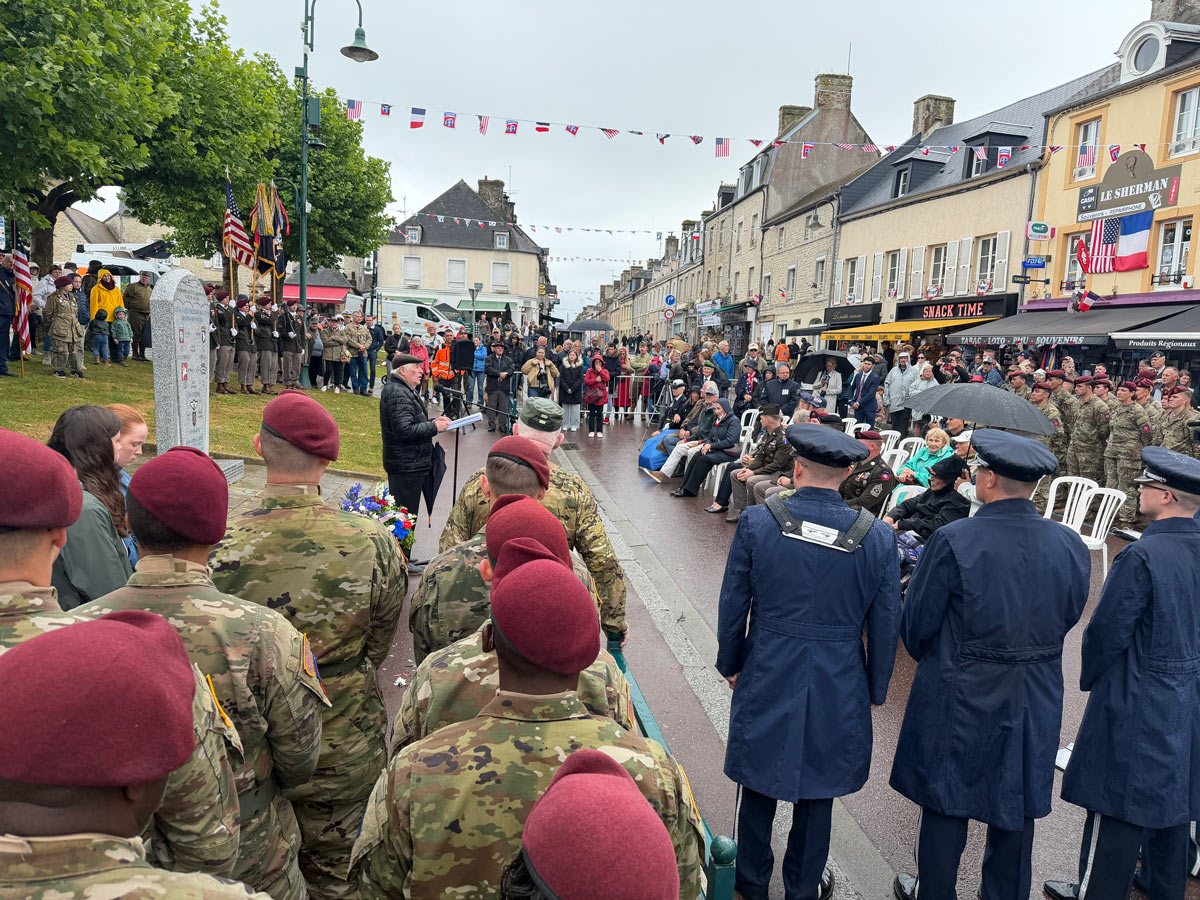
Former Sainte-Mère-Église mayor Maurice Renaud, addressing the crowd.
Jack Boeki arrived in his wheelchair, wrapped beneath a blanket. This 102-year-old Holocaust survivor and D-Day veteran paused to salute the colors of our nation. Shortly thereafter, the ceremony began, and so did the weather. Torrential winds arrived with sheets of rain. Standing unfazed, cold, and soaked, the color guard held their staffs as both the American flag and the 101st Airborne colors violently whipped in the wind. It was as if they were battling Mother Nature herself.
The small crowd, me included, was soaked to the bone. Yet no one moved. The significance of the moment was overwhelming. Patriotism swelled, and tears welled in the eyes of many. At the same time, soldiers and civilians alike rushed forward, forming a shield of umbrellas to keep old Jack dry.
Stoically, he sat. Sorrow and pain in his eyes, his weathered face remained fixed and focused. Near the end of his 102-year journey, he had come to say goodbye to those who never made it home. After several powerful speeches, including remarks from the commander of the 101st Airborne Division, the ceremony concluded. As if it had been planned and timed perfectly, the clouds broke apart, and the sun emerged.
It felt symbolic. As though our nation’s colors had prevailed. As though Mother Nature had finally relented. As though our fallen heroes were being wrapped in warm sunlight by some airborne guardian of the heavens.
We traveled several kilometers away to a small bridge known as La Fière. At first glance, it is an insignificant structure of stone and concrete stretching roughly 100 meters across a marsh. Yet with an estimated 60 percent casualty rate among the units involved, it became the site of one of the most consequential battles in the storied history of the 82nd Airborne Division.
The ceremony began with a detailed account of those critical days delivered by Colonel Keith Nightingale. Without notes or hesitation, he transported us back to 6-9 June, 1944. As he spoke, I could almost smell the gunpowder and taste the metallic tang of blood shed by those young men who gave everything for their country.
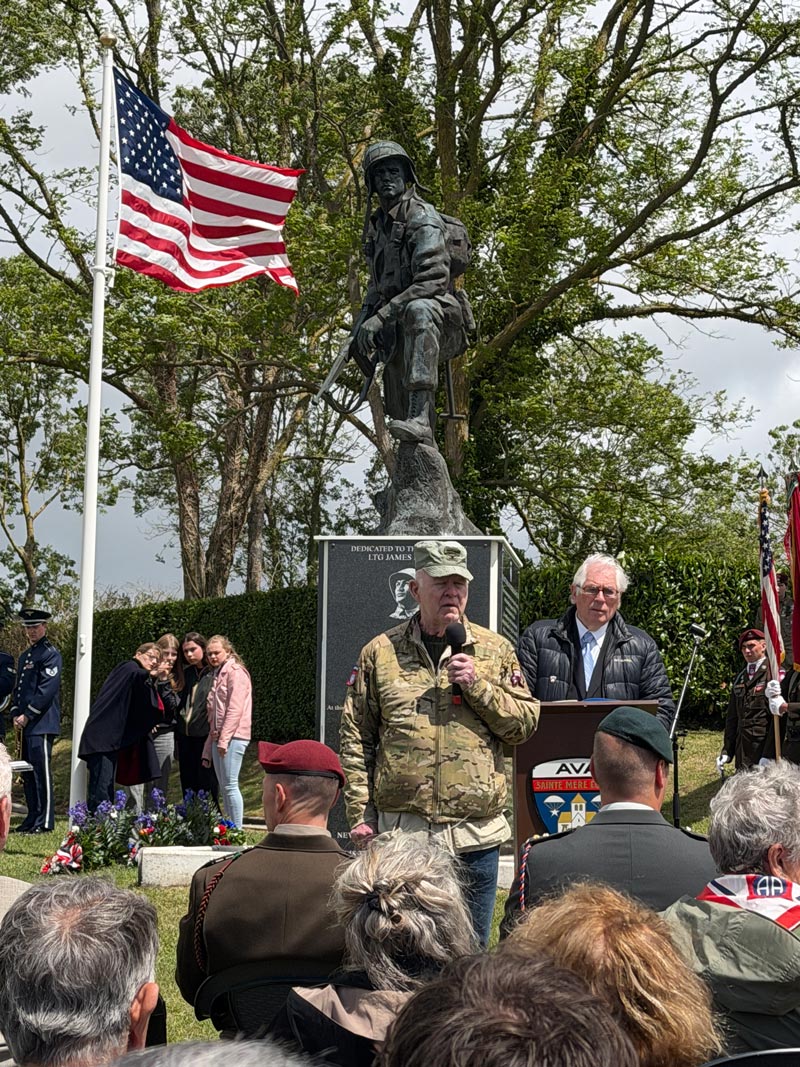
Colonel Keith Nightingale speaks at La Fière Bridge.
Once again, the skies darkened. The wind began to blow, and the heavens opened with the fury of a Panzer attack. Cold and wrapped in modern rain gear, I couldn’t help but think of the conditions those young men endured. For many of them, the war had begun only twenty-four hours earlier. For most, it had already ended. Bodies torn apart. Lives cut short. The unavoidable truth is, mothers and fathers would soon receive the Western Union telegram informing them of their loss. Children would grow up without fathers, fathers without sons; families would forever carry the weight of a collective sacrifice.
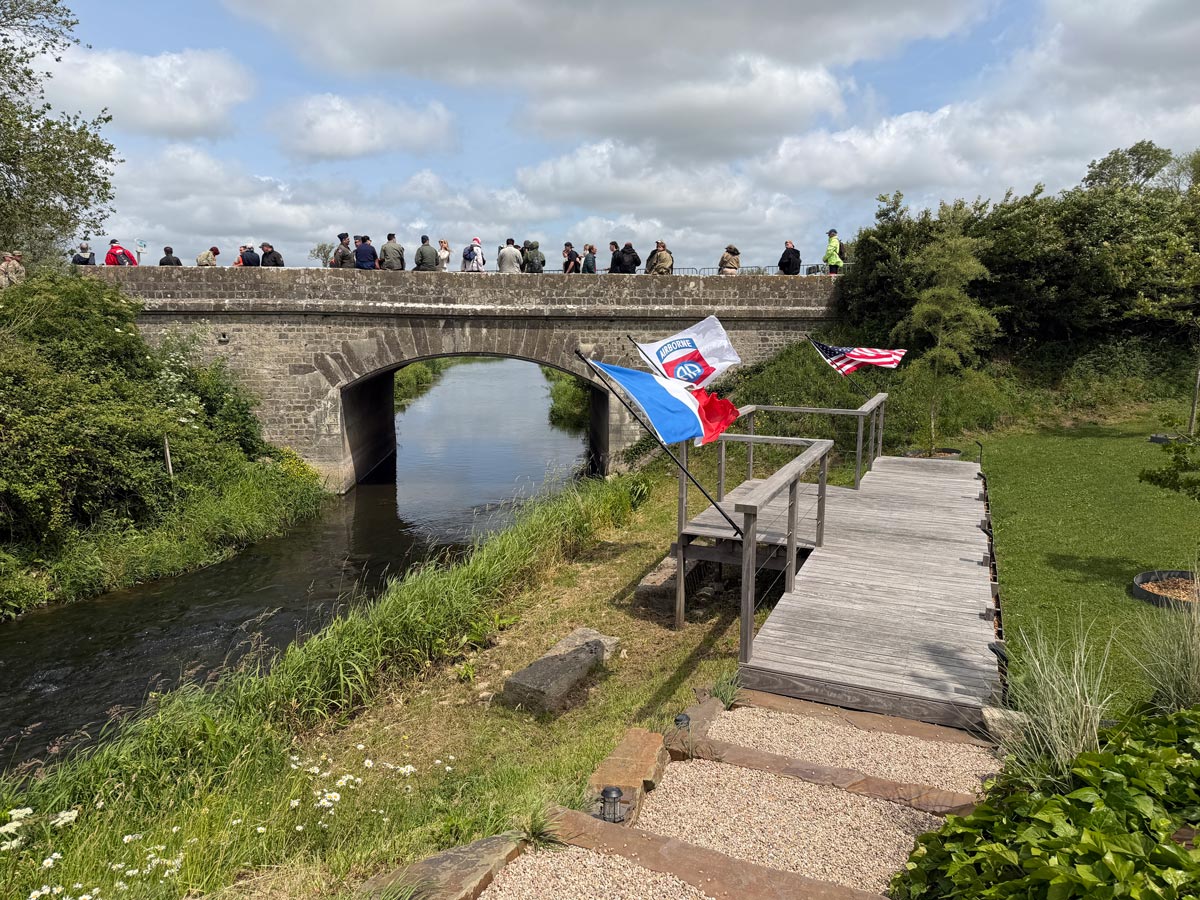
La Fière Bridge from Helen Patton’s Chateau.
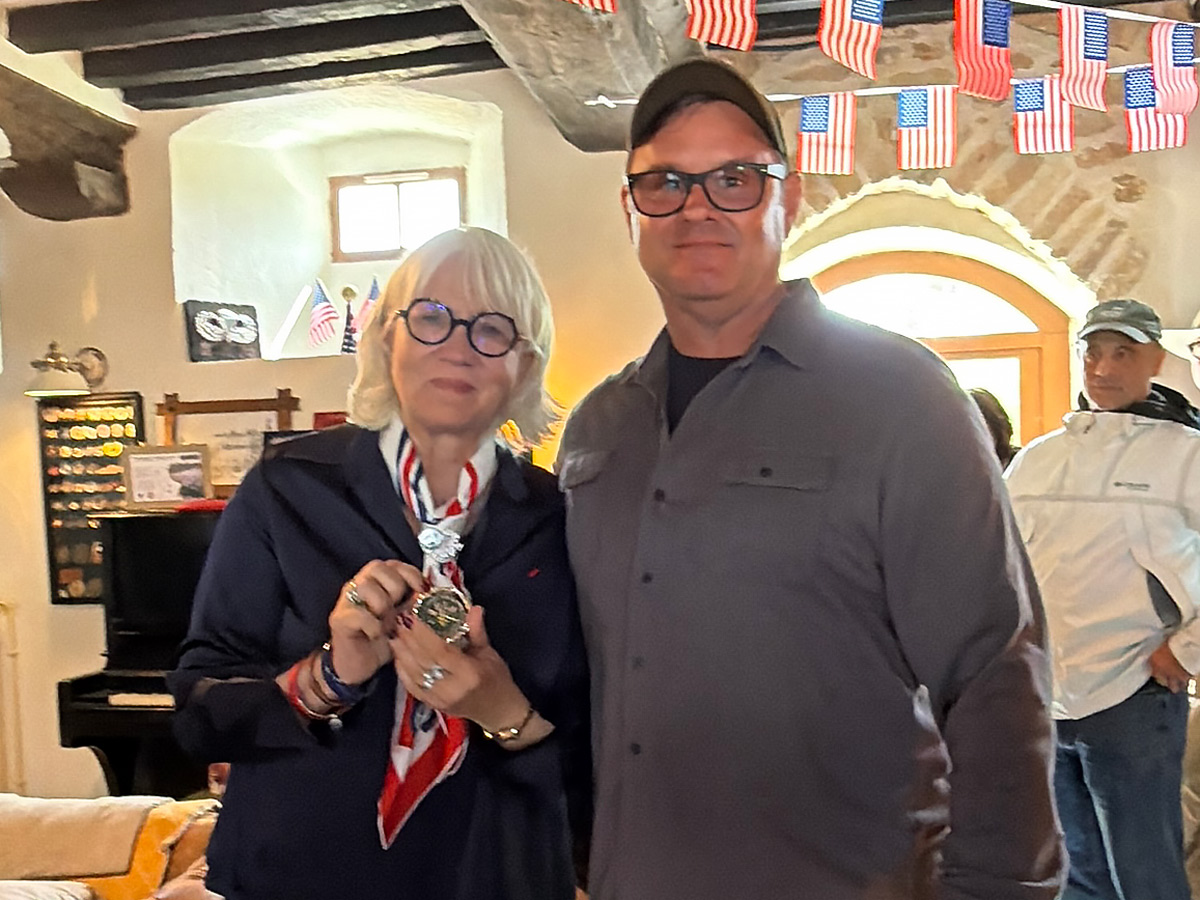
Aaron Brandenburg with Helen Patton after presentation by Aaron of Chapter 78 Challenge Coin.
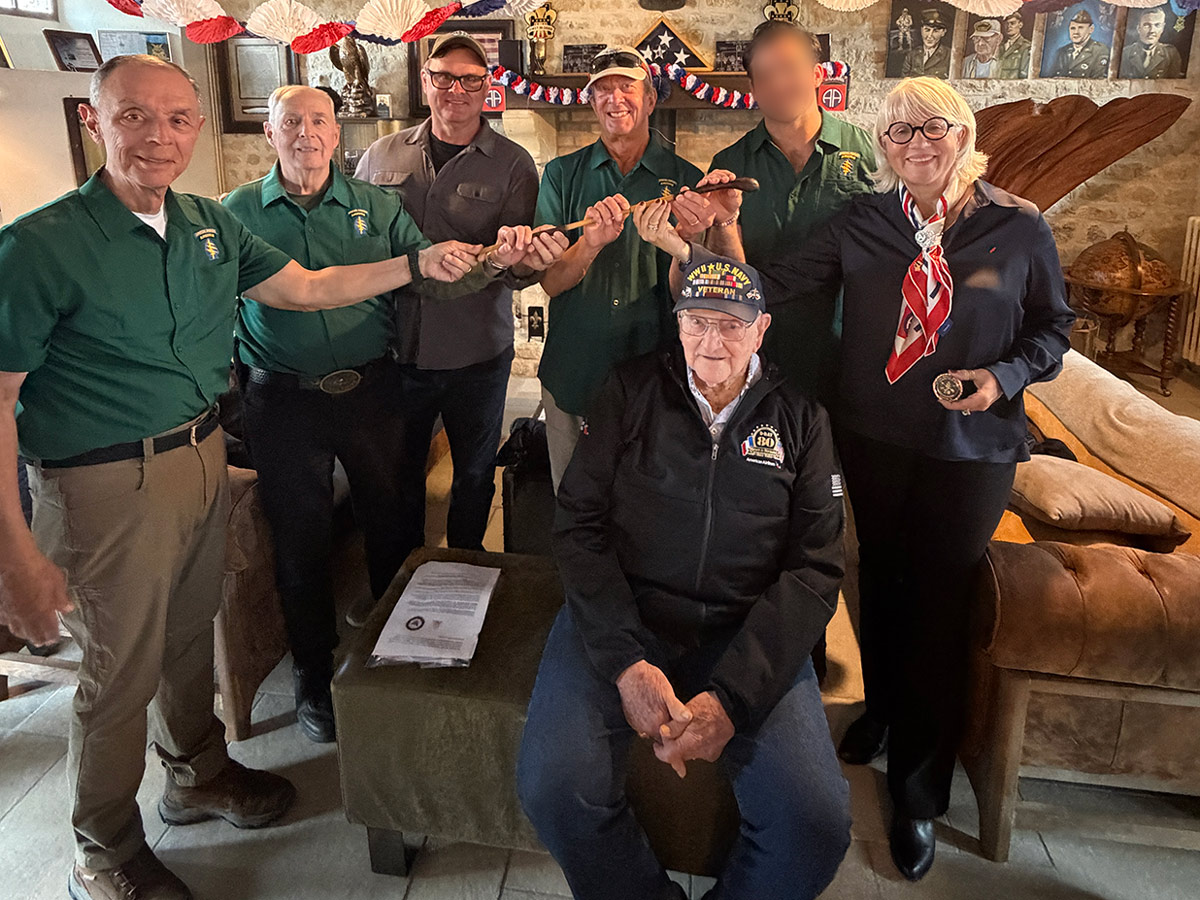
Chapter 78 Delegation holding Patton’s riding crop with Helen Patton and Jack Hugman.
Just 100 meters from the bridge, Helen Patton, granddaughter of General George S. Patton Jr., has painstakingly transformed the old mill house into a guesthouse. Through her efforts, she preserves not only a historic location but also the stories of the men who fought there.
After a handshake and a hug, I presented Helen with an SFA Chapter 78 coin. In return, Helen handed us General Patton’s iconic riding crop that General Patton regularly carried.
Some experiences stay with you forever. The truth is, Normandy makes sure of that.
Coming next month in Part 2:
Chapter 78’s Normandy journey continues—from the Resistance memorial and Angoville-au-Plain’s bloodstained pews to the American Cemetery, where a 107-year-old veteran reads a letter home and a crowd rises for “the Pair of Jacks.” History stopped being something studied—it became something felt.
Leave A Comment