Eight Reasons Military Veterans Should Write
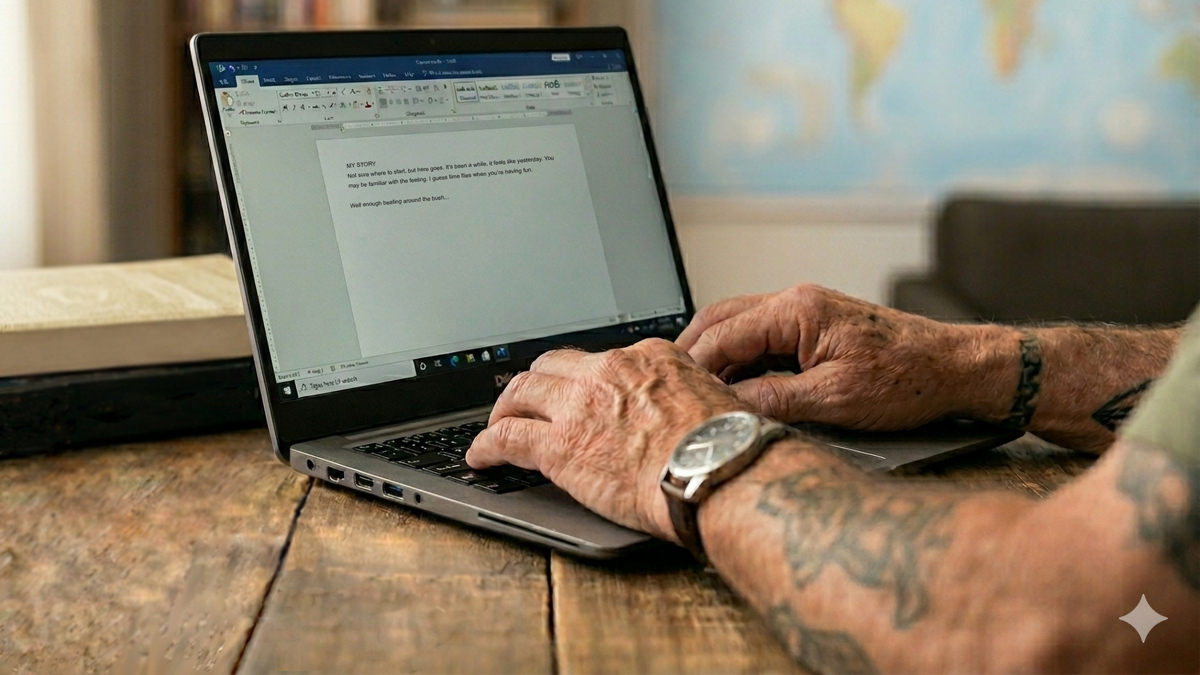
By Robert Bruce Adolph
Originally published on Apr 26, 2026, on SOFREP.com and Medium.com; republished with permission.
Military veterans should write because the hard-earned experience, loss, sacrifice, and truth of your service are worth honoring and preserving.
I retired twice, once from the US Army’s Special Forces in 1997 and later from the United Nations Department of Safety & Security in 2014. I can only hazard a guess that I am not very good at leisure activities, because I found myself at work again as a security consultant in Lebanon, war-torn Ukraine, and Azerbaijan regarding the Nagorno-Karabakh War. I also published a well-reviewed memoir of my early and violent years with the UN. Additionally, I published several dozen essays and commentaries in the US and Europe in recent memory. Writing is my topic today, and one that you might find of interest. Although there is no doubt more, there are at least eight reasons why writing is beneficial. Let me count the ways….
First—Canadian public intellectual, Jordan Peterson, said it, “Writing is the most rigorous form of thought.” If you are concerned for the health of your gray matter, try writing for publication. Every word matters to editors. Exercising the muscle between your ears is a preventative to any number of ailments tied to the mind. Stay sharp and write. Although it may sound absurd, every piece must have an introduction, body, and conclusion. Structure matters. You might be surprised how many fledgling scribblers miss this basic mark. Good writing simplifies complex topics for the reader as well as yourself. The rule of thumb: tell them what you are going to tell them; tell them; finally, tell them what you told them.
Second—If you are curious about people and events, writing is good for you. One of the best ways to understand a topic is to write about it. Writing often compels research. Those who write are often better informed than the public, at least within their areas of interest. Good writers don’t merely have opinions—they have informed opinions. Curiosity, though, remains the heart and soul of good writing.
Third—If you hope to expand your circle of friends, there are few better ways of sparking conversation than talking about your recent writing efforts. Making new friends can be challenging. Psychologists confirm that this is especially true for men. You will discover, as I did, that those topics that interest you often interest others as well. This is true for fiction and non-fiction writers alike. In other words, writing can make you more interesting. Some of the most engaging people I have ever met were handy with a keyboard.
Fourth—Writing led to speaking. When my book was published, I had to promote it, which meant speaking before audiences. It wasn’t as hard as you might think. The memoir covered four years and was based on my extraordinarily challenging and potentially life-threatening experiences in Africa and the Middle East. Speaking about what happened to me required little preparation. And if I am any judge, audiences found the subject matter engaging. My most recent gig was the keynote address before a conference on the future of technology at the London School of Economics and Political Science. The topic had nothing whatever to do with my memoir, but instead my newspaper and magazine essays on related issues. The more you write, at least in my experience, the better you speak.
Fifth—You don’t need to have the talent of Stephen King or John Grisham to become a competent writer. I am living proof. The best of us writes as we speak in what’s called the active voice. You might be like me and know very little about grammar. However, as a lifelong book lover, I had little trouble putting what I had unconsciously learned while reading into practice at the keyboard. In any case, most computers today have integrated grammar check programs. Write! Let the machine correct your tenses, punctuation, and spelling. Storytelling is an art form, just like painting or music. However, it is the most egalitarian of artful pursuits. Average intelligence is sufficient. Anyone who possesses the desire can write and get better at it through practice.
Sixth—Some years back, my ailing father asked me to write and present the eulogy upon the sudden and unexpected death of his wife, my mother. He thought that I had a shot at finding the right words to best describe her life. I could receive no higher praise than to be asked to perform such a critically important and necessary family function. I only hope that I did her enough credit. Essentially, I felt honored by my father’s request. I still do.
Seventh—It isn’t about the money. Although there are a few who can make significant financial gains through writing, most don’t. Count me in the latter category. In fact, I have spent more in terms of both time and bucks in the process than I ever made back. So, if it isn’t about the financial reward, what is it about? For me, it is about self-improvement and the respect that comes with becoming a published author and established writer. It is also about the attempt to leave something of value behind, a legacy of sorts. I am 74 years of age as I write this piece. There are far fewer days ahead than behind. For some of us, legacy matters.
Eighth—Writers have changed the world. Writers have had a greater impact on civilization than any other profession. Writers scribed the histories we read. Writers created our sacred texts. Writers—also great thinkers—established the various schools of philosophy. Writers conceived the most revolutionary secular documents ever penned to parchment, the American Declaration of Independence and the US Constitution. Writing is self-evidently important within a democracy.
On the other hand, I have lived and worked in several countries where writers are regularly harassed, imprisoned, disappeared, or killed outright. Writers clearly matter. Dictators live in fear of the written word.
You don’t have to have lived a life of adventure and danger to write interesting prose. Some of the best writers known to us today spent considerable time within their own homes and communities, Jane Austin, for example. Unsurprisingly, some pretty good thinkers have also been pretty good writers. The two often go together.
For me, writing provides the invaluable intangibles of meaning, purpose and relevancy. Write about your experiences. Write political commentaries. Write about what interests you. For the truly ambitious, try writing a book.
If there is a better self-improvement method for the mind, I do not know of it. Clearly, regular writing can make a positive impact, not only in your own life, but potentially in the lives of others, too.
Not the least of reasons—for those who still suffer from the mental and physical anguish experienced in the aftermath of arduous and hazardous service, writing can offer a possible catharsis. Trust me. It often works.
About the Author:
Robert Bruce Adolph—a qualified Military Strategist—is a retired senior Army Special Forces soldier. Once retired, he joined the UN and subsequently saw service in multiple crisis countries across three continents. Robert holds graduate degrees in both International Affairs & National Security Studies, and formerly taught university courses in US History, American Government, and World Politics. His over three hundred articles and commentaries have appeared in more than fifty newspapers, magazines, professional journals, and academic publications. He also authored the very well-reviewed book Surviving the United Nations: A true story of violence, corruption, betrayal, and redemption, now out in a second paperback edition and on Audible & Kindle. Robert is a member of the Steady State Group, composed of former senior US National Security professionals. Discover more at www.robertbruceadolph.com.

Leave A Comment