An Excert From
Textbook Special Ops:
The Son Tay Raid
Part 2
By Colonel John Gargus, Son Tay Raider, with Cliff Westbrook
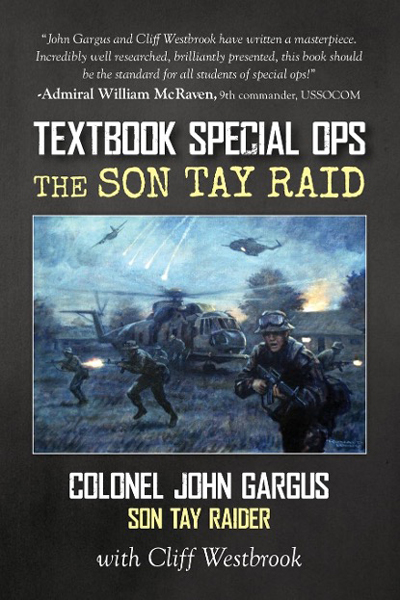
An excerpt from Textbook Special Ops: The Son Tay Raid; published by Palmetto Publishing, 09/17/2025, pages 88-100.
From the editor: Aboard an RC-135 over the Gulf of Tonkin, we monitor U.S. Navy diversionary strikes east of Hanoi and a raiding force slipping into Laos to the west. After months without bombing, the North Vietnamese are only now realizing renewed U.S. activity.
(The last paragraph from Part 1 printed in the March 2026 Sentinel: “The first indication I get that a SAM site is active: I hear the enemy’s long-range radar operator calling out targets in Vietnamese. These are Russian-supplied SA-2 SAMs, known as ‘Guideline’ in NATO’s naming system. (The Soviets’ name for it is the S-75 Dvina.) Its long-range radar is known by the NATO name ‘Spoon Rest’ and picks up targets nearly 150 miles away. That gives them the range to watch all of this US air activity in the Gulf of Tonkin—including us.”
A continuation of CHAPTER 4
Airborne Command Post:
Listening to the Enemy’s Conversations
We hear, in a clear voice, something like: “Xuất hiện tốp không một, phủỏng vị không chín không, cụ ly bốn mủỏi.”
Translation: “Bogey #1 has appeared, azimuth/bearing 090, range 40 kilometers."
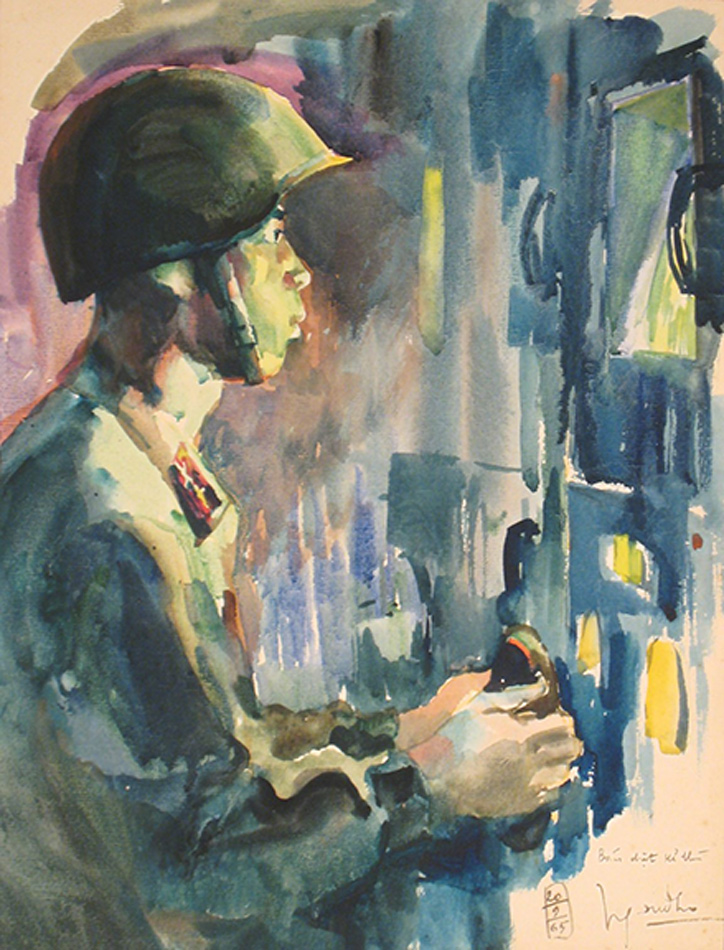
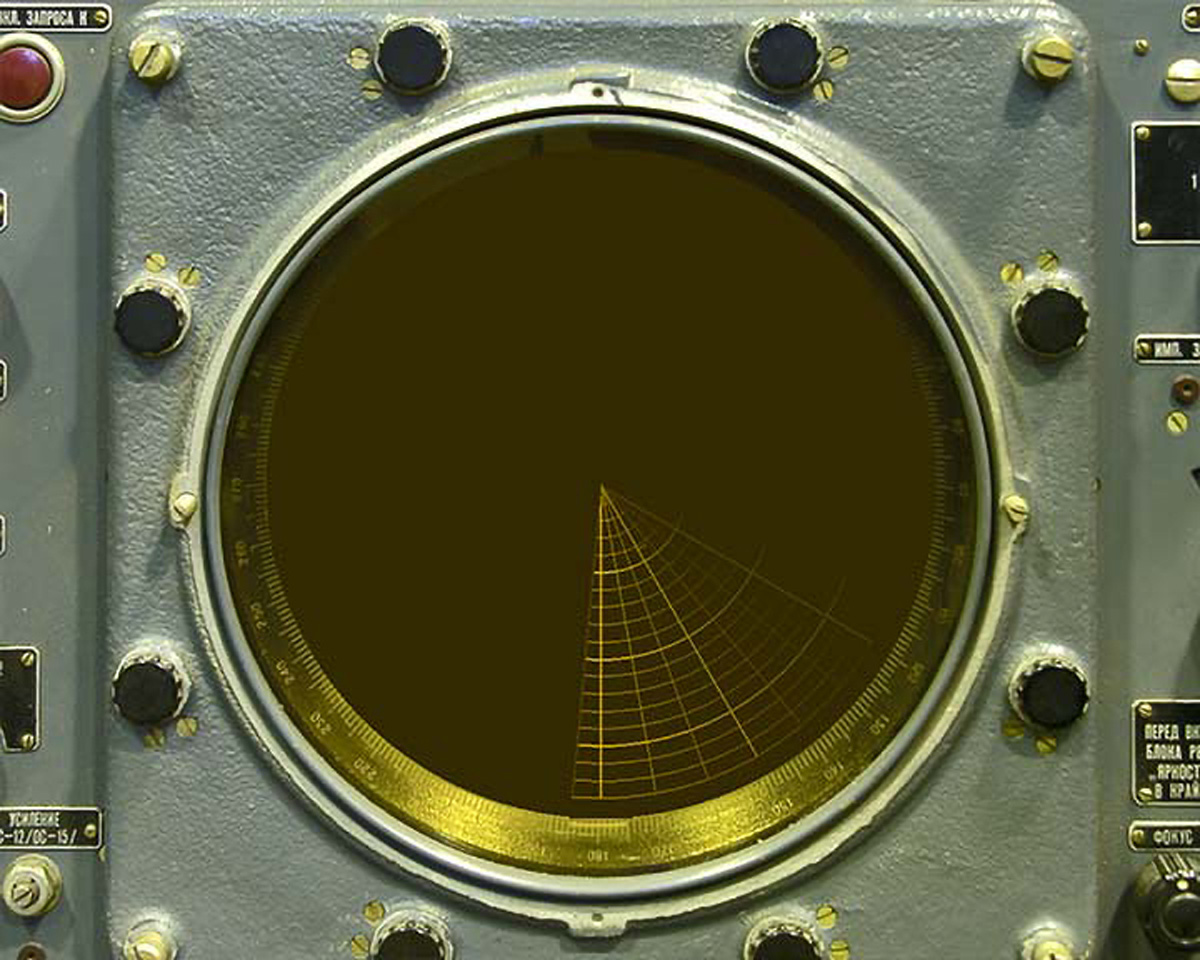
An SA-2 SAM operator and his scope. (1. Public Domain art by a North Vietnamese soldier; 2. Public Domain.) The labels are in Russian.
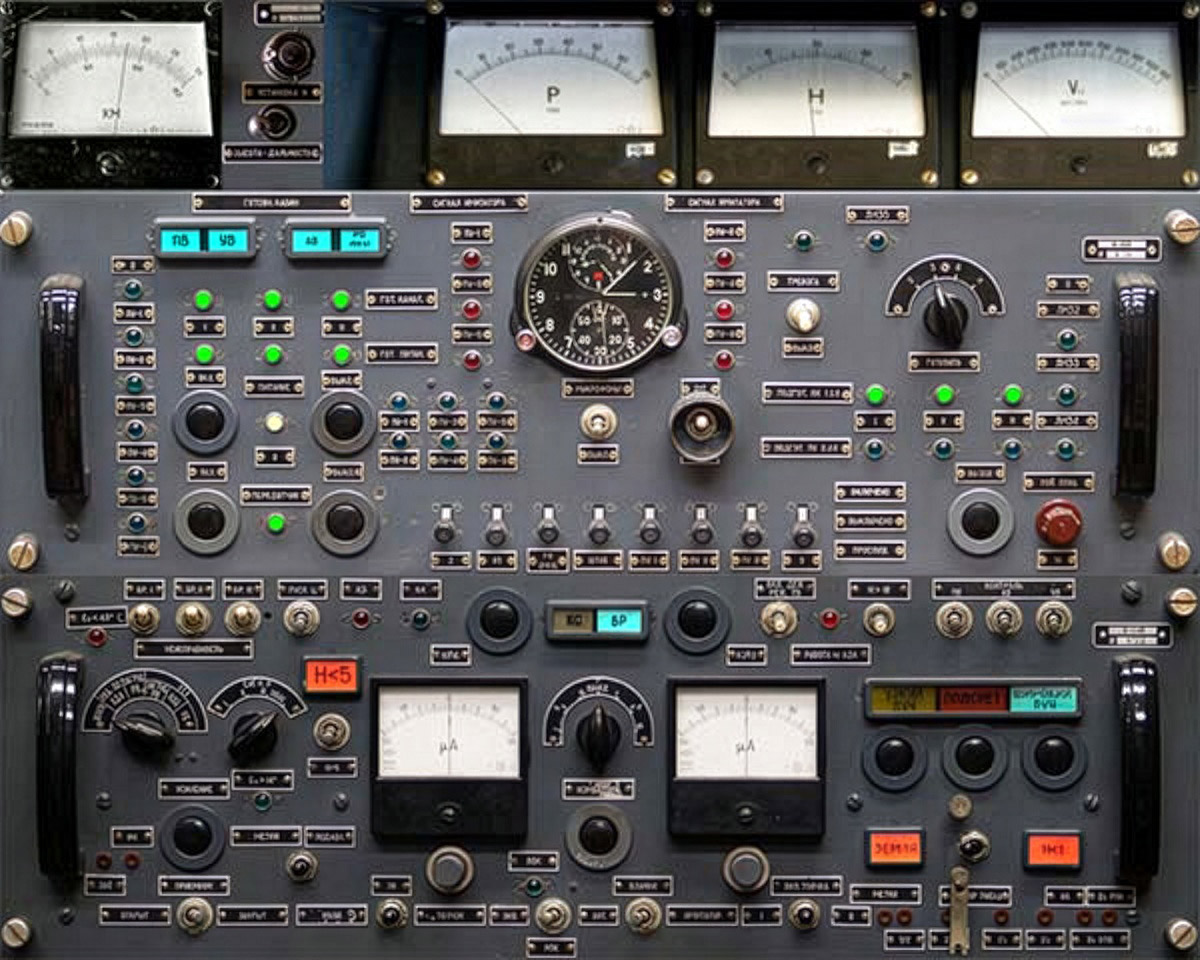
A SA-2 SAM operator station. The labels are in Russian. (Public Domain)
I press my microphone’s button and report this to my AMS. He reports it on the appropriate frequencies, but I’m too busy to listen to what he does with it.
This hapless NVAF controller has no idea that every word he is saying is immediately being translated and broadcast in English to his executioner, an F-105 thousands of feet over his head.
I press the RECORD button. I steal a glance up at my station’s large reel-to-reel tape, directly over my two central screens. They’re rolling, alright. I quickly refocus my eyes to determine who their bogey is—which blip on my screen. There are several of these Navy aircraft that he could be talking about. He certainly sees quite a few.
Our Navy bogeys are now over Haiphong harbor, within the Fan Song radar’s range. The tempo really picks up.
I hear the SAM control officer call out “Cao độ” (altitude) and the number of feet. I can literally hear multiple voices in the van assessing the situation. Our technology is fantastic. The launch control officer is issuing commands and directing everything among his soldiers in the small control building. I picture him standing—like Colonel Frisbie—over the shoulder of his radar operator.
He loudly issues the terminal command: “Phóng!” (Launch!)
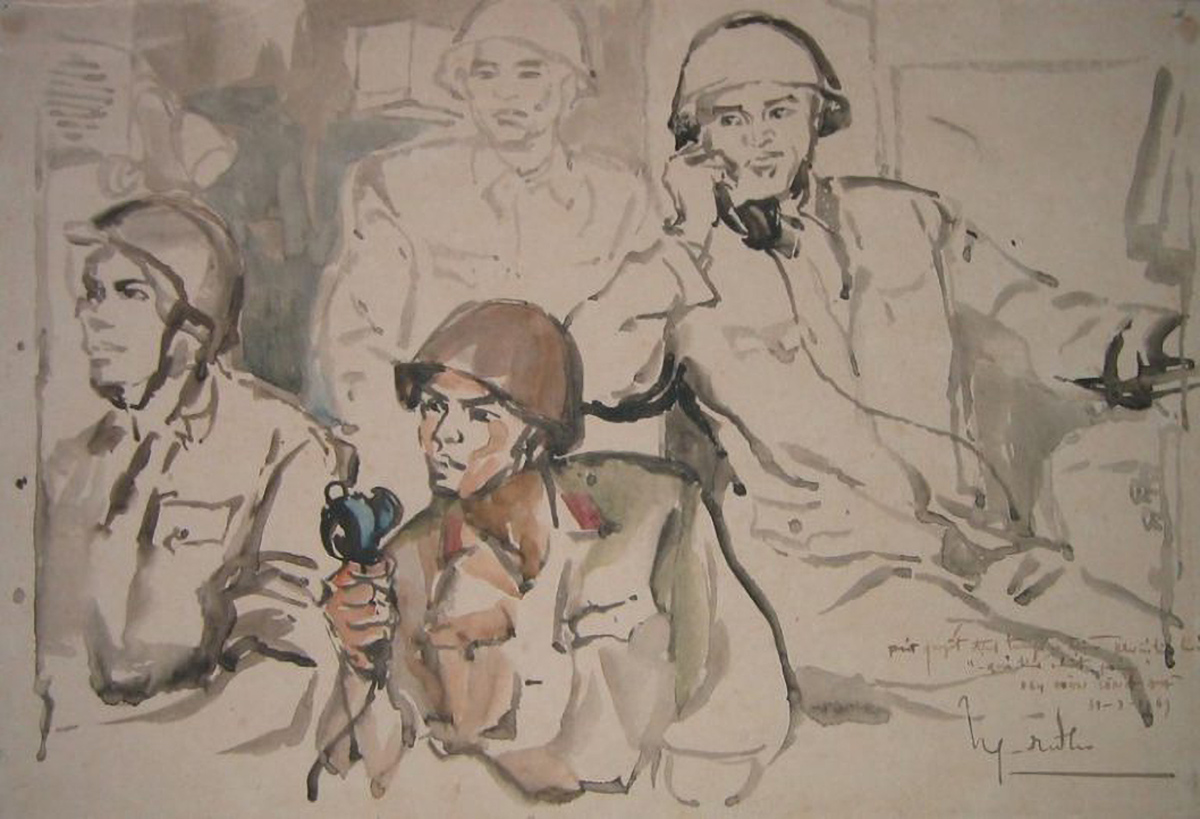
Inside the SA-2 control station. (Public Domain art by a North Vietnamese soldier.)
Immediately, I hear the actual sound of the SAM missile blasting off— so good is our spy technology aboard our Hognose beauty! Under these circumstances, Hognose is what sexy looks like! The command to launch was clear and then one hell of a roaring sound as the SA-2 missile ignited its huge first stage rocket and took off.
This is the first SAM launch of the night. It’s 1:45am. All SAM activity is in the east, over Haiphong Harbor.
At this moment, far from this launch, the Son Tay Raid assault formation is now sneaking in from the dark western mountains undetected. They are on track to arrive at Son Tay in half an hour.
[NOTE: In the case of shoot-downs, sometimes the only real status of a pilot is what has been gleaned by 11-Op and 7-Op intelligence. This is extremely valuable to US authorities. You can imagine that families of downed Airmen are thankful for the details we provide them. And our information greatly aids rescues.]
For my part, because I have trained on all positions, I scan all areas for indications of what’s going on elsewhere, even beyond my 11-Op responsibilities.
These Navy aircraft swarm toward Haiphong harbor over the next hour and a half, a continuous beeline of America’s top naval strike aircraft concentrating their menace on the enemy’s most important harbor.
[NOTE: History records that this 59-aircraft diversionary strike turns out to be the largest nighttime Naval operation to this point in the war. There had not been a night carrier operation this large since June of 1944, the Battle of the Philippine Sea, 26 years prior.]
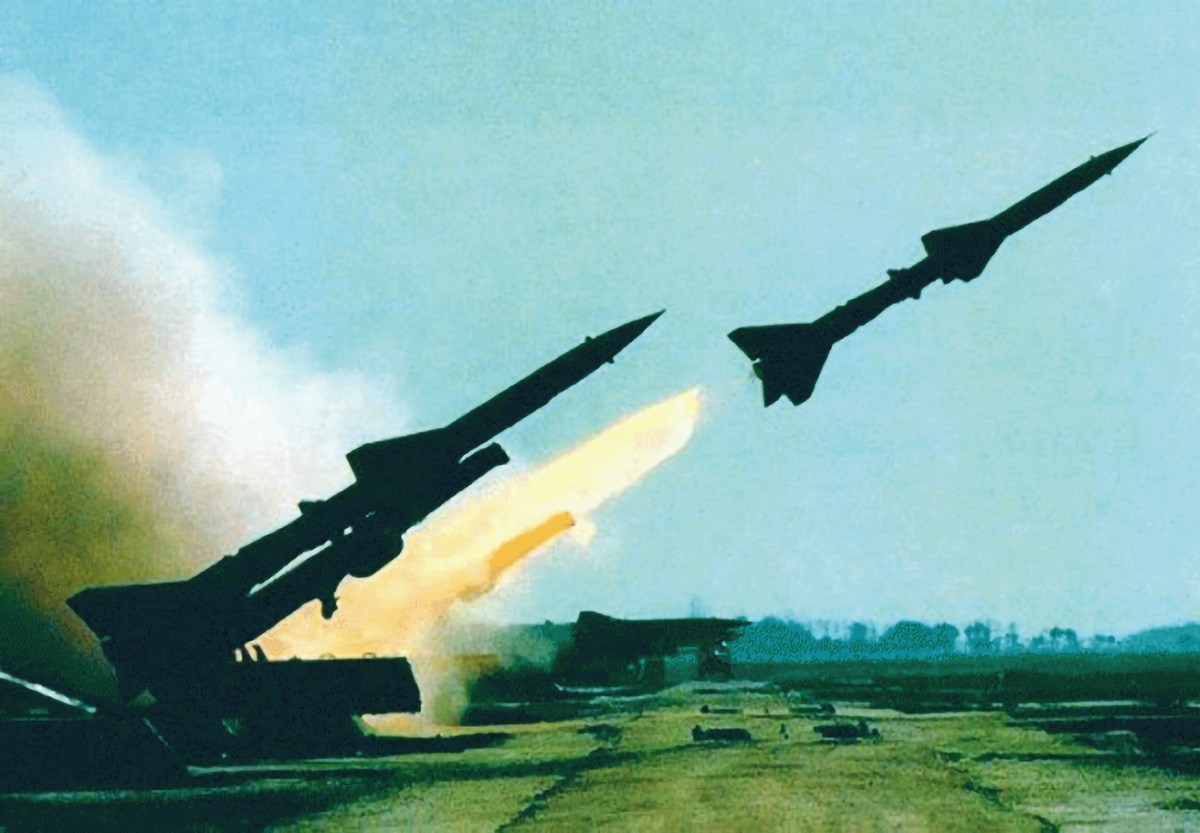
An SA-2 launch. (Eastfoto)
I’m constantly scanning, rolling my dial, searching. The dial is excellent for fine-tuning. It’s like a miniature of one of those steering wheels that have a knob so that a city bus driver can drive with one hand. Clockwise takes me through the next few frequencies up.
2:08am. We hear the five USAF F-105 ‘Wild Weasel’ aircraft arrive over Son Tay, each with their two SAM-site-killing Shrike missiles. This relatively small formation has snuck in from the west, while all the NVAF Air Defense Command had their focus on Haiphong in the east. The F-105s establish a taunting orbit, just daring a SAM site to lock on to them. They are looking for the Fan Song radars. If a Fan Song shines on them, the F-105 will pounce. It’s the epitome of a wild west duel: Weapons loaded and cocked, aimed right at each other. The SAMs and AAA are daring the F-105s to come in on them. The F-105s are daring the Fan Song radar to activate.
2:18am. “Alpha, Alpha, Alpha!” is broadcast by Cherry One, the MC-130 announcing H-Hour of the Son Tay Raid as they have just released their 2 million candlepower Mk 24 flares over the Son Tay POW camp. The helicopters then land, their 56 Green Berets storming into a massive firefight. Within minutes, they have secured the camp, neutralizing between 40 and 100 NVA soldiers. Not a single American casualty.
2:28am. “Negative items” is broadcast both over the UHF radios and the FM radios by Capt. Dick Meadows to Lt. Col. Bud Sydnor, the Ground Force Commander. The Green Berets have searched the entire Son Tay POW camp—and there are no POWs. This is immediately heard by Colonel Frisbie standing next to me. Colonel Frisbie is clearly concerned. His conversation with Manor at Monkey Mountain is grave. This Hognose is amazing as an airborne command post, making this very important conversation effortless and clear in this mentally and emotionally difficult, confusing moment. We cut through the fog of war.
2:30am. “Pull back by the normal plan” is broadcast by Lt. Col. Sydnor to begin withdrawing all troops from the Son Tay POW camp. The HH-53 helicopters Apple One and Apple Two are called back in to extract the Green Berets.
2:31am. The F-105s launch the first two Shrikes against the four active Fan Song sites near Son Tay. Within the next six minutes, there are seven active Fan Song radars identified: four are at the Red River and three more are slightly north of that. Four of these seven are ‘hot’ at any given moment.
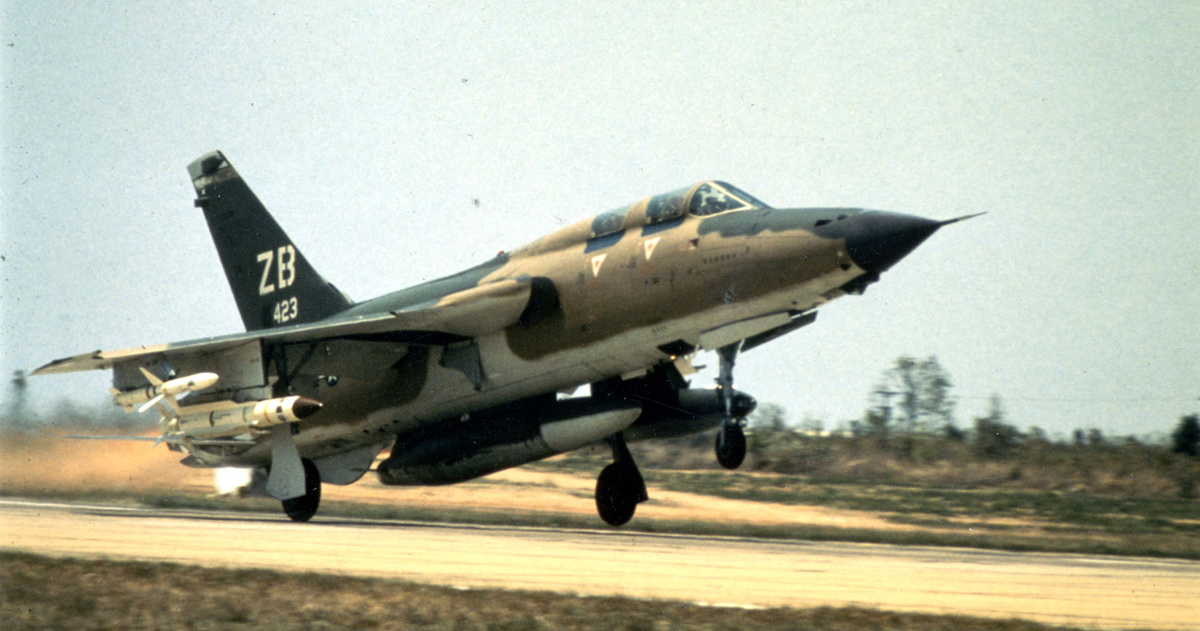
A North American F-105G Thunderchief ‘Wild Weasel’ SAM killer with Shrike missiles at Korat RTAFB. (Public Domain)
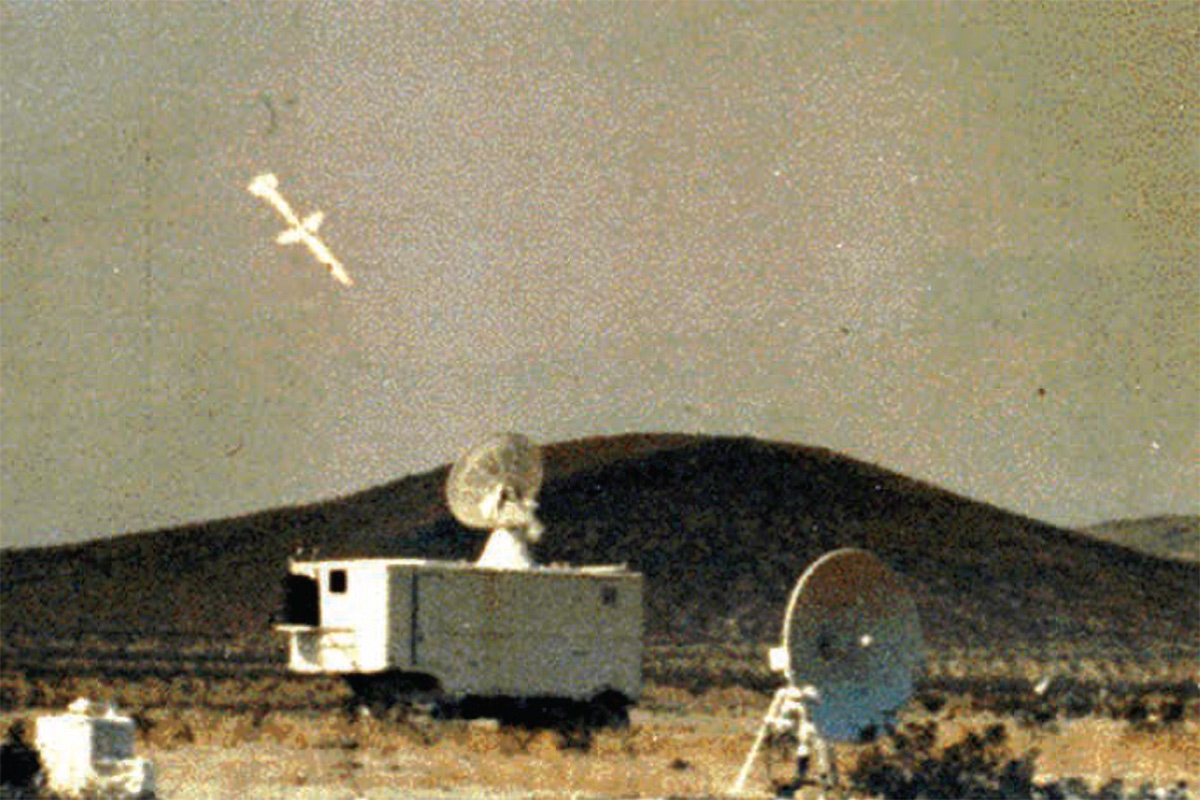
A Shrike missile flying right down a SAM radar signal. (Public Domain)
If not for my headphones, the sound inside the RC-135M cabin is the same sound we all know from commercial flights. But when I’m tuned in to a SAM site and we’ve cleaned up the signals electronically strong and clear, I’m right inside the enemy’s control van, even knowing the number of people by their different voices. I picture that it’s probably dimmed lighting, like our cabin, with operators at their workstations. Their dark screens are lit up with bogeys, a rotating radar sweeping around their screen. The launch control officer is much like our AMS, professional, yet still having a personality, growing in excitement as their prey approached closer and closer to their claws…
Early in the war, the NVAF could shine on our aircraft and track all they want with impunity, launching their missiles at the optimum time, tracking for results and even launching again right away. Later, however, the Americans developed anti-radar missiles like the Shrike that is riding the Fan Song radar signals down to the radar itself and knocking out SAM sites right now. As a result, the NVAF are forced to turn on their radar sparingly and only at great risk to themselves.
2:35am. SAM launch! The first one in the Son Tay area tonight.
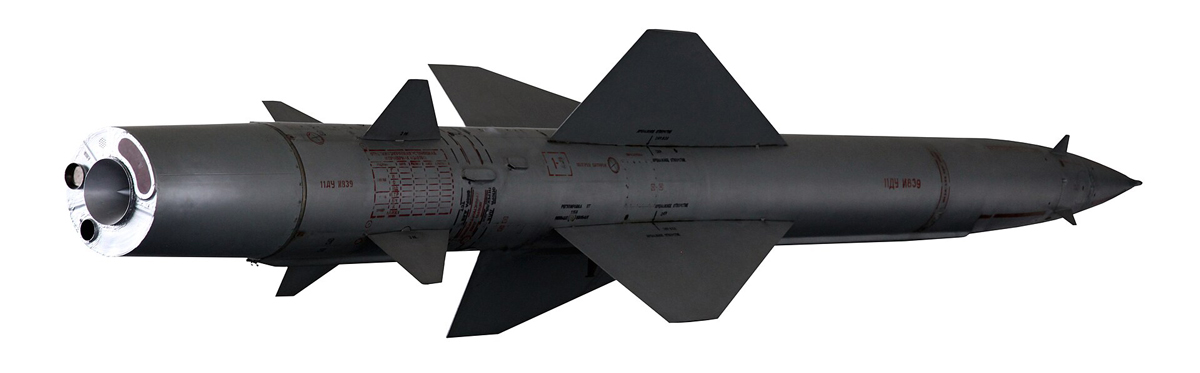
An SA-2 missile 2nd stage rocket and warhead. (Public Domain)
All operators on the Combat Apple mission are pumped up, coordinating with each other, critically aware of the situation and reporting the real time intelligence intended to save American lives and eliminate the enemy threat.
I cannot believe my ears. I tune in to SAM site after SAM site and hear frenzied Vietnamese commands to track an aircraft here or lock on to a threatening fighter there. I’m passing details of SAM site coordinates, operators’ conversations, and potential launch preparations.
Allow me to patch in some additional details (pieced together from my conversations with friends of mine in our Son Tay Raid Association who lived it) that I was not aware of in the heat of the battle.
[NOTE: I’m inserting these verbally-told details by indenting and showing them in italics. I’ve used the best time estimates I have. Any errors/inaccuracies in this are purely mine (CW)—with my apologies!] At this exact moment, Firebird 5, an F-105 at 20,000 feet, is on orbit about 20 miles from Hanoi. He is the backup aircraft in a flight of five. Each time he turns Southeast on the inbound leg of his orbit, he can see, more than 50 miles away, the flashes of the Navy’s diversionary activity dropping flares/incendiaries on the far side of Hanoi.
Up to now, the only SAM activity has been the launching against the Navy A-6s and A-7s for 50 minutes. (Imagine the view looking over the city lights of Manhattan from the far north end of the island, while 4th of July fireworks are celebrating at the Statue of Liberty at the far south end.)
But now, the SAM battle is also right beneath you in the Son Tay area.
Firebird 1, 2, 3, and 4, using roughly perpendicular inbound tracks, take turns launching on the radar signals of live SAM sites. Multiple SAMs are launching at them. In the night, a flying SA-2 looks like a telephone pole balanced on a reddish orange fireball oscillating as its gimbals respond to the radio telemetry signals.
A little perspective: Out of the hundreds of combat missions flown by the crewmembers in tonight’s mission, for almost all of them, this was the first time ever to have a SAM actually launch on them.
2:37am. Apple One begins re-boarding the first two groups of Green Berets just outside the Son Tay POW camp walls for exfiltration.
2:40am. Apple One departs the Son Tay POW camp.
Also at 2:40am: As Firebird 3 turns away from a target at 12,000 feet, a SAM launches. If the SAM is not moving in your windscreen, that’s when you know it’s headed for you. From Firebird 5’s vantage above, the huge explosion fireball seems to engulf Firebird 3, but then he hears, “Mayday, Mayday. Firebird 3 is hit.” The Firebird 3 pilot, Lt. Col. Bill Starkey, gives Firebird 1 a status.
A minute later, Firebird 1 asks 3 if he needed to go home. Starkey replies “Yes, I think I better.” They are out of the fight, but still flyable. They turn toward the southwest and head home high above the lethal altitude of the massive barrage that has now developed.
2:41am. Apple Two lands to pick up the last group of the ground force.
2:45am. Apple Two departs the Son Tay POW camp.
Firebird 5 is now ordered into the fight. Captain Ted Lowry (EWO) knows Major Don Kilgus (his pilot) as a man with an extremely aggressive heart. Having flown about 300 hours together, Lowry trusts him implicitly—Lowry says it works best that way, since Lowry is, by definition, 39 inches in trail at all times. Within seconds of entering the fight, Firebird 5 lines up on one of a number of SAM sites that were beginning to become very active.
The scope tells Lowry the location of a SAM site. Smart F-4 crews overhead know to put that on their 6 o’clock. Kilgus and Lowry turn to put it at their 12, straight ahead. At about 13 miles out, with the F-105’s state-of-the-art avionics system for their Shrike missile, Lowry acquires the target emitter. Get within the parameters. Raise the nose 25 degrees for optimal launch. Bleed the speed to 350 knots. Ready to fire.
The Shrike launches from under the right wing of the F-105. Kilgus executes an evasive 180-degree turn.
The electronic warfare suite gives the F-105’s crew a rattlesnake sound to let you know the SAM site is tracking you. When it changes, adding a steady tone, you know they’ve launched on you.
At that very moment, a rattlesnake and steady tone comes over the headphones: one of the SAMs has launched. Kilgus scans for it, spots it, and lets the SAM develop its flight algorithm. He verifies that it is trailing them. He dives abruptly. The SAM dives with them. Timing the pull for a moment when he knows the SAM will not turn well, Firebird 5 pulls up with four Gs. The SAM fails to make the turn. By this time, a second SAM from the same site is already airborne. Firebird 5, now with less speed, pulls aggressively within the arc of the second SAM. PULL…IT…AROUND. The M-1 ‘grunt’ keeps the blood in your head from draining. The second SAM swings wide, impotent. A third SAM is in the air—it’s getting hairy—and yes, it too is coming at them, and somehow they avoid it as well.
At that same moment, the other flight members were all dodging SAMs and keeping situationally aware of each other as well. A fourth SAM is airborne in the melee and homing in on Firebird 5. You look out your canopy at 4 o’clock low. Not moving. Not good. The Gs strain your craned neck, but you can’t stop looking. A desperate hard turn is not enough.
POWW!! You’ve never heard such a vicious concussion. It explodes about 100 meters away. Its shrapnel hits the fuselage just aft of Lowry’s seat primarily. That bomb flash off your right side totally stuns you. The aircraft is slammed toward the left. …it is 2:46am
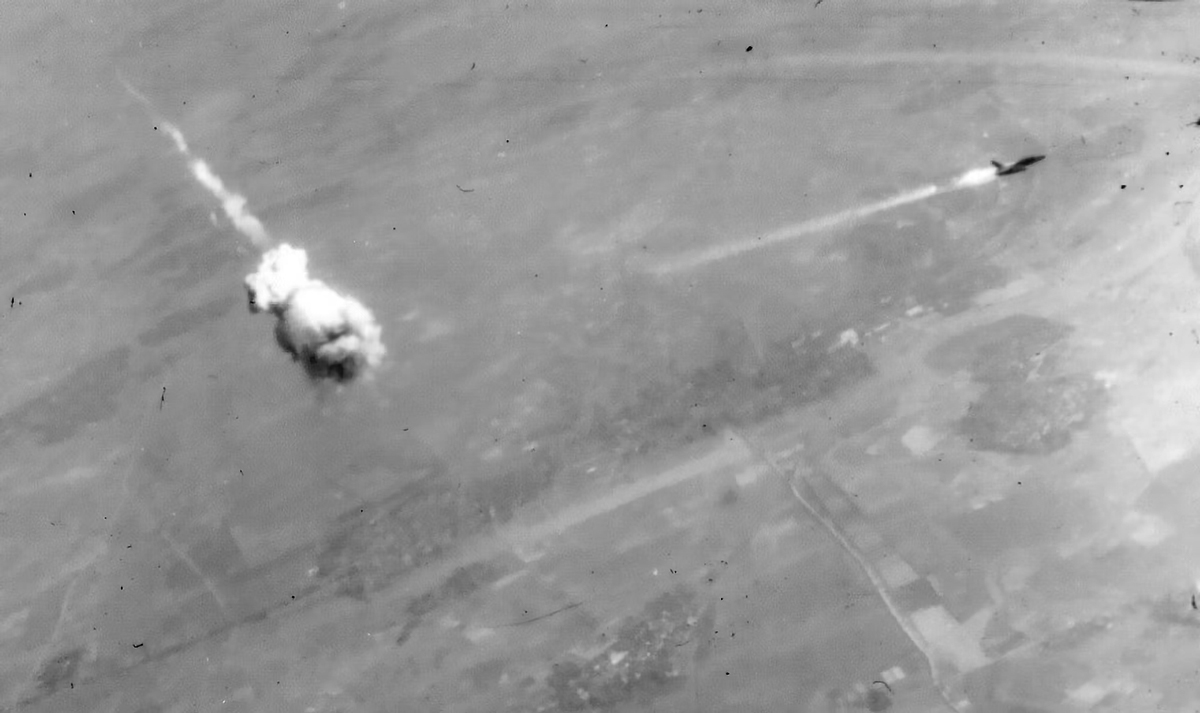
An amazing photo of an SA-2 damaging an F-105 over North Vietnam. (Public Domain)
Aboard the F-105, the crew assesses their aircraft: The damage is aft of you, where the P2 hydraulic system and fuel tanks are. Kilgus says to Lowry, “The Stab Aug is inop.” Horizontal Stabilizer Augmenter is an electro-hydraulic function that helps the jet fly smoother. As an indication of how unruly this jet can be, the F-105G is known by crews as the ‘Thud.’ With Stab Aug now inoperative, it’s going to take more work the rest of the flight. Other than that, this Thud is still functional, as far as the crew can tell. They still have one Shrike left. (Their load was 2 Shrikes and 3 external fuel tanks.) Kilgus says to Lowry, “The airplane is still flyable and we have people down there. We need to stay.”
2:47am: When the rattlesnake comes over the headphones, Lowry identifies the ‘High PRF’ (Pulsed Repetition Frequency) signal and Firebird 5 turns inbound again to line up on it. Pull up 25 degrees. Launch. Hard left. The Shrike hits the bullseye. At $7,000 per Shrike, that’s a great investment.
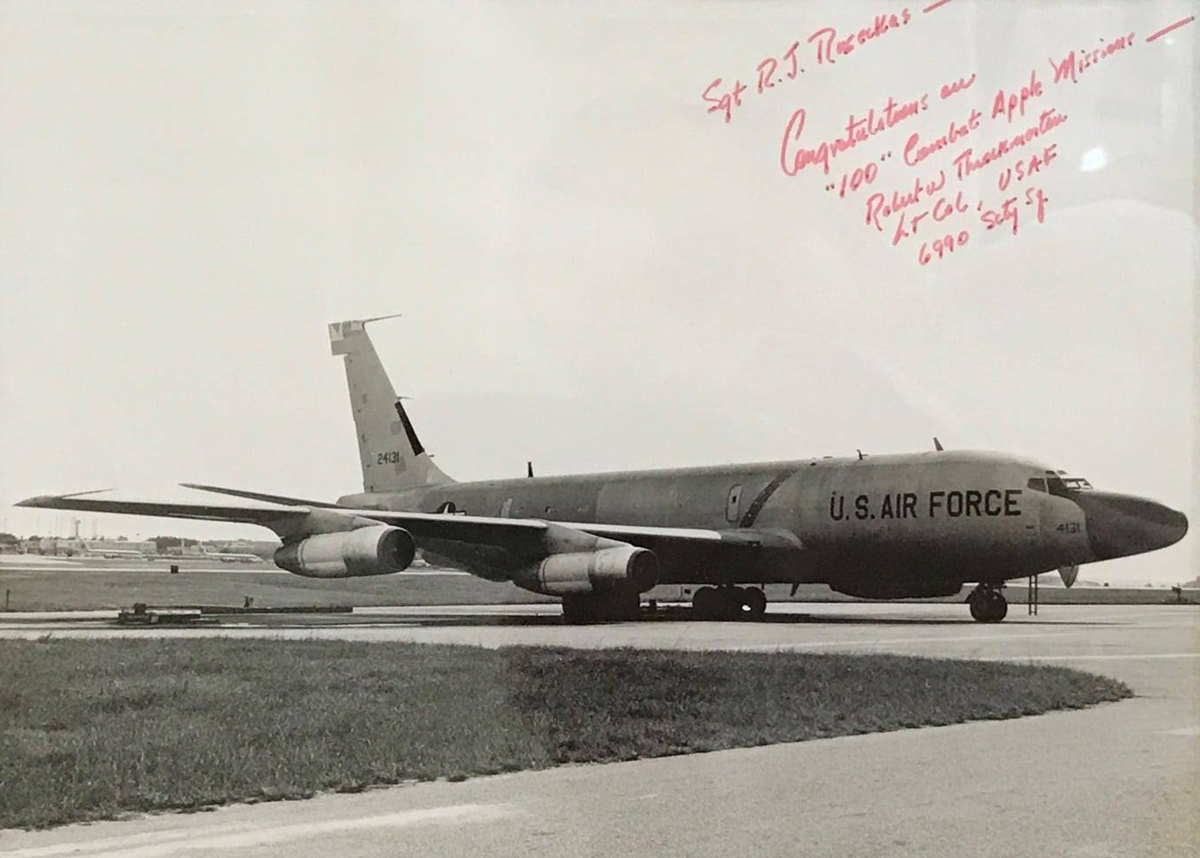
Our beautiful RC-135M at home at Kadena Air Base. The ‘hognose’ radome housed an extraordinary array of sensors, including a particular doppler radar system needed for unparalleled precision. Our mission entailed skimming along enemy boundaries. Straying even slightly into enemy territory would make us fair game for shoot down, as is illustrated in the KAL Flight 007 tragedy of 1983. (Photo provided by Robert Ruseckas)
No missiles left. Damaged by an SA-2. Time to turn southwest and limp to the nearest friendly base, right? No, they remain on station in orbit.
You see, Kilgus and Lowry know they’ve shot all their Shrike missiles. But Charlie, sitting in a surviving SA-2 site, DOESN’T know that. Charlie sees the F-105G’s radar signature, so he’s going to think twice before he shines a radar on any more American aircraft tonight.
2:55am: When Brigham (the call sign of the Ground Controlled Intercept operators at Udorn RTAFB) announces that all other US aircraft have left the area, Firebird 1 tells his wingmen, “Firebirds egress,” Kilgus updates his status: “Firebird 5 is hit. We’re losing fuel and we need a tanker to head this way.”1
We’ll pause the remainder of Ruseckas’ story for the moment. We’ll pick up this story in Chapter 5 about the return from Son Tay.
In the meantime, we need to give the details of the NVA Air Defense response.
1 Ruseckas, Robert J., and Westbrook, Cliff, “The Son Tay Raid in the Airborne Command Post: Listening to Every Transmission from 35,000 feet.” Internet article for the Son Tay Raid Association, 2021.
Textbook Special Ops: The Son Tay Raid, not available in bookstores, can be ordered online from Amazon, Barnes & Noble, Walmart, ThriftBooks, and Better World Books. Copies may also be ordered directly from John Gargus at Gartalon70@gmail.com or by phone at 702-787-5513.
ABOUT THE AUTHORS
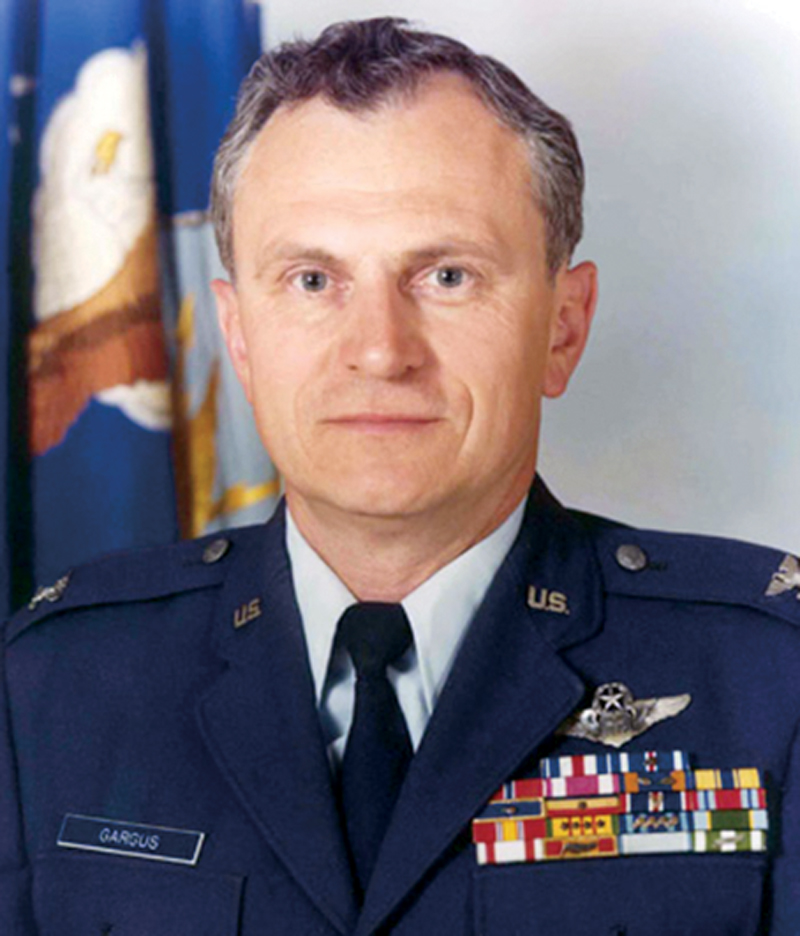
John Gargus, Colonel USAF (Ret.), was a planner of the Son Tay Raid and a navigator aboard the MC-130E(I) Cherry Two in the Son Tay Raid. He has given innumerable speeches about the raid, including many with Lt. Gen. LeRoy Manor, Colonel Bull Simons, and other luminaries of that iconic special ops mission. Born in Czechoslovakia, he was smuggled by his parents at the age of 15 from that Soviet dominated country to live with relatives in America. He is the author of the 2007 book, The Son Tay Raid: American POWs in Vietnam Were Not Forgotten, the most authoritative book on the topic.
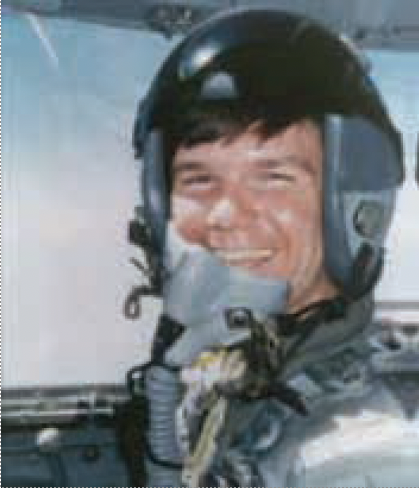
Cliff Westbrook, A 1988 graduate of the US Air Force Academy and a pilot of the B-1 bomber, is the son of Clyde ‘Neal’ Westbrook, the Aircraft Commander of Lime 2 during the Son Tay Raid. As a member of the Son Tay Raid Association, Cliff has interviewed numerous Raiders and helped gather the historical behind-the-scenes facts, including a complete compilation of the radio channels (air & ground) recorded during the Son Tay Raid. Cliff co-authored Who Will Go: Into the Son Tay POW Camp with Terry Buckler. He also co-authored Jakovenko: From the Steppes of Ukraine to the US Army Ranger Hall of Fame with Vladimir Jakovenko.
Leave A Comment